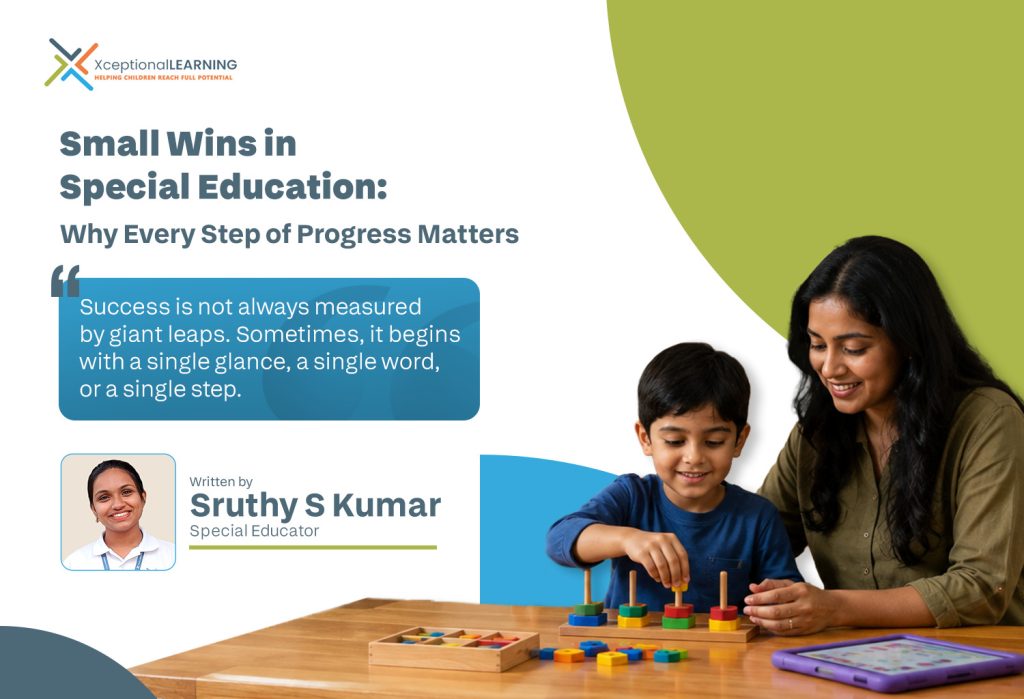
Small Wins in Special Education: Why Every Step of Progress Matters
admin August 18th, 2026

Written By
Sruthy S Kumar
Special Educator
“Success is not always measured by giant leaps. Sometimes, it begins with a single glance, a single word, or a single step.”
In most classrooms, success gets measured in high scores, completed assignments, academic excellence. In special education, it looks different, and that difference is exactly what makes it meaningful.
For many children with disabilities, learning isn’t a race to a finish line. It’s a journey made of hundreds of tiny milestones. A child who makes eye contact for the first time, responds to their name, holds a pencil independently, or communicates a need without falling apart — that child has done something extraordinary.
These moments can look small from the outside. But behind each one are countless hours of patient teaching, repeated practice, and adults who kept believing even when nothing seemed to be changing.
What counts as a “small win”?
A small win is any meaningful step that moves a child closer to independence, communication, confidence, or learning.
Small Wins Can Look Like:
Traditional education measures progress in grades. Special education measures it in individual growth — and every child’s path looks different. A small win might be responding when their name is called, sitting attentively for five extra minutes, sharing a toy, writing one letter correctly, or following a single instruction without help.
None of these look like much on paper. But each one is often the result of weeks, sometimes months, of consistent teaching and encouragement.
Aarav’s first words
The following is a composite example, created to illustrate how small wins can emerge during a child’s learning journey.
To understand what a small win really means, It helps to hear about Aarav, a six-year-old with mild autism.
When Aarav first joined the classroom, every morning began with tears. The room was unfamiliar. The teachers were unfamiliar. The routine was unfamiliar. He avoided eye contact, kept to himself, and showed almost no interest in the people around him. He never tried to communicate with his teacher.
His teacher understood something important early on: learning couldn’t begin until trust did. So instead of pushing for responses, she focused on making the room feel safe and predictable. She greeted him with a smile every day, spoke to him gently, kept the routine the same.
Slowly, the crying eased. He got comfortable walking in. He started sitting near her.
But he still wasn’t talking.
For nearly four months, there was no verbal response at all. Every day, she sat beside him with a set of colourful flashcards, held one up, and named it plainly. This is an apple. This is a ball. This is a cat. She never asked him to repeat it back. She just showed the card, said the word, smiled, and moved to the next one.
A week became two. Two became a month. Four months passed this way, and still, nothing.
Anyone watching from outside might have assumed the activity wasn’t working. Learning and skill development can sometimes be happening long before progress becomes visible to others.
Then came an ordinary afternoon. No lesson planned, no expectation in the air — just the two of them sitting in the classroom cabin with the same flashcards lying on the table as they had a hundred times before. The teacher picked one up, almost out of habit.
Very softly, almost a whisper, Aarav said the name of the object.
She paused. Showed him another card. He named that one too. And another.
For the first time in four months, he responded. She didn’t cheer or make a fuss, just smiled, praised him gently, and kept going, careful not to overwhelm the moment.
That whisper became one of the most memorable moments of his time in that classroom. Although his verbal responses hadn’t been visible before that day, the repeated exposure and steady routine may well have been supporting his learning underneath the surface. The whisper wasn’t necessarily the start of learning; it was the first clear sign of progress his teacher could actually observe.
“The whisper wasn’t necessarily the start of learning; it was the first clear sign of progress his teacher could actually observe.”
In the weeks that followed, Aarav opened up. He tried new words, interacted more, grew more confident. None of it happened suddenly. It was built on hundreds of small, invisible moments that came before the whisper — the whisper was just the first one anyone could see.
Why Small Wins Support Learning
There’s a reason celebrating small achievements works, and it isn’t just sentiment. Successful experiences can strengthen motivation and encourage children to keep trying. When a child receives meaningful feedback after completing a task, that experience can make future practice feel more achievable.
This matters enormously for children with autism, intellectual disabilities, ADHD, developmental delays, or communication challenges, who often need repeated opportunities before a new skill becomes visible from the outside. For these children, moments of success, even small ones, can help sustain engagement and participation over time, gradually building the sense that trying again is worthwhile.
Aarav’s story fits this pattern closely. He stayed quiet for four months, but the consistent routine and repeated practice appear to have laid the groundwork for what came next. The whisper wasn’t necessarily where his learning began; it was simply the moment it became visible to the people around him.
Why the small stuff matters more than it seems
It’s easy to only celebrate the big milestones — reading independently, solving a maths problem. But every big achievement rests on a stack of smaller ones nobody applauds.
Take something as simple as writing your name. Before a child gets there, they need hand strength, the right pencil grip, letter recognition, an understanding of left-to-right movement, sustained visual attention, coordinated hand movement, and memory for the sequence of letters. Skip past all of that in your head, and you miss most of the actual work. Recognizing these steps, instead of only the finish line, keeps both the child and the family motivated through a process that can otherwise feel painfully slow.
Small wins can also ease behavioural distress. For some children, difficult behaviour is linked to frustration — especially when they struggle to communicate a need or understand what’s expected of them. A child who learns to request water with a picture card no longer needs to cry to get that need met. Aarav’s flashcards worked toward something related but distinct: rather than functional communication, they helped build his confidence in responding at all. Once he realized he could respond successfully, the interactions that followed came more easily.
They also make teachers sharper. Tracking daily change, such as a longer attention span, better fine motor control, or more independent task completion, gives teachers real information to work with rather than waiting weeks for a big, obvious outcome. And they change what parents hear. A note home that says “she greeted her classmates without being asked today” or “he named two flashcards after months of practice” tells a very different story than silence, even when the underlying pace of progress hasn’t changed at all.
Celebrating progress doesn’t need to be complicated
None of this requires expensive rewards or elaborate systems. Praising effort in the moment, keeping a simple progress journal, sharing wins with parents as they happen, displaying a child’s work, setting one achievable goal at a time, these go a long way. The point isn’t to reward every single action a child takes. It’s to notice the progress that’s actually meaningful and let the child feel that it was noticed.
Technology’s role in catching what we’d otherwise miss
One practical challenge with small wins is that they’re easy to miss — a child completing a matching activity with slightly less prompting, or holding attention for eight minutes instead of three, isn’t always obvious in the moment. Digital learning tools and progress-tracking platforms have made this easier to catch. Platforms such as XceptionalLEARNING, together with VergeTAB as a purpose-built digital activity device, can help educators deliver structured activities and monitor changes in participation and performance over time. It doesn’t replace the teacher’s judgment, but it does make the invisible a little easier to notice.
What Technology Can Help Track
The bigger shift
Special education teaches something that’s easy to forget elsewhere: growth is rarely instant. It’s built through patience, repetition, trust, and hundreds of small victories that mostly go unnoticed by anyone outside the room.
Four months without a visible verbal response did not necessarily mean four months without progress. Every flashcard, every repeated word, every patient afternoon — together, they built the moment Aarav finally spoke. That whisper wasn’t just a couple of words. It was proof that persistence and belief eventually catch up with a child’s potential.
The first spoken word. The first independent step. The first smile after finishing something hard. None of these are small achievements, no matter how they look from outside the classroom. They’re the building blocks of everything that comes after.
In special education, progress doesn’t always arrive as a breakthrough. Sometimes, it arrives as one small win at a time, and every one of those wins deserves to be seen.
See How XL Can Support Your Child’s Progress
Every child’s journey is different. XceptionalLEARNING helps educators and families track progress, support learning, and build on every small win.
See how XL can support your child’s learning journey.