From Therapy Room to Real Life: Helping Children Generalise Skills Beyond Sessions
admin October 13th, 2026
Introduction
A child learns to request “water” during a therapy session. They identify emotions correctly from pictures. They follow a three-step instruction with their therapist and complete a task independently.
Then they go home, and suddenly the same skill seems to disappear.
For therapists and parents, this can be confusing. Was the skill actually learned?
Often, the child may have learned the skill under specific conditions but may not yet be able to use it flexibly across different situations. The challenge is not always the skill itself, but using it across different people, places, materials and situations. This is called generalisation, and it is an important goal of meaningful behavioural intervention.
What Is Generalisation?
Generalisation means a child can use a learned skill beyond the exact situation in which it was taught. If a child learns to say “help” in a session, we want that communication to happen:
- with the therapist, parents and teachers
- at home and at school
- during play
- whenever a task is genuinely difficult
The goal is not just correct performance in therapy. It is for the skill to become functional in everyday life.
Generalisation is usually discussed alongside maintenance, meaning the skill continues over time after direct teaching stops.
Generalisation and Maintenance
Generalisation means using a learned skill in different settings, with different people or in new situations. Maintenance means continuing to use that skill over time, even after direct teaching or support has been reduced.
Why Is Generalisation Sometimes Difficult?
Children often learn skills under very specific conditions. They may know how one therapist asks a question, recognise the same flashcards, sit at the same table and respond to the same type of prompt. When one of these elements changes, the child may not realise the skill still applies.
For example, a child learns to identify “apple” from a picture in therapy. Later, the teacher holds up a real apple and the child doesn’t respond. This doesn’t mean the child doesn’t know what an apple is. They may simply need support transferring the skill from one example to another.
Learning a skill and using it across settings are related but separate challenges. That is why generalisation has to be planned, not just hoped for.
From Structured Practice to Functional Use
Behaviour therapy often begins with structured teaching because structure helps a child understand what is expected. But structure should eventually become a bridge to natural situations. Take requesting a preferred item:
- Therapy setting. The therapist teaches the child to request a toy using a word, gesture, picture or communication system.
- Different materials. The child practises requesting different toys, snacks and activities.
- Different people. The child uses the same communication with the therapist, parent, teacher and other familiar adults.
- Different environments. The skill is practised at home, in the classroom, during play and in community settings.
- Natural opportunities. The child begins to use the skill spontaneously when they genuinely want or need something.
These stages often overlap rather than following a strict order. Therapists may start varying people and materials early, and the child’s progress will guide the pace. Over time, this turns a therapy target into a functional life skill.
From Structured Practice to Everyday Life
A skill learned during therapy needs opportunities for practice in everyday situations. Gradually extend practice from structured activities to familiar routines at home, at school and in the community.
The Role of Parents in Generalisation
Therapy cannot, and should not, be limited to the hours a child spends with a therapist. Parents and caregivers naturally create opportunities for skills to be used throughout the day. A routine like getting ready for school can involve:
- following instructions
- making choices
- requesting help
- waiting
- moving between activities
- completing routines independently
- communicating feelings
The goal is not to turn every moment at home into a therapy session. Parents don’t need to become therapists. Instead, practice can be built into everyday routines:
- Asking for a preferred food at breakfast is often a more meaningful communication opportunity than a worksheet.
- Waiting for a turn in a family game is a natural way to practise waiting.
It helps to ask the therapist which skills to focus on and how to respond, so that home and therapy stay consistent.
Generalisation Is More Than Repetition
Repeating the same activity can help establish a skill, but generalisation also requires opportunities to practise across different examples. In behaviour intervention, this may include multiple-exemplar training, where a child learns to apply a skill across varied people, materials, instructions and situations. Therapists may deliberately vary:
- People: different therapists, parents, teachers and caregivers.
- Places: the therapy room, classroom, home, playground and community.
- Materials: different toys, pictures, real objects, books and digital activities.
- Instructions: different but equivalent ways of presenting the same expectation.
- Situations: both structured activities and natural routines.
Variation helps the child learn the concept behind the skill rather than depending on one teaching arrangement.
Natural consequences can also make a skill meaningful. For example, when a child appropriately asks for help opening a container, receiving suitable assistance shows how communication can help them in everyday situations.
Watch for Prompt Dependence
Prompts are valuable teaching tools. They give the child the support needed to respond successfully. But if a child always waits for an adult to tell them what to do, the skill may not yet be independent.
For example:
Adult: “What do you need?” Child: “Help.”
The next step is teaching the child to recognise when help is needed and say “help” without waiting for the question. The therapist’s role gradually shifts from providing support to creating opportunities for independence.
Prompt fading should be carefully planned and based on each child’s individual needs.
Measuring What Happens Outside Therapy
One of the most useful questions a therapist can ask is: “Is the skill happening outside the therapy room?”
Progress monitoring should go beyond whether a child can perform a task in session. It can also track:
- who the child performs the skill with
- where it occurs
- how independently it is performed
- how often it occurs
- whether it continues over time
- whether it appears spontaneously
- whether the child can use it in a new situation
Parent and teacher observations are a valuable part of this picture. They show whether intervention is translating into everyday functioning.
Connecting Assessment, Planning and Everyday Practice
Generalisation works best when it is part of the whole intervention journey, not an afterthought at the end. One useful way to organise that journey is in four linked steps:
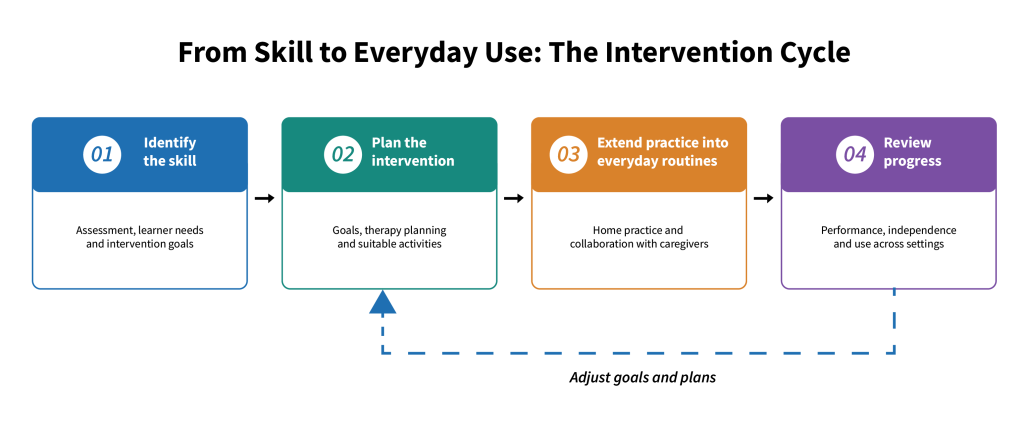
- Identify the skill. Assessment helps therapists understand the learner’s needs and set clear intervention goals.
- Plan the intervention. Goals are turned into a therapy plan with suitable activities, including opportunities to practise across different people, materials and settings.
- Extend practice into everyday routines. Caregivers and therapists work together so that practice continues at home through ordinary routines.
- Review progress. Therapists observe performance, independence and use of the skill across settings, then adjust the plan.
This is a suggested framework, and generalisation never happens automatically. It depends on planning, practice with different people and places, and careful observation.
This is also how therapy clinics and hospitals can organise intervention as one ongoing process, where assessment, planning, intervention, reinforcement and monitoring are linked parts rather than separate tasks. For special educators and schools, the same cycle supports school-based intervention and coordination with families. If you would like to read more about structuring intervention goals, see our article on behaviour therapy and intervention planning.
How Digital Activities Can Support Generalisation
Digital activities can offer additional opportunities to practise skills using different pictures, examples, instructions and learning scenarios. When these activities are selected according to a child’s goals, they can complement structured teaching and support continued practice beyond individual therapy sessions.
However, completing a digital activity successfully does not necessarily mean that a child can use the same skill independently in everyday life. Therapists and caregivers still play an important role in creating opportunities to apply learned skills during conversations, play, classroom activities and daily routines.
XceptionalLEARNING connects planned intervention, digital activities and progress monitoring, supporting therapists and educators in organising learning activities and reviewing progress. VergeTAB, a locked digital learning device powered by the XL Platform, can support this process when used as part of the integrated approach. These tools can complement therapist-led teaching and home practice, while observations from everyday situations help establish whether a skill is being used beyond structured activities.
The objective is not to replace real-world experiences with screen-based practice. It is to use structured digital learning alongside meaningful opportunities for children to apply their skills in everyday situations.
The Real Measure of Progress
Imagine a child who has learned to ask for help. In therapy, they request help correctly ten times. That is meaningful progress.
Now imagine more. At home, the child struggles to open a container and says, “Help.” At school, they can’t find their pencil and ask the teacher. At the playground, they approach an adult when they need assistance.
These moments may not look like formal therapy achievements, but they show something bigger: the child is using a learned skill to take part more independently in everyday life.
Quick Takeaways
- Generalisation doesn’t happen automatically; plan for it.
- Vary people, places, materials and instructions.
- Use everyday routines instead of extra worksheets.
- Fade prompts gradually to build independence.
- Track whether skills appear outside therapy, not just inside it.
Conclusion
Therapy shouldn’t end when the session ends. A skill becomes truly meaningful when a child can carry it from one environment to another, from one person to another, and from structured practice into everyday life.
For therapists, this means planning not only for skill acquisition but also for generalisation, maintenance, independence and functional use. For parents and caregivers, it means recognising that ordinary routines can be powerful opportunities for learning. For the child, it means that skills from therapy become tools for communicating, participating, making choices and solving problems.
The ultimate goal is not for a child to perform a skill because therapy taught them to. It is for the child to use that skill because it helps them navigate their world.
Editorial Note
This article was originally written by Danita Rose and has since been reviewed and updated by the XceptionalLEARNING team.
Connect Therapy Planning with Everyday Learning
XceptionalLEARNING brings together intervention planning, digital activities and progress monitoring to support therapists and educators in organising learning and extending practice beyond structured sessions.