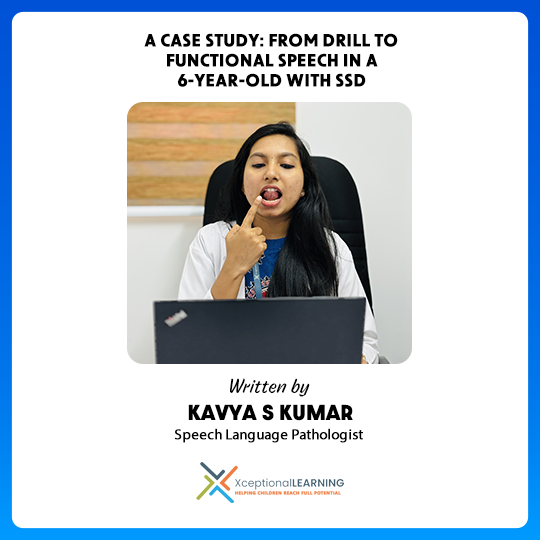
A Case Study: From Drill to Functional Speech in a 6-Year-Old with SSD
admin January 14th, 2026

Reflections from a hybrid intervention journey with a 6- year old child
When Ayaan first came for therapy, he was everything you’d expect from a curious six-year-old—talkative, playful, and full of stories. But if you listened closely, his speech wasn’t always easy to understand. Certain sounds disappeared, others were swapped, and in longer sentences his clarity dropped even more.
Like many children with a provisional diagnosis of Speech Sound Disorder (SSD), Ayaan could produce sounds correctly when asked—say it once, repeat after me—but those same sounds seemed to vanish the moment speech became natural.
And that’s where the real challenge began.
When drills worked… but speech didn’t
In the early sessions, Ayaan did well with traditional articulation drills. With visual cues and repetition, he could produce target sounds accurately at the word level. He enjoyed “getting it right” and proudly waited for the next turn.
But outside those moments—while telling a story, answering questions, or chatting during play—the same errors returned. His parents shared a familiar concern:
“He can say it properly in therapy, but we don’t hear it at home.”
This gap between practice and real communication became the focus of intervention.
Shifting the focus: from sounds to communication
Instead of asking Ayaan to repeat sounds again and again, therapy slowly shifted toward how and where speech is actually used.
Technology became a support—not the center of therapy, but a quiet partner that helped create real-life communication moments.
Using interactive digital activities, Ayaan practiced sounds while:
- Describing pictures
- Answering simple questions
- Telling short stories
- Playing turn-taking games
He wasn’t “doing drills” anymore. He was talking for a reason.
Learning through play, stories, and choice
What made the biggest difference was how natural the sessions began to feel. Ayaan chose activities, reacted to visuals, laughed at silly prompts, and corrected himself when something “didn’t sound right.”
Hearing his own speech played back helped him notice the difference between clear and unclear productions—without constant adult correction. Over time, he began to pause, think, and try again on his own.
That moment—when a child starts monitoring their own speech—is powerful.
Carrying speech beyond the therapy room
The same digital activities were shared with caregivers, with simple guidance:
- Encourage speech during daily routines
- Focus on communication, not perfect sounds
- Praise effort and clarity, not just correctness
This consistency helped Ayaan use his sounds while talking about his day, playing at home, and responding in class. Slowly, speech stopped being an “exercise” and became part of who he was.
What changed for Ayaan?
Over time, Ayaan’s speech became:
- Clearer in spontaneous conversations
- More confident and less hesitant
- Easier for unfamiliar listeners to understand
Most importantly, he stopped worrying about how he sounded and focused on what he wanted to say.
A gentle reminder for clinicians and parents
Ayaan’s journey is a reminder that:
- Drills build accuracy, but meaning builds carryover
- Children learn best when speech feels natural, not forced
- Technology works best when it supports interaction—not replaces it
When therapy looks and feels like real life, children don’t just practice speech. They use it.
Closing thoughts
Moving from drill to functional speech isn’t about abandoning structure—it’s about widening the lens. By blending technology with naturalistic, play-based interaction, therapy can meet children where they truly communicate in stories, conversations, laughter, and everyday moments. And that’s where real change happens.
Ayaan’s journey reminds us that real progress happens when speech is used naturally, not just practised. With the XceptionalLEARNING Platform, therapy supports meaningful communication beyond drills. Contact us to connect with licensed therapists and help your child use speech confidently in everyday life.