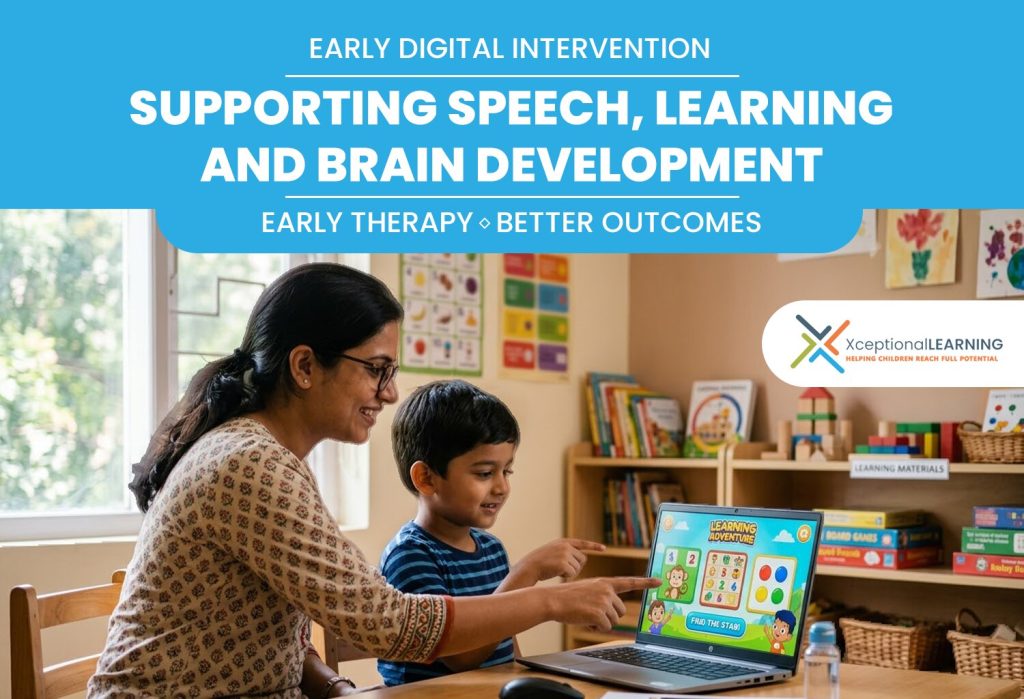
How Early Digital Intervention Can Transform a Child’s Speech, Learning, and Brain Development
admin March 18th, 2026

How structured digital therapy tools help children build communication, cognitive skills, and school readiness during the most critical early years
Early childhood is a time of rapid discovery and growth. Children learn to communicate, move with control, explore their surroundings, express emotions, and understand the world around them. But for many children, this journey isn’t always smooth. Speech delays, sensory challenges, attention difficulties, or behavioural struggles can affect learning and interaction.
Early intervention has always been important — and today, digital tools and digital therapy platforms are reshaping how quickly, consistently, and effectively children can grow. Thoughtfully designed and guided, early digital intervention can shift a child’s learning path, opening doors that might otherwise stay closed. This blog examines how early digital intervention influences real-life learning, fosters key developmental skills, and promotes everyday growth.
Curious How Digital Therapy Supports Early Development?
Before exploring how early digital intervention shapes speech, learning, and development, it can be helpful to see how structured digital therapy activities work in real settings. Interactive digital therapy tools allow children to practice communication, attention, and early learning skills through guided activities designed by therapists.
Watch this video to see how digital intervention supports everyday learning.
What is Early Digital Intervention?
Early intervention typically refers to birth to 6 or 7 years. Digital intervention is usually more appropriate from about 2–7 years, as very young children (0–2 years) derive limited benefit, and screen exposure must be minimal and guided.
Unlike passive screen time, these tools are interactive, guided, and skill-focused, targeting areas like:
- Speech and language
- Cognitive skills and pre-academics
- Motor and sensory development
- Social-emotional growth
Key Features:
- Interactive modules for speech, occupational therapy, and cognitive skills
- Adaptive learning that adjusts to a child’s pace
- Progress dashboards for parents and therapists
- Teletherapy integration for remote guidance
- Multisensory activities combining visual, auditory, and tactile learning
Goal: Continuous, engaging practice that bridges therapy sessions and everyday life — giving children a structured way to develop skills when the brain is most receptive.
Understanding Early Brain Development
Early childhood is a time of incredible brain growth. During these years, the brain forms countless connections that help children talk, think, move, and understand the world. While a child’s brain grows rapidly in size, it’s also shaping the skills and abilities they will use for years to come. Connections that are used often become stronger, while those rarely used may fade.
This is why repetition, practice, and meaningful experiences are so important. The early years are a window of opportunity, where guidance, interactive activities, and supportive experiences can have a lasting impact on how children communicate, solve problems, manage emotions, and interact socially.
In short: Early childhood is not just about growing bigger — it’s about building the foundation for learning, development, and life skills.
Key Development Areas Supported by Digital Intervention
A well-designed digital intervention system supports the entire spectrum of early development.
1. Speech and Language Development
Children with speech delays or language disorders benefit from:
- Vocabulary building with picture-word associations
- Articulation practice using audio models
- Sentence formation exercises
- Receptive and expressive language development
- Turn-taking and joint attention
- Intonation, stress, and prosody understanding
Why digital tools help: The language centres of the brain — Broca’s and Wernicke’s areas — form connections rapidly in early childhood. Consistent practice, repetition, and auditory exposure strengthen these circuits.
2. Cognitive and Pre-Academic Skills
Digital platforms strengthen foundational thinking skills:
- Attention and focus through short, engaging activities
- Memory skills (working, visual, auditory)
- Sequencing and problem-solving
- Early numeracy: counting, patterns, and number sense
- Early literacy: phonics, blending, and sight words
Tip: These skills rely on repeated practice, which digital tools make consistent and fun.
3. Motor and Sensory Development
Even on screens, digital activities can improve:
- Fine Motor Skills: Tracing, drag-and-drop, matching, drawing, tap-and-hold precision tasks
- Sensory and Perceptual Skills: Visual discrimination, spatial awareness, auditory matching, tracking, scanning
These abilities directly support handwriting, reading fluency, balance, and classroom performance.
4. Social and Emotional Development
Digital tools can strengthen:
- Identifying emotions and facial expressions
- Learning social rules and role-playing interactions
- Following routines and self-regulation exercises (breathing, waiting, pausing)
Why it matters: Social brain circuits remain adaptable; digital tools help gradually internalize social behaviours and self-regulation, especially for children with developmental delays.
How Digital Intervention Can Change a Child’s Learning Path
Digital intervention can reshape learning trajectories in powerful ways:
1. Boosting School Readiness
Children who practice early cognitive, speech, and pre-academic tasks show:
- Better listening skills
- Stronger attention span
- Early literacy and numeracy readiness
- Improved confidence
- Better social participation
This reduces stress when transitioning to school.
2. Preventing Widening Learning Gaps
Without early support, small developmental delays widen over time. Digital intervention strengthens foundational skills early — preventing future struggles with reading, writing, comprehension, and behaviour.
3. Increasing Engagement & Motivation
Children engage more with interactive modules compared to traditional worksheets. The brain learns better through dopamine-reward cycles — praise, rewards, animations — which digital platforms use effectively.
4. Providing Accessibility & Continuity
Not every family has daily access to therapists. Digital intervention ensures:
- Continuity at home
- Access for rural/remote families
- Support during school holidays
- Carryover between therapy sessions
5. Offering Data-Driven Personalization
Progress dashboards show:
- Strengths
- Areas that need improvement
- Progress over time
- Suggested next activities
This allows individualized learning paths for each child.
See How Digital Therapy Transforms Learning
Discover real therapy sessions, expert-led insights, and interactive activities that help children build communication, focus, and learning skills.
See how structured digital intervention supports real progress in everyday learning.
Watch Therapy Videos
Learn from Experts
Common Myths About Digital Intervention
- “Digital tools cause screen addiction.” Structured, purposeful use is not the same as entertainment screen time.
- “Digital tools replace offline therapy.” They extend practice — they do not replace human connection.
- “Young children shouldn’t use digital tools.” Supervised and guided digital activities to strengthen early foundational skills.
- “Only children with delays benefit.” All children gain from early cognitive, language, and sensory skill-building.
Real-Life Examples of Digital Intervention
- Speech Delay: A 3-year-old uses daily picture-sound-word modules and begins forming 2-word phrases. Home practice speeds up therapy progress.
- Attention Difficulties (ADHD): Short, 3–5 minute activities gradually increase focus, improving classroom participation and reducing frustration.
- Preschool Readiness: A child entering kindergarten recognizes letters, follows instructions, identifies numbers, and expresses emotions confidently.
- Motor or Sensory Delays: Fine-motor tasks improve hand-eye coordination and handwriting readiness.
Overall: Digital intervention bridges gaps between therapy sessions and everyday life.
Healthy, Realistic Use
Digital intervention is powerful — but only when used responsibly.
- It must be supervised.
- It must be balanced with real-world play.
- Screen time must be structured and purposeful, not extended.
- It must complement — not replace — real interaction.
- Quality matters: only developmentally appropriate tools should be used.
Best approach: Combine digital practice + real-life play + parent involvement for optimal results.
Need Guidance for Your Child’s Development?
If you’re concerned about your child’s speech, learning, or overall development, early support can make a lasting difference. The right intervention at the right time helps children build stronger communication, learning, and social skills with confidence.
Our expert therapists will guide you with personalized strategies, early intervention plans, and effective digital therapy solutions tailored to your child’s unique needs.
Chat with our team on WhatsApp today to discover how early digital intervention can support your child’s progress.
The Future of Early Digital Intervention
Current innovations show exciting possibilities:
- AI-powered adaptive learning
- Teletherapy collaboration
- More naturalistic social simulations
- Long-term developmental analytics
- Integrated multi-domain (speech + OT + cognitive) systems
- Greater accessibility for underserved populations
As neuroscience evolves, early digital intervention will only become more personalized, precise, and impactful.
Conclusion
Early childhood is a window of rapid brain growth, forming connections that influence learning, communication, behaviour, and emotions. The brain grows rapidly in the early years, forming millions of new connections that support learning and development.
Thoughtful digital intervention can:
- Strengthen foundational skills
- Offer structured, consistent practice
- Bring therapy into the home
- Support parents and educators
- Ensure guided learning every day
It enhances interaction, strengthens therapy, and expands learning.
Early intervention becomes more effective when supported by the right technology and expert guidance. XceptionalLEARNING provides a comprehensive digital therapy platform offering online therapy services for children, along with powerful digital therapy tools for therapists and practical digital tools for inclusive education. These solutions help therapists, educators, and families deliver structured support that strengthens communication, cognitive skills, and learning development.
Contact our team today to learn more or request a free demo of the XceptionalLEARNING platform.