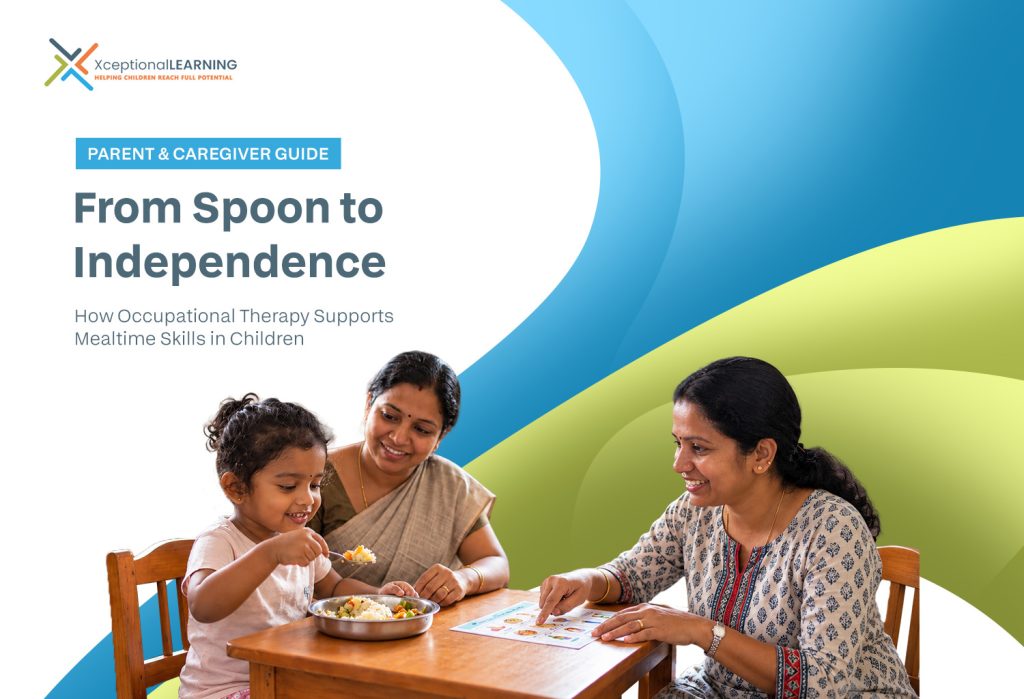
From Spoon to Independence: How Occupational Therapy Supports Mealtime Skills in Children
admin October 19th, 2026
A guide for parents and caregivers
Introduction
Mealtimes are an important part of a child’s daily routine. They provide opportunities to develop independence, coordination, communication and social participation. For many children, learning to eat involves gradually developing skills such as picking up food, holding a spoon, drinking from a cup, managing different food textures and remaining comfortably seated during meals.
However, some children find these activities challenging. They may struggle to use utensils, avoid certain foods, become distressed by particular textures or require considerable assistance to participate in mealtimes.
Occupational therapy (OT) can help children develop the skills needed to participate in everyday activities, including eating and self-feeding. An occupational therapist considers the child’s abilities, environment, sensory responses and daily routines to identify practical ways to support participation and independence. [1, 8]
Understanding the reasons behind a child’s mealtime difficulties is an important first step towards finding appropriate support.
What Does Mealtime Independence Mean?
Mealtime independence does not necessarily mean that a child must eat every meal without assistance. It means developing the skills to participate as independently and safely as possible, according to their age, abilities and individual needs.
These skills may include:
- Sitting in a stable, comfortable position during meals.
- Reaching for and picking up suitable pieces of food.
- Holding and using a spoon, fork or cup.
- Bringing food to the mouth with increasing control.
- Exploring different food textures and tastes at an appropriate pace.
- Communicating hunger, fullness, discomfort or a need for help.
- Following familiar mealtime routines.
Some children may need physical assistance, adapted utensils, specialised seating or additional time. Independence can also mean learning to communicate preferences and participate in parts of the routine, even when complete self-feeding is not yet possible.
The aim is to help each child participate meaningfully, rather than expecting every child to achieve the same outcome at the same time. [1, 2]
Understanding Different Mealtime Challenges
Mealtime difficulties can have different causes, and recognising the difference helps families seek appropriate support.
1. Difficulties with self-feeding
Some children have difficulty holding utensils, scooping food, coordinating hand movements or bringing food to their mouths. They may spill frequently, become frustrated or depend on an adult for most of the meal.
These challenges can be associated with difficulties in fine motor coordination, posture, motor planning or other developmental factors. Occupational therapy can help identify the skills affecting participation and develop an individualised approach to practising them. [1, 6, 8]
2. Food selectivity and sensory-related difficulties
Some children strongly prefer particular foods and may reject unfamiliar tastes, smells, colours or textures. Others may become uncomfortable with sticky hands, food touching their skin or changes in the appearance of familiar meals.
Food selectivity can have several contributing factors, including sensory preferences, medical concerns, developmental differences and previous feeding experiences. It is particularly important not to assume that all food refusal is caused by sensory processing differences. [2, 7]
An occupational therapist may help a child participate more comfortably in food-related activities, while a wider healthcare team addresses nutritional, medical or behavioural concerns when needed.
3. Difficulties with chewing or swallowing
Some children experience difficulty chewing food, managing liquids or swallowing safely. Coughing or choking during meals, a wet or gurgly voice after eating, recurrent respiratory concerns or unusually prolonged meals may indicate a feeding or swallowing problem.
These concerns require appropriate clinical assessment. An occupational therapist may contribute within their professional competence, but swallowing difficulties may require assessment by a speech-language therapist with relevant feeding and swallowing expertise, a paediatrician or another qualified healthcare professional. [2, 3]
Some children experience difficulties with food textures, sensory responses, chewing or swallowing that go beyond typical picky eating. Learn more about feeding and oral-motor challenges in children with special needs.
Important: Do not treat suspected swallowing difficulties as a self-feeding or sensory issue alone. Seek medical advice promptly.
Why Might a Child Struggle with Mealtimes?
Mealtime participation depends on several abilities working together. A child may have difficulty because of one factor or a combination of factors.
- Postural stability: Children need an appropriate seating position to support comfortable movement of their arms and hands. Poorly supported seating may make reaching for food and using utensils more difficult.
- Fine motor skills: Holding a spoon, picking up small pieces of suitable food and controlling a cup require hand strength, coordination and controlled movements.
- Eye-hand coordination: Children need to coordinate what they see with how they move their hands when reaching for food, scooping or bringing utensils towards their mouths.
- Sensory experiences: Smells, tastes, textures, temperatures and the feeling of food on the hands can influence a child’s comfort and willingness to participate.
- Attention and routine: Some children find it difficult to remain engaged, transition to meals or manage busy environments. Predictable routines and reduced distractions may help.
- Medical and nutritional factors: Pain, reflux, gastrointestinal difficulties, allergies, dental problems, nutritional concerns and other health conditions may affect eating. These possibilities should be considered rather than assuming that the difficulty is behavioural.
Paediatric feeding disorders can involve medical, nutritional, feeding-skill and psychosocial factors. A child may therefore need input from more than one professional. [2, 3]
How Does an Occupational Therapist Assess Mealtime Participation?
An occupational therapist begins by understanding the child’s everyday experiences rather than focusing only on how much food the child eats.
The assessment may include the following areas.
1. Understanding the child’s history
The therapist may ask about the child’s developmental history, current eating habits, preferred foods, mealtime routines and level of assistance. Parents may also describe situations in which the child becomes uncomfortable, refuses food or participates more successfully.
2. Observing mealtime activities
When appropriate, the therapist may observe the child during a meal or a relevant activity. This can help identify difficulties with seating, reaching, grasping utensils, coordinating movements and managing the mealtime environment.
Observation alone cannot establish every medical or swallowing-related cause. Further assessment or referral may be necessary. [3]
3. Identifying strengths and support needs
The therapist considers what the child can already do and which parts of the activity require assistance. For example, a child may be able to grasp a spoon but struggle to scoop food, or may self-feed comfortably when the chair and table are positioned appropriately.
4. Setting individualised goals
Goals should be practical, meaningful and suited to the child. Examples include improving spoon use, participating in a familiar mealtime routine, tolerating a wider range of food-related experiences or using a cup with appropriate assistance.
Progress should be monitored over time, with strategies adjusted according to the child’s response. [1, 8]
How Occupational Therapy Can Support Mealtime Skills
Occupational therapy strategies should be based on the child’s assessment, developmental level and individual needs. The following are examples of approaches that may be considered.
1. Developing utensil skills
Children learn to use utensils through opportunities to practise. An occupational therapist may introduce activities that develop grasp, coordination and controlled hand movements.
For example, a child might practise scooping suitable materials during play before trying the movement with food. During meals, the therapist may recommend a spoon that is easier to hold or a plate that helps keep food in place.
The level of assistance can be gradually adjusted as the child develops greater control. Practice should remain manageable and encouraging rather than becoming a source of pressure.
2. Improving posture and positioning
A stable, comfortable seating arrangement can support a child’s participation. Depending on the child’s needs, the therapist may review chair height, foot support, table position and access to utensils.
For young children, appropriate high-chair or booster-seat use and supervision are also important for safety. [4]
Positioning recommendations should be individualised, particularly for children with significant motor difficulties or specialised seating needs.
3. Supporting hand-eye coordination
Activities such as placing objects into containers, transferring items between bowls and using simple tools can provide opportunities to practise reaching and controlled hand movements.
These activities may help develop skills relevant to self-feeding, although improvement in a play activity does not automatically mean that the child will use the same skill during meals.
The therapist can identify which activities are meaningful for the child and help connect practice to everyday routines.
4. Supporting sensory participation
For children who find certain food experiences uncomfortable, the therapist may consider gradual, appropriate opportunities to engage with food.
A child might begin by seeing a new food on the table, helping to place it on a plate or exploring it with a utensil before deciding whether to touch or taste it.
The pace should be guided by the child’s response, and participation should not depend on forcing the child to taste or finish a food. Food selectivity can have several causes, so sensory-based strategies should form part of an appropriate assessment and support plan rather than being used as a universal solution. [2, 7]
5. Establishing predictable mealtime routines
Consistent routines can help children understand what to expect. Families may use a familiar place for meals, wash hands before eating, reduce distractions and allow sufficient time for the child to participate.
Caregivers can model eating, offer suitable food options and respond to signs of hunger and fullness. Children do not need to finish everything on their plates, and the amount they eat can vary from one day to another. [4, 5]
A Practical Example: Building Spoon-Feeding Skills
Consider a child who wants to feed independently but frequently spills food while using a spoon.
The occupational therapist may first observe the child’s sitting position, grasp, coordination and ability to scoop food. The therapist may then recommend a more stable seating arrangement, a suitable spoon and opportunities to practise with manageable portions.
At home, the caregiver can place the spoon within easy reach, demonstrate the movement and allow the child time to try. Assistance can be provided when needed without taking over the entire activity.
Progress might initially involve holding the spoon, then scooping a small amount, and eventually bringing it to the mouth with greater control.
This example illustrates a possible approach, not a guaranteed outcome or a treatment plan for every child. The appropriate strategies depend on the child’s individual needs and safety.
Understanding Developmental Milestones
Children develop self-feeding skills at different rates. The Centers for Disease Control and Prevention (CDC) identifies using fingers to move food towards the mouth as a movement milestone by 9 months. By 18 months, many children feed themselves with their fingers, try to use a spoon and drink from an open cup, although spills may occur. [6]
These milestones provide general developmental guidance. They are not a complete assessment of feeding ability and should not be used as strict deadlines for every child.
If a child loses previously acquired skills, is not progressing as expected or has difficulties that concern the family, discuss these concerns with the child’s healthcare provider. Developmental milestone checklists do not replace validated developmental screening or clinical assessment. [6]
What Parents Can Do at Home
Small changes to everyday routines can create more opportunities for participation.
- Offer opportunities to practise: Allow the child to try age-appropriate self-feeding activities when it is safe to do so.
- Use suitable utensils: Choose tools that the child can hold and manage comfortably.
- Keep routines predictable: Familiar mealtime patterns can help children prepare for the activity.
- Model eating: Children may learn by observing caregivers eating and using utensils.
- Allow enough time: Rushing can make mealtimes more stressful and reduce opportunities to practise.
- Respect hunger and fullness cues: Avoid pressuring a child to finish every portion.
- Introduce unfamiliar foods without pressure: Offer suitable foods repeatedly and allow the child to become familiar with them at their own pace.
- Notice small achievements: Recognise efforts such as holding a spoon, reaching for food or communicating a need for help.
Caregiver responses and children’s eating behaviours can influence each other over time. A calm, responsive approach is preferable to turning every meal into a struggle. However, persistent feeding difficulties may need professional assessment rather than changes to parenting strategies alone. [9, 10]
When recommended by a therapist, visual supports and structured practice can help children understand familiar routines. Explore structured digital activities for children as one possible resource to complement professional guidance.
Keep Mealtimes Safe
Safety must remain the priority while a child learns to eat independently.
- Ensure that the child is sitting upright in a safe, appropriate position.
- Supervise the child throughout eating.
- Prepare foods in shapes, sizes and textures appropriate to the child’s developmental abilities.
- Avoid foods that present choking hazards, such as whole grapes, whole nuts and hard raw vegetable pieces, unless prepared in a safe, age-appropriate way.
- Keep mealtimes calm and avoid allowing children to eat while walking, running or playing.
- Ask the child’s healthcare provider for advice if you are unsure about food textures, choking risks or swallowing safety.
Choking hazards can remain relevant even after a child begins self-feeding. Food preparation and active supervision are essential. [11]
If the child chokes or has difficulty breathing, seek emergency assistance. If you notice recurring coughing, choking, breathing changes or other signs of swallowing difficulty during meals, seek prompt medical assessment.
When Should You Seek Professional Help?
Consider speaking with your child’s healthcare provider if you notice:
- Persistent difficulty learning or using age-appropriate self-feeding skills.
- A very restricted range of accepted foods that affects daily life or raises nutritional concerns.
- Frequent distress, refusal or prolonged mealtimes.
- Difficulty chewing or managing food textures.
- Coughing, choking or other concerns about swallowing.
- Poor growth, dehydration or concerns about nutritional intake.
- Loss of previously acquired feeding skills.
A paediatrician can help investigate medical or nutritional concerns and coordinate referrals. Depending on the child’s needs, the support team may include an occupational therapist, speech-language therapist with feeding and swallowing expertise, dietitian, dentist or other relevant professionals. [2, 3]
If mealtime difficulties persist or you are concerned about your child’s ability to eat safely, consult a qualified healthcare professional. Parents can also explore therapy options for their child to understand the support available.
Supporting Independence, One Step at a Time
Mealtime independence develops through opportunities to practise, appropriate support and attention to the child’s individual needs. Some children progress quickly, while others need more time, adapted equipment or coordinated professional support.
Occupational therapy can help identify barriers to participation and develop practical strategies for everyday routines. The goal is not to make every meal perfect or to expect children to eat without help. It is to support safe, meaningful participation and help each child build skills towards greater independence.
With patient guidance and an individualised approach, mealtimes can become opportunities for learning, connection and growing confidence.
Looking for Support with Your Child’s Everyday Skills?
Every child develops at their own pace. If you have concerns about your child’s self-feeding or participation in everyday routines, speak with a qualified healthcare professional to understand the support that may be appropriate.
Explore XceptionalLEARNING’s resources for families and learn more about support options for children.
References
- American Occupational Therapy Association. Occupational Therapy Practice Framework: Domain and Process—Fourth Edition. American Journal of Occupational Therapy. 2020;74(Suppl. 2):7412410010. https://doi.org/10.5014/ajot.2020.74S2001
- Goday PS, Huh SY, Silverman A, et al. Pediatric Feeding Disorder: Consensus Definition and Conceptual Framework. Journal of Pediatric Gastroenterology and Nutrition. 2019;68(1):124–129. https://doi.org/10.1097/MPG.0000000000002188
- Arvedson JC. Assessment of pediatric dysphagia and feeding disorders: Clinical and instrumental approaches. Developmental Disabilities Research Reviews. 2008;14(2):118–127. https://doi.org/10.1002/ddrr.17
- Centers for Disease Control and Prevention. Tips for Mealtime Routines. Updated March 2, 2026. https://www.cdc.gov/infant-toddler-nutrition/mealtime/index.html
- Centers for Disease Control and Prevention. Signs Your Child Is Hungry or Full. https://www.cdc.gov/infant-toddler-nutrition/mealtime/signs-your-child-is-hungry-or-full.html
- Centers for Disease Control and Prevention. Developmental Milestones by 9 Months; Developmental Milestones by 18 Months. Updated May 2026. https://www.cdc.gov/act-early/milestones/9-months.html and https://www.cdc.gov/act-early/milestones/18-months.html
- Reche-Olmedo L, Torres-Collado L, Compañ-Gabucio LM, Garcia-de-la-Hera M. The Role of Occupational Therapy in Managing Food Selectivity of Children with Autism Spectrum Disorder: A Scoping Review. Children. 2021;8(11):1024. https://doi.org/10.3390/children8111024
- Gronski M, Doherty M. Interventions Within the Scope of Occupational Therapy Practice to Improve Activities of Daily Living, Rest, and Sleep for Children Ages 0–5 Years and Their Families: A Systematic Review. American Journal of Occupational Therapy. 2020;74(2):7402180010. https://doi.org/10.5014/ajot.2020.039545
- Wang J, Zhu B, Wu R, et al. Bidirectional Associations Between Parental Non-Responsive Feeding Practices and Child Eating Behaviors: A Systematic Review and Meta-Analysis of Longitudinal Prospective Studies. Nutrients. 2022;14(9):1896. https://doi.org/10.3390/nu14091896
- Lumeng JC, Miller AL, Appugliese D, Rosenblum K, Kaciroti N. Picky Eating, Pressuring Feeding, and Growth in Toddlers. Appetite. 2018;123:299–305. https://doi.org/10.1016/j.appet.2017.12.020
- Centers for Disease Control and Prevention. Choking Hazards. Updated March 11, 2026. https://www.cdc.gov/infant-toddler-nutrition/foods-and-drinks/choking-hazards.html
Editorial note: Originally written by Chinnu K Sabu, Occupational Therapist. Updated by the XceptionalLEARNING team for clarity and relevance.
Disclaimer: This article is for general educational purposes only. It does not replace an individual assessment, diagnosis or treatment plan from a qualified healthcare professional.