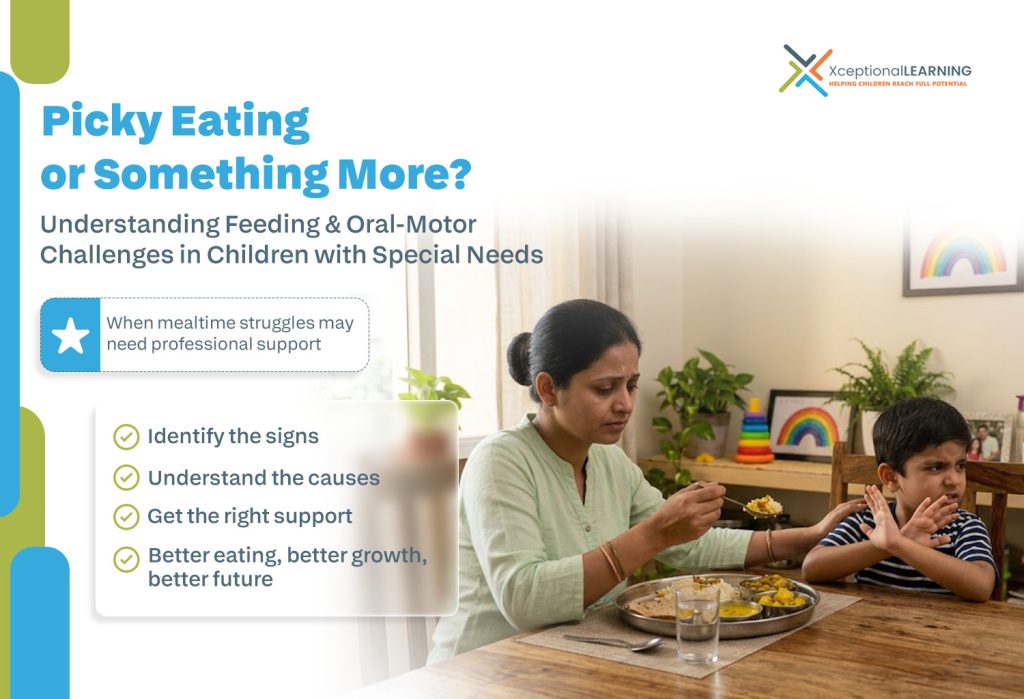
Picky Eating or Something More? Understanding Feeding and Oral-Motor Challenges in Children with Special Needs
admin July 21st, 2026

Clinically Reviewed By
Rakshitha S
Consultant Speech & Swallowing Pathologist
Digital Practitioner (SLP)
Key Takeaways
- Typical picky eating usually improves gradually with time and gentle exposure. A feeding or oral-motor challenge tends to stay narrow, or get worse, without support.
- Two or more red flags (gagging, food refusal by texture, stalled weight gain, mealtimes over 30–45 minutes) are worth a professional look.
- Feeding therapy is a team effort — SLPs, OTs, pediatricians, and dietitians working together, not any one discipline alone.
- Earlier support tends to mean a shorter, less intensive path to progress.
A Familiar Mealtime Scene
Dinner time at home shouldn’t feel like a negotiation. But for many parents, it does. A child pushes the plate away the moment a new food touches it. Another gags at the sight of mashed vegetables, or won’t touch anything that isn’t crunchy. Meals stretch on for over an hour, full of coaxing and bargaining, and everyone ends up back at the same three “safe” foods that never change.
Picky eating on its own is extremely common. Most children go through phases of narrow preferences that ease with time and a bit of gentle exposure. But research shows that feeding difficulties are significantly more common among children with developmental, sensory, or neurological conditions, including autism, cerebral palsy, and certain genetic or neuromuscular conditions, than they are in the general pediatric population.
So what looks like stubbornness at the table is often something else entirely: a physical or sensory difficulty with the actual mechanics of eating. That’s a skill that needs support, not a preference that needs correcting.
Knowing the difference matters. Getting it right early can change a child’s relationship with food for years to come.
Could It Be More Than Picky Eating?
If your child shows two or more of these signs, it’s worth considering a professional feeding assessment.
What Feeding and Oral-Motor Therapy Actually Addresses
Feeding therapy usually involves a multidisciplinary team, simply because eating draws on so many different systems at once. Depending on what a child needs, that team may include:
- Speech-Language Pathologists (SLPs), particularly those trained in swallowing and oral-motor coordination
- Occupational Therapists (OTs), who address sensory processing, self-feeding skills, and posture or positioning during meals
- Pediatricians, who rule out or manage underlying medical causes
- Dietitians and nutritionists, who monitor growth, weight, and nutritional adequacy when a diet is significantly restricted
Together, this team looks at a few core things:
Chewing mechanics. Can the child move food side to side with the tongue, grade the strength of a bite, and coordinate the jaw across different textures?
Swallowing safety (dysphagia). Does food or liquid move safely from the mouth to the stomach without entering the airway? For some children this is a genuine medical safety concern, not just a comfort issue.
Texture progression. Can the child move gradually from purees to soft solids to more complex textures, at a pace their oral-motor system can actually handle?
Oral sensory aversion. Some children find certain textures, temperatures, or smells genuinely distressing because of heightened sensory sensitivity. That’s not defiance.
Both ASHA and the American Occupational Therapy Association (AOTA) treat interprofessional collaboration as the preferred model of care for pediatric feeding disorders. No single discipline manages this alone; SLPs and OTs in particular work as complementary members of the same care team.
Feeding therapy can help improve: chewing skills, swallowing safety, oral-motor coordination, texture acceptance, mealtime confidence, independent eating skills, and the overall family mealtime experience.
Why Early Identification Matters
Feeding difficulties rarely resolve on their own when there’s an underlying oral-motor or sensory cause, and left unaddressed, they tend to compound over time. A child who avoids entire textures for years may fall behind on the oral-motor strength needed for clearer speech, develop real nutritional gaps, or build lasting anxiety around mealtimes that only gets harder to unlearn the longer it goes on.
Early intervention works with a child’s development instead of against it. Oral-motor skills, sensory tolerance, and mealtime confidence all respond better to therapy at a younger age. Catching a feeding concern early often means a shorter, less intensive course of intervention than addressing the same concern years later.
A Small Story from the Clinic
Note: the details below are a composite, anonymized illustration based on patterns we see often in pediatric feeding cases. It doesn’t describe one identifiable child.
When Arun, age 3, first came in for therapy, his parents described him simply as “a picky eater who’s a bit behind.” He ate only three foods: plain rice, a specific brand of biscuit, and banana. He’d never accepted anything with a mixed texture. Mealtimes routinely ran past 45 minutes and usually ended in tears, his and his mother’s both.
An oral-motor and sensory assessment, done jointly by an SLP and an OT, turned up two things. His tongue lateralization was mildly reduced, which made it hard for him to move food side to side. And he had a strong aversion to wet, mixed textures rooted in sensory processing differences rather than behaviour. Neither of these had been obvious from the outside. Arun’s parents had simply assumed he was being stubborn.
Therapy combined direct oral-motor exercises to build chewing strength with a structured, low-pressure texture-exposure plan the family could follow at home. They also set up a visual mealtime routine on VergeTAB, so Arun could see and anticipate each step before a new food showed up. Over four months, he went from three accepted foods to twelve, and mealtime dropped to under 20 minutes. His parents reported that the predictable visual routine appeared to ease his anxiety around mealtimes.
You can also read our blog, How Sensory Play Became the Bridge to Communication for a Child with ASD, which shares a real therapy journey and highlights how proper assessment can identify underlying sensory challenges and guide effective intervention.
Typical Picky Eating vs. Feeding/Oral-Motor Challenges
| Aspect | Typical Picky Eating | Feeding/Oral-Motor Challenge |
|---|---|---|
| Food range | Narrow but slowly expands over time | Stays narrow or shrinks further over months |
| New foods | Reluctance, but will sometimes taste with encouragement | Refusal, gagging, or distress even at the sight or smell |
| Physical signs | None | Gagging, coughing, choking, excessive drooling |
| Weight/growth | Typically on track | May show poor weight gain or growth concerns |
| Chewing | Manages age-appropriate textures | Food pocketing, avoids chewing, prefers purees past the expected age |
| Mealtime duration | Occasionally long, improves with routine | Consistently very long, high distress |
| Response to time | Improves gradually with patience and exposure | Doesn’t improve, or gets worse, without intervention |
Red Flags to Watch For — and When to Ask for Help
Some patterns are worth raising with a pediatrician or feeding specialist rather than waiting them out. Ask yourself whether your child:
None of these signs confirm a problem on their own. But if you’re answering yes to two or more, that’s a reasonable point to stop waiting and start asking.
Common Causes of Feeding and Oral-Motor Challenges
Feeding difficulties can come from several overlapping causes, including:
- Sensory processing differences. Heightened or reduced sensitivity to taste, texture, smell, or temperature.
- Oral-motor weakness or poor coordination. Difficulty with the muscle strength or sequencing needed to chew and swallow efficiently.
- Underlying medical conditions. Reflux, allergies, or structural issues that make eating physically uncomfortable.
- Neurological or developmental conditions. Autism, cerebral palsy, and genetic syndromes can all affect motor planning and sensory regulation.
- Early negative experiences. A choking incident or a painful swallowing episode can create lasting food-related anxiety.
Figuring out the underlying cause is a key part of what a feeding assessment sets out to do.
What Happens During a Feeding and Oral-Motor Assessment
A typical assessment is collaborative and non-invasive. It usually includes:
- A detailed conversation with parents about feeding history, current diet, and mealtime behaviour
- Watching the child eat familiar foods to assess positioning, chewing, and swallowing patterns
- An oral-motor examination to check muscle tone, coordination, and the structure of the mouth
- Screening for sensory sensitivities across different textures, tastes, and temperatures
- A referral for further medical evaluation, such as a swallow study, if there’s a safety concern like aspiration
The goal is to build a clear picture of why a child is struggling, so therapy can target the actual cause instead of just the symptom.
Where Technology Can Support the Process
Feeding and oral-motor therapy is, at its core, hands-on clinical work — no app replaces a trained therapist working directly with a child’s mouth, muscles, and swallowing patterns. But between sessions, a tool like VergeTAB, XceptionalLEARNING‘s Digital Activity Book, can support the broader mealtime experience through visual routines, therapist-assigned home activities, and progress tracking — always alongside therapist-guided intervention, never instead of it.
What Parents Can Do at Home
Professional guidance is essential for genuine feeding difficulties, but a few things can support progress between sessions:
- Keep mealtimes calm and predictable. Consistent timing and seating can reduce anxiety.
- Introduce new foods alongside familiar, accepted ones rather than swapping them in outright.
- Avoid pressuring or bargaining around eating. It tends to increase resistance over time.
- Let your child explore food with their hands or through play outside of mealtimes, if sensory aversion is part of the picture.
- Follow any specific exercises or techniques your child’s feeding therapist recommends, and stay consistent with them.
- Keep a simple food and symptom log to share with your specialist, noting new foods tried and any reactions.
Frequently Asked Questions
The Takeaway
Mealtimes are one of the most repeated, daily moments of connection between a child and their family, which is exactly why feeding difficulties can feel so exhausting for parents to navigate alone. Understanding the difference between a passing phase and a genuine feeding challenge isn’t about labeling every fussy eater as having a disorder. It’s about recognizing when a child needs more support than patience alone can offer.
If your child’s mealtime struggles feel bigger than a typical phase, an early assessment can make a real difference. The earlier the underlying cause is identified, the sooner your child can begin building safer, more confident eating skills. Our speech-language pathologists and occupational therapists work together to identify the underlying cause and build an individualized therapy plan.
This article is meant for educational purposes and isn’t a substitute for professional medical advice, diagnosis, or assessment. If you’re concerned about your child’s feeding, growth, or swallowing safety, please talk to a qualified pediatrician or feeding specialist.
References
- American Speech-Language-Hearing Association (ASHA). Pediatric Feeding and Swallowing (Practice Portal). Available at: https://www.asha.org/practice-portal/clinical-topics/pediatric-feeding-and-swallowing/
- American Occupational Therapy Association (AOTA). Occupational Therapy and Feeding, Eating, and Swallowing. Available at: https://www.aota.org/practice/clinical-topics/feeding-eating-swallowing-deficits
- Gronski, M. P. (2021). Occupational Therapy Interventions to Support Feeding and Toileting in Children From Birth to Age 5 Years. American Journal of Occupational Therapy, 75(5). Available at: https://research.aota.org/ajot/article/75/5/7505390010/12674/
- Arvedson, J. C., Clark, H., Lazarus, C., Schooling, T., & Frymark, T. (2010). An Oral, Motor, Medical, and Behavioral Approach to Pediatric Feeding and Swallowing Disorders: An Interdisciplinary Model. Perspectives on Swallowing and Swallowing Disorders (Dysphagia). Available at: https://pubs.asha.org/doi/10.1044/sasd20.3.65