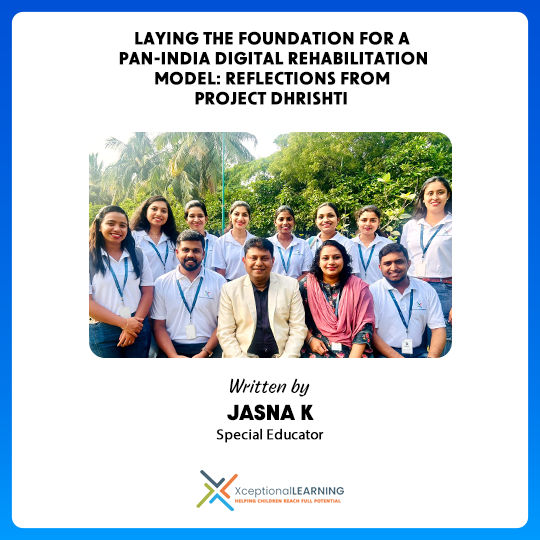
Laying the Foundation for a Pan-India Digital Rehabilitation Model: Reflections from Project DHRISHTI
admin January 2nd, 2026

As a special educator, I strongly believe that meaningful change in rehabilitation and inclusive education occurs when knowledge, practice, and systems work together. Between November 20 and December 17, I had the opportunity to be part of Project DHRISHTI—a technology-driven initiative focused on strengthening rehabilitation practices through structured digital integration. I remain deeply grateful to XceptionalLEARNING for trusting me with this opportunity and for being part of a team that believes in purposeful innovation.
Project DHRISHTI and the Role of Technology
DHRISHTI – Digital Holistic Resource for Inclusive Support, Hybrid Therapy and Intervention is designed to support professionals working with Children with Special Needs (CwSN) by integrating technology into assessment, intervention, and documentation. In a field where consistency, clarity, and accountability are essential, technology serves as a powerful facilitator—enhancing professional efficiency while keeping the child at the centre of intervention.
The project is envisioned as a Pan-India initiative, adaptable across states and service delivery systems, while remaining grounded in real field requirements.
Training Setting and Context
The training sessions were conducted in Vijayawada at HEAL, Thotappilly. The environment at HEAL played a significant role in the success of the programme. Its calm, well-organised setting supported focused learning, reflection, and collaboration, making it an ideal space for an intensive residential training model.
Professionals Trained and Training Approach
The participants of the programme were special educators working within inclusive education systems, specifically Inclusive Education Resource Persons (IERPs) supporting CwSN at BHAVITHA Centres, and School Assistants (Spl.Ed) working with CwSN in regular inclusive school settings. In the initial phase of Project DHRISHTI, a pilot study was conducted to gain a clear understanding of their workflow patterns, field-level challenges, and working environments. Insights from this phase were instrumental in shaping the structure, content, and delivery of the training, ensuring alignment with real-world professional needs.
The training was implemented through three-day residential programmes conducted across multiple batches, allowing for focused engagement and uninterrupted learning. Sessions were facilitated collectively by the training team, creating a multidisciplinary and collaborative learning environment reflective of real rehabilitation practice.
A strong emphasis was placed on hands-on learning and real case-based documentation, with due importance given to ethical standards and confidentiality. Participants were guided through the complete professional process—from case history collection and assessment to goal setting and structured digital documentation—within a unified digital framework.
Rather than limiting the sessions to demonstrations alone, professionals actively worked with real case scenarios and were encouraged to apply the same processes to children from their own caseloads. This learning-by-doing approach played a critical role in bridging the gap between conceptual understanding and confident real-world application of technology.
Field Realities and Team Strength
The training period was intensive. Continuous sessions, travel, and changing climatic conditions took a toll on health at times. However, the encouragement and strength drawn from the team made a significant difference. The leadership and reassurance provided by our Founder and CEO, Dr. Jino Arushi, and, in his absence, the steady guidance of Anjana Jyothi, Chief Commercial Officer, helped keep the team motivated and focused. The collective support within the team proved invaluable during demanding days.
Participant Response and Impact
Participants were highly cooperative and receptive throughout the training. Their engagement reflected a growing understanding that technology can improve the overall quality of professional work, bring structure and clarity to documentation, and enable professionals to better showcase their productivity and outcomes. Observing the shift from initial hesitation to growing confidence reaffirmed the importance of guided, hands-on exposure to digital systems.
Collaboration and Implementation
Project DHRISHTI is implemented as a collaborative initiative between Samagra Shiksha, Andhra Pradesh, and XceptionalLEARNING. This partnership ensured that the project remained system-aligned, field-relevant, and professionally empowering.
Looking Ahead
This experience has strengthened my belief that technology, when introduced with sensitivity and strong professional guidance, can meaningfully transform rehabilitation practice. With upcoming phases of training planned under Project DHRISHTI, there is significant potential to further strengthen inclusive education and rehabilitation services across wider contexts.
I conclude this reflection with gratitude—to my team at XceptionalLEARNING for their resilience and collaboration, to the leadership that guided us, and to the professionals who trusted the process. Together, we are moving toward a future where innovation and human expertise work hand in hand to support every child’s potential.
To learn more or collaborate with us on inclusive, technology-enabled rehabilitation, contact us at XceptionalLEARNING.