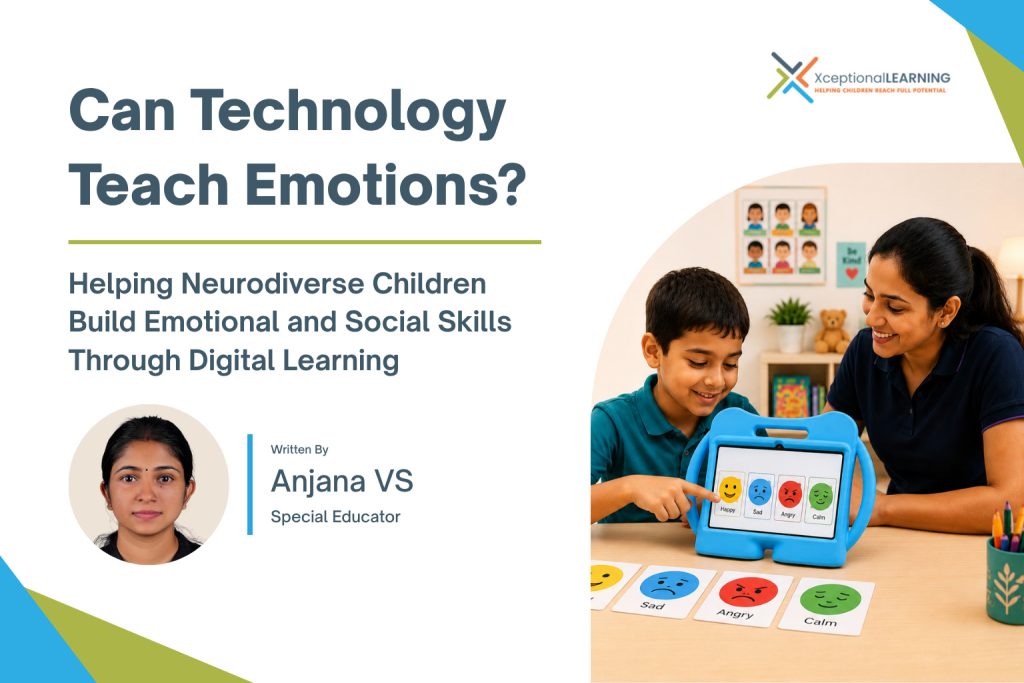
Can Technology Teach Emotions? Helping Children Develop Emotional and Social Skills Through Digital Learning
admin June 16th, 2026

Written By Anjana VS
Special Educator
Digital Tools for Social-Emotional Learning in Neurodiverse Children
In today’s world, children are growing up surrounded by screens, sounds, animations, and interactive digital experiences. While many people still debate whether technology is helping or distracting children, one important question is gaining increasing attention:
Can Technology Actually Teach Emotions?
For neurodiverse children—including those with autism, ADHD, developmental delays, sensory sensitivities, and communication difficulties—understanding emotions and social behaviour can sometimes be challenging. Social situations may feel confusing, fast-paced, or emotionally intense. Recognizing facial expressions, responding to conversations, or managing feelings in different environments may require additional support.
In such cases, technology can provide calm, interactive, and predictable learning spaces where children can explore emotions, practice social responses, and build confidence in ways that feel safe, supportive, and easier to process.
Rather than replacing human interaction, digital learning tools are increasingly becoming supportive bridges that help children understand emotions, strengthen social skills, build relationships, and develop confidence in real-life experiences.
Key Takeaways
- Technology can support emotional development in neurodiverse children.
- Digital tools help teach emotional recognition, empathy, communication, and social skills.
- Social-Emotional Learning (SEL) becomes more accessible through visual and interactive experiences.
- Technology works best when combined with human guidance and real-life practice.
- Personalized digital learning can improve confidence, emotional regulation, and participation in everyday activities.
Understanding Social-Emotional Learning (SEL)
Social-Emotional Learning (SEL) refers to the process through which children learn to:
- Recognize emotions
- Manage feelings
- Build empathy
- Develop relationships
- Make responsible decisions
- Communicate effectively
These skills are essential for emotional well-being, independence, learning, and successful participation in everyday life.
While many children naturally develop emotional understanding through observation and social interaction, neurodiverse children may benefit from clearer instruction, visual supports, and repeated opportunities to practice these skills. Many neurodiverse learners respond particularly well to structured, visual, and interactive learning experiences. This is where technology can play an important role.
Why Technology Feels Natural for Neurodiverse Children
Many neurodiverse children are naturally drawn to digital environments. Technology provides consistency, structure, and control—qualities that often reduce stress and support learning.
Unlike real-life social interactions, digital tools can:
- Slow down communication
- Repeat lessons multiple times
- Use visuals and animations
- Offer immediate feedback
- Reduce social pressure
For example, a child who finds facial expressions difficult to understand during conversations may feel more comfortable learning through animated characters on a screen. Technology also supports multisensory learning through visuals, sounds, and interactive activities, helping improve attention, engagement, and participation.
Digital Tools That Help Teach Emotions
Today, many digital tools support emotional learning and social-emotional development in neurodiverse children, ranging from simple emotion-recognition applications to interactive virtual learning experiences.
1. Emotion Recognition Apps
Emotion-recognition apps help children identify feelings using pictures, animations, and facial expressions through simple interactive activities.
These tools often focus on:
- Happy, sad, angry, scared, surprised, and frustrated expressions
- Body language cues
- Emotional vocabulary
- Real-life social scenarios
For children who find social cues difficult to interpret, repeated visual exposure can gradually improve emotional understanding.
2. Social Stories and Interactive Narratives
Digital social stories help children prepare for everyday situations such as making friends, visiting a doctor, sharing toys, or managing disappointment.
These stories use visuals, narration, and step-by-step explanations to teach appropriate emotional responses and social behaviour.
Interactive stories are particularly effective because children actively participate in decision-making. Instead of simply reading about emotions, they experience emotional situations through guided interaction.
For example, a story may ask:
- What should the character do if a friend feels sad?
- How might this person feel after being ignored?
- What is a calm way to respond when angry?
This active participation strengthens emotional reasoning and social understanding.
3. Virtual Role-Play and Simulations
One of the biggest challenges for neurodiverse children is transferring skills learned in structured environments into real-world situations.
Virtual role-play tools create safe practice spaces where children can:
- Start conversations
- Respond to emotions
- Solve social conflicts
- Practice empathy
- Understand consequences
For example, a virtual classroom simulation may help a child practice:
- Raising a hand
- Sharing materials
- Understanding personal space
- Responding when someone feels sad
Because mistakes inside simulations are safe, children often become more willing to try new responses and behaviours.
4. Augmentative and Alternative Communication (AAC) Tools
Some neurodiverse children experience difficulty expressing emotions verbally. AAC devices and communication apps provide alternative ways to communicate.
Children can use symbols, pictures, or words to express:
- “I am angry.”
- “I need a break.”
- “I feel scared.”
- “I want help.”
This reduces frustration and emotional outbursts caused by communication barriers.
When children gain a reliable voice—even a digital one—emotional regulation and self-expression often improve significantly.
5. Emotion-Based Games
Gamified emotional learning is becoming increasingly popular. Rather than simply teaching emotions through explanation, games allow children to experience emotional decision-making in an engaging and interactive way.
Examples include:
- Choosing calming strategies during stressful situations
- Helping characters solve conflicts
- Identifying emotional triggers
- Matching coping skills to emotions
These experiences make emotional learning more meaningful, practical, and enjoyable.
How Technology Supports Emotional Safety
One of the most overlooked benefits of digital intervention is the emotional safety it can provide. Many neurodiverse children experience anxiety in social situations because they fear making mistakes, being judged, or not responding quickly enough.
They may avoid participation because:
- They fear embarrassment
- They process information slowly
- They struggle with sensory overload
- They find social reactions difficult to interpret
Technology creates safer and less stressful learning environments where children can explore communication and social interaction more comfortably.
Digital tools allow children to:
- Pause and think before responding
- Retry activities without punishment
- Learn privately without social pressure
- Practice skills independently at their own pace
Unlike real-life interactions that may sometimes feel overwhelming, technology offers predictable and controlled experiences that reduce pressure and encourage participation.
This emotional safety promotes confidence-building, experimentation, and active engagement.For example, a child who avoids face-to-face conversation practice may willingly interact with a digital avatar, interactive application, or virtual character. Over time, the confidence gained through these experiences can gradually transfer into real-world social situations.
See How Technology-Supported Learning Can Build Confidence and Engagement
Watch how technology-assisted learning helps children participate more actively, build confidence, and strengthen important developmental skills through engaging activities.
Need Guidance for Your Child’s Learning and Development?
The Role of Visual Learning in Emotional Understanding
Emotions are invisible experiences, and many neurodiverse children benefit from seeing emotions represented visually.
Digital tools can break down emotional concepts through:
- Colour coding
- Emoji scales
- Animated facial expressions
- Step-by-step emotional sequences
- Visual coping charts
For example:
- Red may represent anger
- Blue may represent sadness
- Green may represent calmness
Visual emotional mapping helps children understand feelings in a more concrete and accessible way.
Can Technology Replace Human Connection?
The answer is simple: No.
Technology should never replace emotional relationships, caregivers, teachers, therapists, or peer interactions. Instead, technology works best as a supportive tool. Human relationships teach empathy, warmth, spontaneity, and authentic emotional experiences. Technology simply creates structured opportunities to practice these skills in a safe and supportive environment.
The most effective emotional learning happens when:
- Digital tools
- Human guidance
- Real-life practice
work together.
For example:
- A child learns emotional vocabulary through an app.
- A teacher reinforces it during classroom activities.
- Parents practice it through everyday conversations.
- The child gradually applies these skills independently.
Technology becomes a bridge—not the destination.
The Future of Emotional Learning Technology
The future of emotional learning is becoming increasingly personalized and technology-driven. Emerging innovations are exploring how brain activity, attention patterns, and emotional responses can be supported in real time, particularly for neurodiverse children and children with ADHD.
Brain-Tracking Technology
Wearable devices may help monitor focus, attention, and emotional stress during learning activities.
Attention Development Tools
Interactive brain-based activities may support concentration, impulse control, and sustained attention.
Neurofeedback Training
Children may receive real-time visual or auditory feedback based on brain activity to improve self-regulation and focus.
Personalized Emotional Support
AI-powered platforms may adapt learning activities according to a child’s emotional state and attention level.
Stress and Anxiety Detection
Smart systems may identify early signs of stress or sensory overload and provide calming strategies when needed.
These innovations have the potential to make emotional learning more individualized, engaging, and effective. In this evolving landscape, technology-based platforms can help support emotional learning, communication development, sensory-friendly engagement, and personalized intervention strategies that encourage confidence, emotional regulation, and meaningful participation in everyday life.
Conclusion
Technology cannot replace human relationships, empathy, or meaningful social experiences, but it can become a powerful tool for helping neurodiverse children understand emotions, strengthen communication, develop social skills, and build confidence. Through interactive learning experiences, visual supports, emotional learning activities, and personalized interventions, digital tools create opportunities for children to practice important life skills in ways that feel engaging, structured, and accessible.
As educational technology continues to evolve, XceptionalLEARNING continues to support neurodiverse children through innovative digital learning solutions that bridge the gap between education, therapy, and everyday development. By combining emotional learning, communication support, sensory-friendly activities, and personalized interventions, the platform helps children build confidence, improve focus, strengthen emotional regulation, and participate more meaningfully in daily life. When combined with the guidance of parents, educators, and therapists, technology becomes more than a learning tool—it becomes a supportive bridge that empowers children to grow, connect, and succeed.