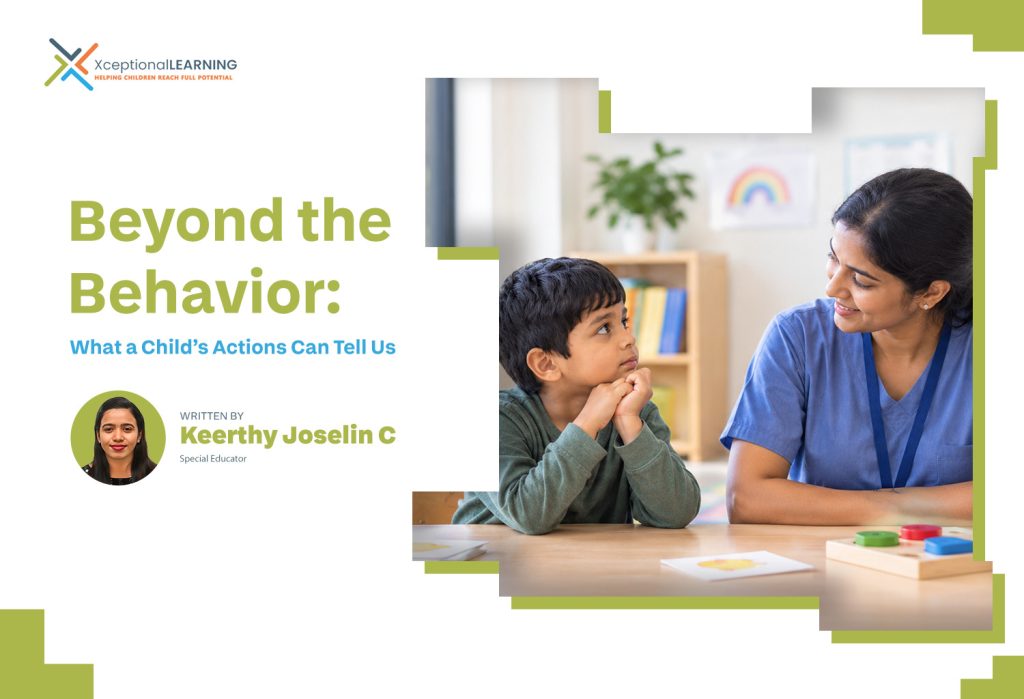
Looking Beyond Behaviour: Understanding Children in the Classroom
admin November 4th, 2026

Written by Keerthy Joselin. C
Special Educator
A child refuses to join an activity. Another becomes upset during a classroom transition. Someone else leaves their seat repeatedly or avoids a task.
It is easy to describe what we see as challenging, disruptive, or non-compliant. But what if the behaviour is telling us something important?
Children do not always have the words to explain what they feel, what they need, or what is making a situation difficult. Sometimes their actions are how they communicate. When educators look beyond the behaviour, they can understand children more deeply and respond with greater care.
Key Takeaways
- Behaviour can be a form of communication, and the same behaviour may mean different things for different children.
- Routines, sensory experiences, and task demands all shape how children respond.
- Observing patterns helps educators work out what support may be needed.
- Understanding behaviour does not mean removing expectations. It means making expectations accessible.
1. When “Not Participating” Might Mean Something Else
Imagine a child who regularly avoids group activities. It may look like refusal, but there could be several reasons:
- The room feels too noisy or overwhelming.
- The child is unsure what to do.
- The instructions are hard to follow.
- The activity feels unfamiliar or unpredictable.
- The child needs more time before joining the group.
These are possibilities to explore, not conclusions to reach quickly. Rather than asking, “Why won’t this child participate?” try asking:
“What might be making participation difficult for this child?”
That small change replaces quick judgement with curiosity.
2. The Same Action Can Tell Different Stories
A child’s behaviour does not happen in isolation. The environment, the activity, the people, and the expectations around them all play a part.
Take a child who leaves a group activity. For one child, it may be a response to sensory overload. For another, it may mean they have not understood the instructions. A third may simply need a short movement break. The behaviour looks similar, but the reasons differ.
That is why getting to know each child matters. When a behaviour happens, educators can pause and ask:
- Was the task too difficult, too long, or unclear?
- Was the usual routine changed?
- Could the environment be making things harder?
- What helped the child feel comfortable or re-engage?
Understanding begins when we stay open to more than one explanation.
3. Small Classroom Details Can Make a Big Difference
Sometimes a small change makes an activity much easier to manage. Educators might try:
- Giving a clear warning before transitions.
- Using visual supports to show what happens next.
- Breaking a large task into smaller steps.
- Offering simple choices where appropriate.
- Providing a quieter space when a child needs a break.
- Allowing extra processing time.
These adjustments do not lower expectations. They create conditions in which children can engage more successfully.
4. A Classroom Moment: Looking at the Whole Picture
This is a fictional composite example, not a report of a specific child.
Consider a child who often becomes upset when free play ends and a structured activity begins. At first, it seems like a refusal to follow instructions. But the educator starts observing more closely over a couple of weeks and notices two things: the child is most distressed when play ends suddenly, and when several instructions arrive at once.
The educator tries a five-minute warning, a visual reminder card, and one instruction at a time. The first few days are still difficult, and some transitions go better than others. Gradually, the upset becomes shorter and less frequent, and the child begins to move to the next activity with only a prompt.
The lesson is not that one strategy works for everyone. It is that careful observation can point to support worth trying, and that progress is rarely a straight line.
5. What Educators Can Notice in Everyday Routines
Everyday moments offer useful information about a child’s needs.
During transitions
Notice which changes are harder than others. Consider whether advance warnings, visual reminders, or a predictable routine would help.
During learning activities
Observe whether the child struggles with particular tasks, instructions, group sizes, or activity lengths. Consider explaining differently or dividing the task into smaller steps.
During social interactions
Notice when the child finds it hard to join peers, share materials, or take part in groups. Consider modelling, communication support, or adult guidance.
During moments of distress
Look at what happened beforehand and what helped the child recover. Respond calmly, and consider whether the child needs reassurance, space, help communicating, or a change in the situation.
6. From Quick Judgements to Better Questions
The words educators use shape how they understand a child. Try describing what you observe, then asking what might be contributing.
| Quick judgement | A more helpful question |
|---|---|
| “The child is being difficult.” | “What is making this hard for the child?” |
| “The child never listens.” | “Are the instructions clear and manageable?” |
| “The child is attention-seeking.” | “What might the child be communicating?” |
| “The child refuses to work.” | “Is the task understood and achievable with support?” |
Describing what happened without attaching a label makes patterns easier to spot and next steps easier to plan.
7. Understanding Does Not Mean Removing Expectations
Looking beyond behaviour does not mean ignoring boundaries. Children still need routines, expectations, and chances to build skills. The difference is in the response: clear boundaries combined with an effort to understand the child’s experience.
Educators can acknowledge feelings, explain expectations, teach other ways to communicate, and offer help. For example:
“I can see that you are upset. It is time to finish this activity. Let’s look at what happens next, and I’ll help you get started.”
This keeps the expectation in place while recognising that the child may need help meeting it.
When safety is involved
Understanding a behaviour never outweighs keeping everyone safe. If a behaviour puts the child or others at risk of harm, the first step is to make the situation safe, following your school’s safeguarding and behaviour-support policies. Reflection and planning come afterwards, ideally with colleagues, the family, and relevant professionals.
8. When to Look for Further Support
Everyday adjustments help many children, but not all needs can be met in the classroom alone. Some behaviours may be influenced by a child’s communication needs, neurodevelopmental differences, sensory experiences, anxiety, or experiences of stress or trauma. These are possible considerations, not conclusions that can be drawn from behaviour alone. Educators are not expected to diagnose these conditions and should seek appropriate guidance when needed.
Consider talking with the family and seeking guidance from a specialist, such as a special educational needs coordinator, psychologist, or speech and language therapist, when:
- the behaviour is frequent, intense, or lasting despite reasonable adjustments;
- it affects the child’s learning, friendships, or wellbeing;
- the child seems to be struggling to communicate or understand;
- the pattern is new or has changed suddenly.
9. A Simple Reflection Checklist
When a behaviour is hard to understand, take a moment to ask:
- What exactly did I observe?
- Is it linked to a particular activity, time, or situation?
- Does the child have a way to tell me what they need?
- What has helped before?
- What one small adjustment could I try?
- Would it help to talk with the family or another professional?
These questions help move from reacting to behaviour towards making informed, supportive decisions.
10. Frequently Asked Questions
The Takeaway: Look Beyond the Moment
Behind an action there may be a feeling, a need, a difficulty, or something in the environment that deserves attention. The goal is not simply to stop a behaviour. It is to understand what is happening, help the child build useful skills, and create a setting where they feel supported and able to take part.
Sometimes, looking beyond the behaviour is the first step towards understanding the child.
A note on tools: Keeping notes on observations over time can make patterns easier to identify and support easier to coordinate. Platforms such as XceptionalLEARNING offer connected digital solutions for therapy, special education and hybrid intervention. Digital tools can help organise relevant information, while observation, professional judgement and each child’s individual needs remain central to planning support.
Further Reading
These sources offer background on the ideas behind this article. This post is an educational overview, not a research review, and the sources are not presented as validating every strategy mentioned above.
- Carr, E. G., & Durand, V. M. (1985). Reducing behavior problems through functional communication training. Journal of Applied Behavior Analysis, 18(2), 111–126. https://doi.org/10.1901/jaba.1985.18-111
- Dunn, W. (1997). The impact of sensory processing abilities on the daily lives of young children and their families: A conceptual model. Infants & Young Children, 9(4), 23–35. https://doi.org/10.1097/00001163-199704000-00005
- Greene, R. W. (2014). The Explosive Child: A new approach for understanding and parenting easily frustrated, chronically inflexible children (5th ed.). Harper. Open Library (ISBN 9780062270450)
Explore XceptionalLEARNING in Practice
If you work in a school, clinic or therapy setting, discover how XceptionalLEARNING can support structured planning, digital activities and progress monitoring across learning and intervention programmes.