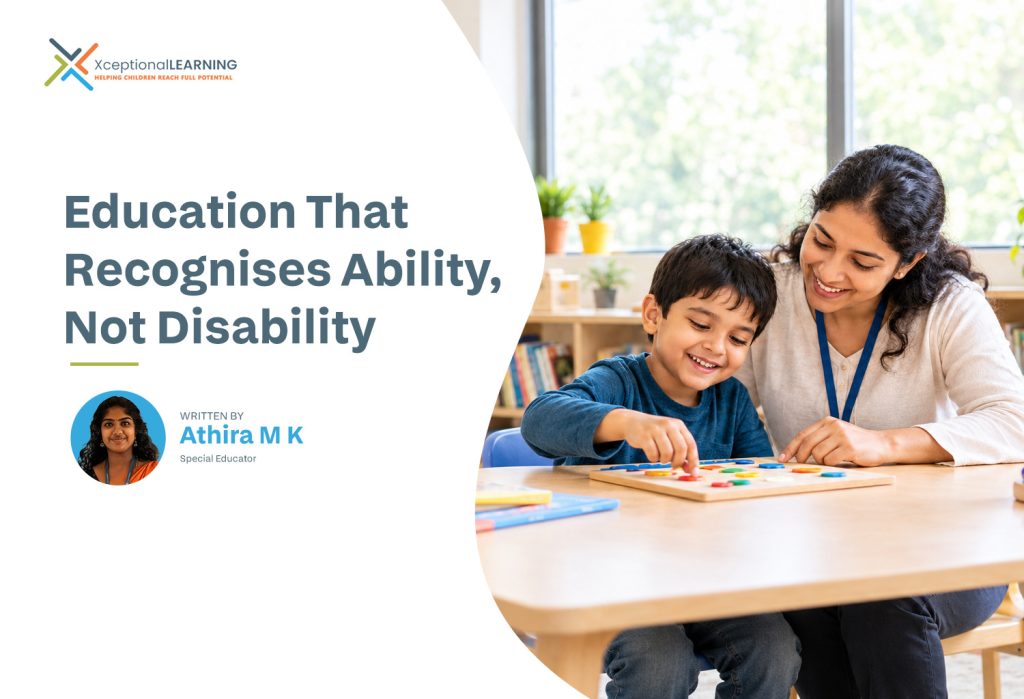
Education That Recognises Ability, Not Disability
admin October 28th, 2026
Written by Athira M K
Special Educator
Introduction
Education is more than teaching children to read, write, count or achieve academic goals. At its heart, it is about understanding the learner, recognising individual abilities and creating opportunities for growth.
Every child is different, with their own strengths, interests, learning preferences, ways of communicating, experiences and developmental needs.
For children with disabilities, this understanding matters even more. A disability should not define a child’s educational journey. Education should begin by recognising what the child can do, understanding the support they need, and using their existing abilities as a foundation for further learning.
A strength-based, individualised approach shifts the focus from limitations to possibilities. The goal is not to make every child learn in the same way, but to give every child the opportunity to learn in a way that works for them.
1. Looking Beyond Disability
A disability is only one part of a child’s identity. It should never be the first or only thing we notice about a learner.
Every child has abilities, interests, preferences and potential. One child may communicate confidently, another may have a strong visual memory, and another may show creativity through drawing, music, movement or practical activities.
Education sometimes concentrates on the areas where a child struggles. Understanding challenges is important, but focusing only on limitations means we can overlook strengths. A strength-based approach begins with a different question:
“What can this child do?”
From there, educators can ask:
“How can we use these abilities to support further learning?”
This simple change in perspective can lead to more positive and meaningful learning experiences. For a closer look at introducing the person before the diagnosis, see What If We Saw the Person First?
2. Understanding the Individual Learner
Individualised education begins with understanding the child as a whole person. Every learner has a different starting point. Some children grasp information quickly, while others benefit from repetition, extra time, visual support, demonstrations or practical experience.
Educators can look at:
- What the child already knows
- What the child can do independently
- Where support is needed
- Interests and preferences
- Communication abilities
- Attention and participation
- Learning pace
- Social and practical skills
- Progress over time
This picture helps educators plan learning experiences that suit the individual child. Individualisation does not mean lowering expectations. It means finding the right pathway towards meaningful goals.
3. Building on Strengths
A child’s strengths can be the starting point for learning, and they can also help children approach areas they find difficult.
Consider a child who loves trains but finds counting hard. Instead of starting with a worksheet, the teacher lines up toy carriages and invites the child to count the passengers boarding each one. The child is interested, understands the activity and wants to take part, so counting becomes purposeful rather than daunting.
In the same way:
- A child who enjoys music may learn new concepts through songs and rhythm.
- A child who loves animals may engage more with reading, counting or communication activities built around animals.
- A child who enjoys drawing can practise fine motor skills, communication, creativity and early writing through drawing-based tasks.
Strengths are not separate from education. They are its foundation.
4. Setting Individual and Meaningful Goals
Not every child needs to work towards the same goals at the same time. For one learner, recognising letters may be an important goal. For another, expressing a choice, following an instruction, completing a task or joining a group activity may be just as meaningful.
Individual goals may focus on:
- Communication
- Literacy and numeracy
- Attention and participation
- Social interaction
- Motor development
- Daily living skills
- Problem-solving
- Confidence
- Independence
Good goals are meaningful, achievable and appropriately challenging. They are best set together with parents and, where relevant, with specialists such as special educators, speech and language therapists or occupational therapists, whose assessments can show what support a child needs.
Many schools record these goals in an Individualised Education Plan (IEP). To see how such plans can stay flexible as a child grows, read Reimagining Individualized Education Plans (IEPs) in a Hybrid Era.
The purpose is not simply to complete a fixed list of academic tasks. It is to help each child develop skills that contribute to learning, participation and everyday life.
5. Recognising Progress in Different Ways
Progress does not always show up in marks, grades or completed worksheets. A child may show progress by:
- Staying engaged for longer
- Making a choice independently
- Communicating a need
- Trying a new activity
- Completing part of a task
- Responding to an instruction
- Working with another child
- Asking for help
- Correcting a mistake
- Using a learned skill in a new situation
These small steps are meaningful. When educators recognise individual progress instead of constantly comparing children, learners feel a greater sense of achievement. Progress should be measured against where the child started, not against where another child is. Small Wins in Special Education: Why Every Step of Progress Matters explores this idea further.
6. Different Ways to Learn, at the Right Pace
There is no single way to teach every concept. Children may learn through pictures, objects, stories, demonstrations, movement, music, hands-on activities, games, conversation or practical experiences. Multisensory Teaching Strategies in Special Education offers practical ideas for combining these approaches.
A child who struggles with a written explanation may understand the same idea when it is demonstrated. Another may need repeated, varied practice before a concept feels familiar. Offering several pathways gives more children the chance to understand and take part.
Children also develop skills at different rates. An individualised approach allows them to:
- Revisit activities and practise skills
- Take extra time to process information
- Receive appropriate support
- Try different approaches
- Progress gradually
- Move on to new challenges when they are ready
The aim is neither to rush a child nor to hold them back, but to offer the right level of challenge and support at the right time. The method can change according to the learner, while the purpose of learning stays meaningful.
7. Supporting Participation and Communication
Children are more likely to take part when learning connects with their interests, abilities and experiences. Teachers can encourage this through real choices, clear routines, manageable activities, encouragement, movement breaks and practical experiences.
Participation should not be understood as simply sitting quietly or completing every task. A child may participate by making a choice, answering a question, communicating with a peer, attempting an activity or showing interest in something new.
Communication is central to this. Children may communicate through speech, gestures, facial expressions, body movement, pictures, symbols, writing or other methods, and every meaningful form of communication should be valued. Children should be supported to make choices, express preferences, ask for help, share ideas and describe their needs and feelings. When children can express themselves, they become more active participants in their own learning.
8. Learning Through Experience, Confidence and Independence
Learning extends beyond academic subjects. Everyday activities develop cognitive, social, motor, communication and practical skills. Sorting objects supports classification and thinking. Sequencing activities builds memory and logical understanding. Cooking, gardening, building and role-play connect learning with real life and give children a reason to use their skills.
Confidence grows through success. If a child repeatedly finds tasks difficult or unsuccessful, they may become hesitant to take part. Achievable steps, appropriate support, encouragement and chances to try again help children believe in their own abilities. Teachers can build confidence by recognising effort, celebrating progress, offering choices and avoiding unnecessary comparison.
Over time, education should also help children become more independent: starting activities, making choices, following routines, solving problems, asking for help, correcting mistakes and using learned skills in everyday situations. Support should be given when needed, but opportunities for independent action should always be created.
The ultimate purpose is not simply to teach a particular skill. It is to help the child use their abilities with greater confidence and independence.
9. Technology as a Supporting Tool
Technology can strengthen individualised education when it is chosen to match a child’s needs and learning goals. It can offer additional ways to access information, practise skills, communicate and show understanding, and it can let children practise at their own pace.
However, technology should remain a supporting tool, not the centre of education. A device cannot replace a teacher’s understanding, and digital resources cannot replace encouragement, relationships or human connection.
Platforms such as XceptionalLEARNING show how this can work in practice. It is a structured digital therapy and learning platform in which educators and therapists can assign activities, link them to individual goals, create personalised digital materials and track progress, while families can continue guided practice at home. The teacher’s judgement still decides how, when and whether each activity is used. For more on involving families, read Empowering Parents at Home: Building a Structured Digital Learning Ecosystem for Children.
Technology can support learning, but the learner must always remain at the centre.
10. Creating an Inclusive Learning Environment
An inclusive environment recognises that fairness does not always mean giving every child exactly the same thing. Some children need additional time, different materials, adapted activities, communication support or more opportunities to practise.
Inclusion means creating genuine opportunities for every learner to participate, learn, communicate and contribute. It also means teachers, families, professionals and the child working together to understand what works best for that learner.
This thinking is rooted in law. Article 24 of the UN Convention on the Rights of Persons with Disabilities recognises the right of persons with disabilities to education and requires countries to ensure an inclusive education system at all levels, including reasonable accommodation and individualised support within the general education system.
In India, the Rights of Persons with Disabilities (RPwD) Act, 2016 was enacted to give effect to the Convention. It defines inclusive education as a system in which students with and without disabilities learn together, with teaching adapted to different learning needs. Section 16 requires governments and local authorities to endeavour to ensure that the institutions they fund or recognise provide inclusive education, including reasonable accommodation, individualised support and monitoring of each student’s participation and progress. Section 31 gives every child with a benchmark disability, aged six to eighteen, the right to free education in a neighbourhood school or a special school of their choice.
Laws set the framework, but it is everyday practice in classrooms and homes that turns inclusion into reality.
Try This: A Quick Checklist for Teachers and Parents
- What can this child already do, and what do they enjoy?
- How could that interest be used to introduce the next skill?
- What is one small, achievable goal for the coming weeks?
- Which different ways of learning (pictures, objects, movement, music) could I offer?
- How does this child communicate, and am I recognising all of it?
- What small signs of progress have I noticed recently?
- Who else (family, specialists) should be part of the planning?
Conclusion: From Limitations to Possibilities
When education focuses mainly on disability, attention drifts towards what a child finds difficult. When it focuses on ability, we begin to notice possibilities. A strength-based approach asks what the child already knows, what they enjoy, what motivates them, what they can achieve with support and what they might achieve next. This does not mean ignoring challenges. It means understanding them while refusing to let them define the whole learner.
Every child has strengths, potential and a unique learning journey. Education should recognise individual abilities, understand learning needs, set meaningful goals, celebrate progress and give children the opportunity to grow in confidence and independence. Technology can contribute, but it remains one of many tools. The most important part of education is still the learner.
Instead of asking:
“What can this child not do?”
we should ask:
“What can this child do, and how can we help them do more?”
When we recognise ability before disability, learning becomes more respectful, meaningful and empowering.
See the ability. Understand the learner. Support the potential. Recognise the progress. Empower every child.
Bring Strength-Based Learning to Your School, Clinic or Home
Every child deserves support that starts with what they can do. XceptionalLEARNING helps special schools, inclusive classrooms, therapists and families bring structure, personalised activities and visible progress together in one place.
For families, therapists and educators: Contact the XceptionalLEARNING team or write to care@xceptionallearning.com.
Take the first step today: see the ability, and let us help you support the potential.