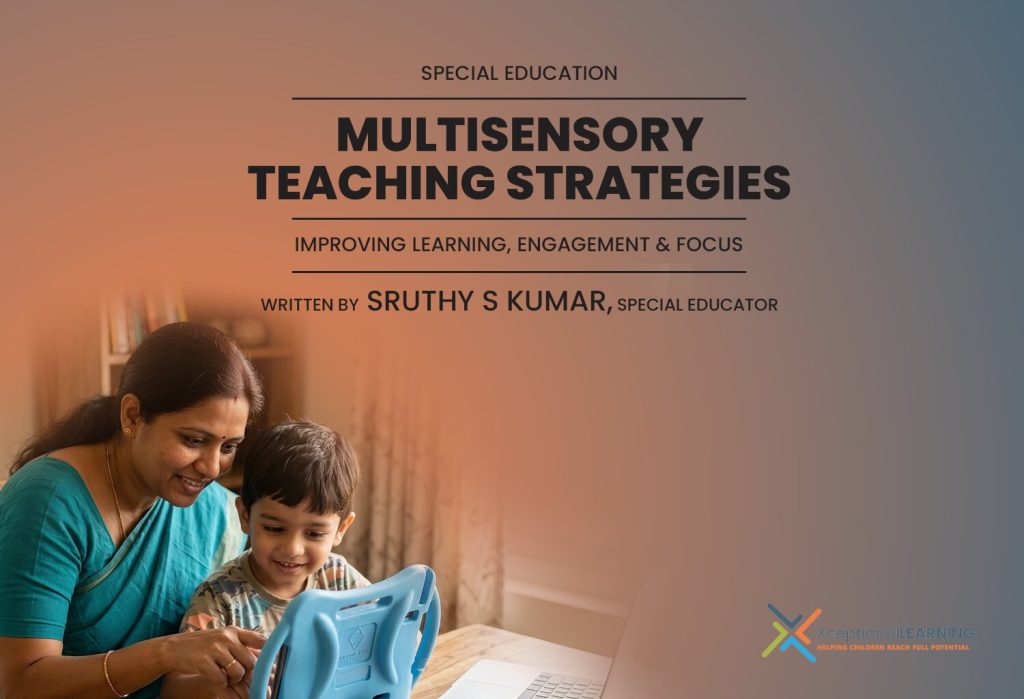
Multisensory Teaching Strategies in Special Education for Better Learning and Engagement
admin April 1st, 2026

Written by Sruthy S. Kumar
Special Educator
Introduction
Many children with learning difficulties struggle to stay engaged in traditional classroom environments. For students with Specific Learning Disabilities (SLD) such as dyslexia, dysgraphia, and dyscalculia, relying on a single teaching method can lead to frustration, reduced confidence, and slower academic progress.
Multisensory teaching in special education offers an effective solution. By combining visual, auditory, kinaesthetic, and tactile learning methods, educators can create engaging experiences that improve understanding, retention, and participation.
This approach not only supports academic development but also builds confidence, motivation, and independence in children with special needs.
Why is Multisensory Teaching Important?
Multisensory learning strategies are highly effective because they engage multiple areas of the brain at the same time.
Multisensory teaching helps children:
- Understand and retain information more effectively
- Improve focus and sustained attention
- Actively participate in classroom activities
- Develop fine and gross motor skills
- Build confidence and a positive attitude toward learning
For children with special needs, this approach transforms learning into an interactive experience they can see, hear, touch, and actively engage with.
Multisensory Strategies
By addressing different learning styles, multisensory strategies improve attention, memory, and comprehension, making learning more inclusive and effective.
Visual Strategies (Seeing)
Visual learning helps children process and understand concepts through images and visual cues.
Examples:
- Charts, pictures, and colour coding
- Visual schedules and graphic organizers
- Animated videos and digital flashcards
- Storyboards and illustrated worksheets
Example in class:
A child learns story sequencing by arranging picture cards instead of only listening to instructions.
Auditory Strategies (Hearing)
Auditory methods strengthen listening, language development, and comprehension.
Examples:
- Songs, rhymes, and verbal repetition
- Recorded instructions and guided listening
- Audiobooks and storytelling sessions
- Text-to-speech tools
Example in class:
A child listens to a letter sound, sees it on screen, and repeats it aloud.
Kinaesthetic Strategies (Movement-Based Learning)
Kinaesthetic learning involves movement and interaction, helping children learn through action.
Examples:
- Role play and action-based learning
- Sorting, matching, and sequencing activities
- Interactive games and movement tasks
- Drag-and-drop digital activities
Example in class:
A child learns categorization by sorting objects or interacting with grouping activities.
Tactile Strategies (Touch and Feel)
Tactile learning supports understanding through hands-on experiences.
Examples:
- Tracing letters and drawing
- Crafting and textured materials
- Manipulating shapes or blocks
- Digital tracing and touch-based tools
Example in class:
A child traces letters while seeing the shape and hearing the sound.
See Real Results: How Multisensory Learning Transforms Children
Watch how structured multisensory learning improves engagement, confidence, and learning outcomes in real therapy sessions:
Want to implement multisensory learning effectively?
Integrating Technology in Multisensory Teaching
Technology enhances multisensory learning by combining visual, auditory, and interactive elements into a single experience.
Effective ways to integrate technology include:
- Educational apps that combine visual and auditory learning
- Interactive whiteboards for touch-based engagement
- Virtual or augmented reality for immersive learning
- Audiobooks and speech-to-text tools
- Tablets and digital drawing tools
When used thoughtfully, technology supports teaching and improves consistency in learning.
Multisensory Tools and Platform Ideas
1. Visual Learning Tools
To strengthen visual processing and concept understanding:
- Animated lessons and visual sequences
- Interactive digital worksheets
- Engaging activity-based learning modules
Digital platforms like XceptionalLEARNING provide structured visual learning experiences through interactive content and digital activity book.
Other tools:
- Digital flashcards
- Storyboarding platforms
- Visual design tools like Piktochart
2. Auditory Learning Tools
To improve listening and comprehension skills:
- Guided audio instructions
- Recorded lessons and prompts
- Text-to-speech and read-aloud features
Platforms like XceptionalLEARNING support auditory learning through structured therapy-based audio interactions.
Other tools:
- NaturalReader
- Read&Write
- Audiobooks and audio-based lessons
3. Kinaesthetic Learning Tools
For movement-based and interactive learning:
- Drag-and-drop activities
- Matching and sorting exercises
- Gamified learning tasks
XceptionalLEARNING enables interactive engagement through activity-based digital tasks that keep learners actively involved.
Other tools:
- Scratch (interactive learning)
- ClassVR (immersive learning experiences)
4. Tactile Learning Tools
To enhance hands-on learning and fine motor skills:
- Digital tracing and drawing tools
- Shape manipulation and modelling activities
- Touch-based tablet learning
Platforms like XceptionalLEARNING offer tactile learning through digital writing, tracing, and sensory-based activities.
Other tools:
- Osmo
- Tiggly
- Digital drawing and tracing apps
Conclusion
Multisensory teaching in special education creates engaging, inclusive, and effective learning experiences for children with diverse needs. By combining visual, auditory, movement-based, and tactile strategies, educators can support better understanding, retention, and participation.
With structured digital platforms like XceptionalLEARNING, these strategies can be implemented more effectively and consistently. When used in the right way, multisensory learning not only improves academic outcomes but also builds confidence, independence, and long-term success for every child.
Need help choosing the right multisensory learning approach?
Effective special education combines visual, auditory and hands-on learning with structured goals and meaningful practice. XceptionalLEARNING supports educators, therapists and families with digital therapy and learning solutions designed to complement individualised intervention and home practice.
Explore XceptionalLEARNING’s solutions for special schools, inclusive education and therapy professionals.