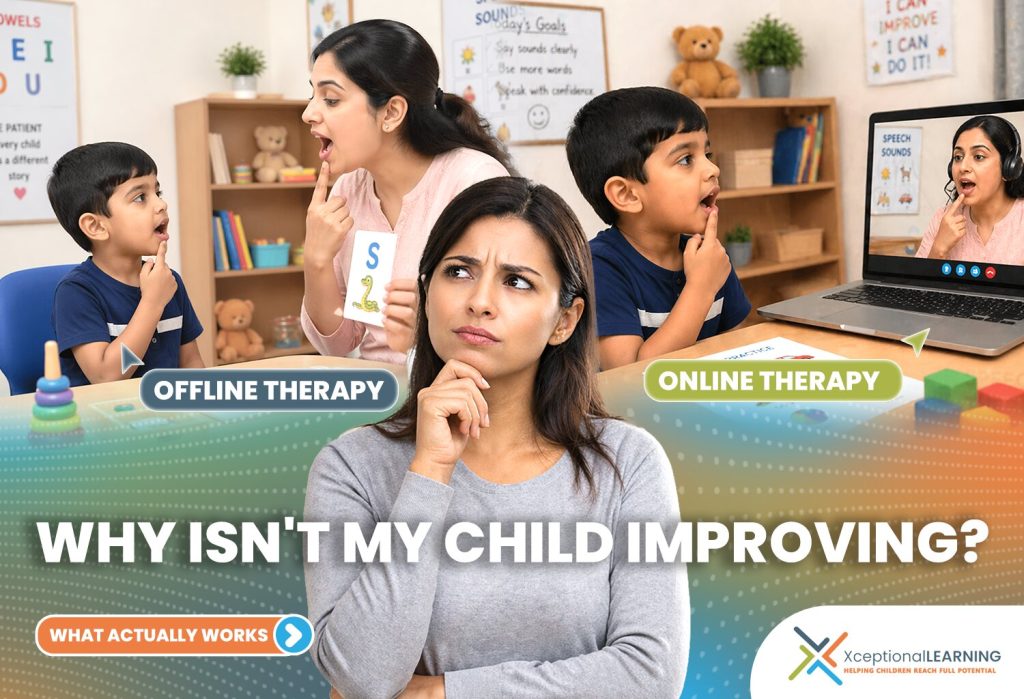
Online vs Offline Therapy for Children: Why Progress Is Slow and What Actually Works
admin May 19th, 2026

Clinically Reviewed by
Meha P. Parekh
Special Educator
Introduction: “We’re Doing Therapy… So Why Isn’t My Child Improving?”
You’re attending therapy regularly.
You’re following every instruction.
You’re doing everything you can as a parent.
But deep down, one question keeps coming back:
“Why isn’t my child improving?”
Progress feels slow.
Results feel unclear.
And doubt starts creeping in.
- Are we choosing the wrong therapy?
- Should we switch from offline to online—or the other way around?
Here’s the truth most people won’t tell you:
Therapy Is Rarely the Problem — The Support System Around It Matters Most
If your child isn’t improving, it’s usually not about online vs offline therapy—
It’s about what happens between sessions.
Quick Summary
- Therapy alone (online or offline) is not enough
- Lack of daily structured practice slows progress
- Online therapy improves consistency and tracking
- Offline therapy supports hands-on development
- A structured hybrid approach delivers the best results
How to Know If Your Child’s Therapy Is Actually Working
Before switching therapy types, ask yourself:
- Is my child improving week by week?
- Do we follow a structured routine at home?
- Can I clearly track progress?
- Does therapy continue beyond sessions?
If your answer is “No” to even 2 of these…
The issue is not therapy type. It’s the lack of a system.
Not Seeing Progress? Let’s Fix That
The Real Problem: Therapy Happens Only a Few Hours a Week
Most children attend therapy:
- 2–3 sessions per week
- 30–60 minutes each
That’s less than 5% of their total time.
But learning doesn’t happen in isolated sessions.
It happens:
- During daily routines
- Through repetition
- In small, consistent moments
If therapy stops after the session ends, progress slows down—no matter how good the therapist is.
Why Therapy Is Not Working for Many Children
Let’s address the real issue clearly.
Children don’t improve when:
- Practice is inconsistent
- There is no structured home routine
- Progress is not tracked
- Therapy is disconnected from daily life
Therapy isn’t failing. The structure is missing.
Understanding Online Therapy (What’s Changed Today)
Online therapy today is not just video calls—it’s a structured system.
Platforms like XceptionalLEARNING enable:
- Guided therapy programs
- Interactive Digital Activity Books
- Therapy videos for daily practice
- Progress tracked the platform dashboard
This transforms therapy into a continuous learning process, rather than a weekly activity. Platforms like XceptionalLEARNING offer structured digital therapy programs that help children practice consistently at home and show measurable improvement.
See how structured therapy actually improves real outcomes
Explore how therapy, tracking, and daily practice work together
Ready to see real progress for your child?
Why Online Therapy Works So Well
- Consistency → No travel = fewer missed sessions
- Engagement → Interactive tools keep children involved
- Measurable Progress → Clear tracking for parents
- Home Integration → Therapy continues daily
Limitations of Online Therapy
Let’s be practical:
- Requires internet access
- Younger children need parental involvement
- Limited physical interaction
Powerful—but not complete on its own
Understanding Offline Therapy
Offline therapy includes clinic-based or school-based sessions.
It offers:
- Direct therapist interaction
- Hands-on guidance
- Sensory and motor skill support
- Controlled environment
Where Offline Therapy Works Best
- Motor skill development
- Sensory integration
- Severe developmental conditions
- Initial assessments
The Hidden Problem with Offline Therapy
Even though it’s effective:
- Sessions are limited
- Travel can disrupt consistency.
- No structured continuation at home
This creates a critical gap between sessions.
Online vs Offline Therapy: What Actually Matters
| Aspect | Online Therapy | Offline Therapy |
|---|---|---|
| Accessibility | From home | Requires travel |
| Flexibility | High | Fixed schedules |
| Cost | More affordable | Higher |
| Engagement | Interactive tools | Therapist-led |
| Progress Tracking | Data-driven | Limited/manual |
| Physical Support | Limited | Strong |
| Consistency | Easier | Often disrupted |
Quick reflection:
Which side does your child fall into right now?
- Mostly consistent
- Mostly inconsistent
That answer matters more than the therapy type.
What Actually Works: The Hybrid + Structured Approach
The most effective model today combines:
- Online therapy → daily structure and engagement
- Offline therapy → hands-on support
- Home practice → consistency
Together, this creates real, measurable progress.
What Therapists Consistently Observe
Children who follow daily structured practice (even 20 minutes) improve significantly faster than those relying only on weekly sessions.
Consistency beats intensity—every time.
Real Example: What Changes Everything
A 4-year-old with speech delay attended therapy twice a week for 6 months.
Progress: Minimal
Then one change was introduced:
- 20 minutes of structured daily practice at home
- Guided activities + therapy videos
Within 8–10 weeks:
- Vocabulary improved
- Response time increased.
- Engagement became stronger.
The therapy didn’t change.
The system did.
How Technology Is Improving Therapy Outcomes
Modern therapy now includes:
- Digital Activity Books
- Guided therapy videos
- Real-time progress dashboards
- Structured learning paths
This reduces guesswork and helps parents stay consistent.
The Hardest Part: Consistency at Home
This is where most parents struggle.
- Busy schedules
- Lack of guidance
- Child losing focus
This is exactly where tools like VergeTAB help.
Where VergeTAB Makes a Real Difference
- Distraction-free environment
- Structured and controlled therapy activities
- Goal-based learning system
- Seamless integration with XceptionalLEARNING Platform
Children:
- Stay focused longer
- Engage better
- Show more consistent improvement
Watch how structured therapy creates real progress
See the transformation in action
Ready to see this for your child?
Frequently Asked Questions
Is online therapy effective for children with speech delay or autism?
Yes—especially when combined with structured daily practice and guided activities.
Can online therapy replace offline therapy?
Not completely. A hybrid approach delivers better results.
Why is my child not improving in therapy?
In most cases, it’s due to a lack of consistency and structured practice between sessions.
How can I improve therapy results at home?
By introducing daily guided activities, tracking progress, and maintaining a routine.
How long does it take to see results?
With consistent practice, improvements are usually visible within a few months.
Conclusion: It’s Not About Online vs Offline—It’s About What Works
If your child’s progress feels slow, the issue is rarely the therapy method.
The real challenges are:
- Lack of structure
- Lack of consistency
- Lack of continuity between sessions
When therapy becomes:
- Structured
- Continuous
- Measurable
Progress becomes visible—and faster.
Take the Next Step
You don’t need more therapy. You need a better system.
Start by:
- Identifying what’s missing
- Fixing the gap
- Creating a structured routine