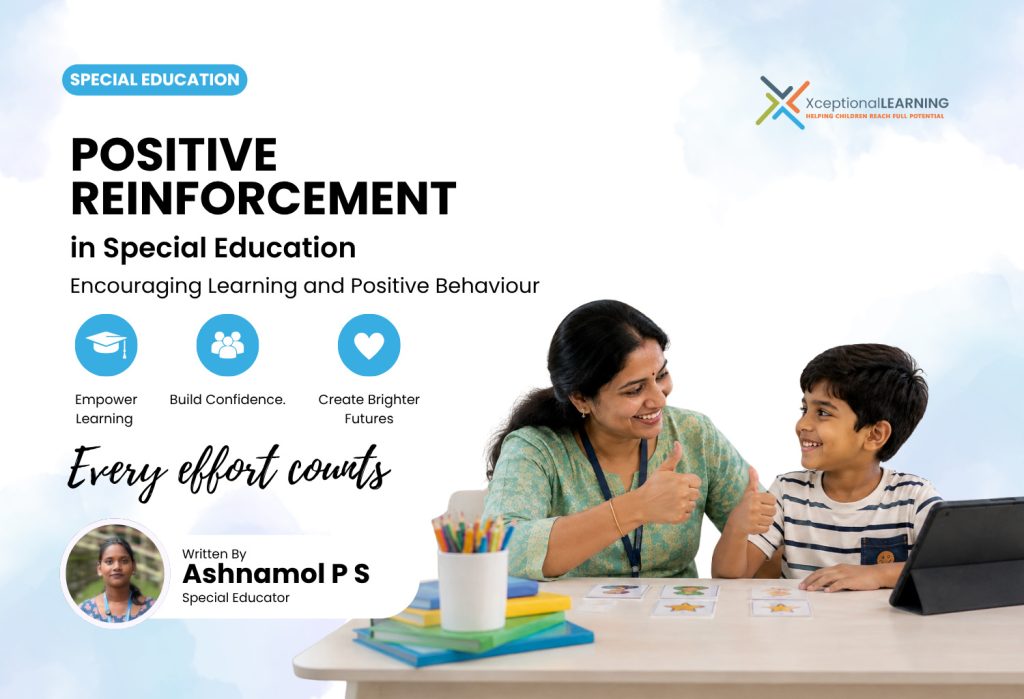
Positive Reinforcement in Special Education: Encouraging Learning and Positive Behaviour
admin September 9th, 2026

Written By Ashnamol P S
Special Educator
Introduction
In special education, effective teaching requires strategies that consider each child’s individual needs, abilities, interests, and learning style. Positive reinforcement is an important teaching and behaviour-support strategy used to increase desired behaviours and encourage learning.
It can support communication, classroom participation, task completion, social interaction, appropriate behaviour, and independence. When used intentionally, it helps learners understand which behaviours are expected and increases the likelihood of those behaviours occurring again.
What Is Positive Reinforcement?
Positive reinforcement occurs when a consequence is added after a behaviour and increases the likelihood of that behaviour occurring again in the future.
The word “positive” means that something is added — it does not simply mean “good.”
Example: Student completes a task → Teacher provides specific praise → Student is more likely to complete similar tasks again.
Not everything given to a child is automatically a reinforcer. A consequence is considered a reinforcer only when it actually increases the future occurrence of the behaviour. Reinforcement should therefore be based on the individual child’s preferences rather than adult assumptions, a principle that applies throughout this article, from choosing a reinforcer to praising a specific action.
Key Principle
Positive reinforcement means adding a consequence after a behaviour that increases the likelihood of that behaviour occurring again.
Behaviour → Reinforcer → Increased Future Behaviour
How Does Positive Reinforcement Work?
Positive reinforcement follows a simple sequence:
Desired Behaviour → Meaningful Reinforcer → Increased Future Behaviour
Example: Student raises their hand → Teacher provides specific praise → Student is more likely to raise their hand again.
Effective reinforcement requires:
- A clearly identified target behaviour
- A meaningful reinforcer
- Prompt delivery after the behaviour
- Clear feedback about the behaviour being reinforced
- Observation of whether the behaviour actually increases
- Adjustment according to the learner’s changing needs and preferences
Types of Reinforcement and Reinforcement Systems
Different children respond to different reinforcers.
1. Social Reinforcement Positive attention or interaction from another person, such as praise, smiles, high-fives, thumbs-up, and encouraging statements. Example: A student waits for their turn → Teacher says, “Excellent waiting! You waited for your turn.”
2. Tangible Reinforcement Providing access to a preferred physical item after a desired behaviour, such as stickers, small toys, art materials, or preferred classroom objects. Example: Complete the writing task → Receive a preferred sticker.
3. Activity Reinforcement Providing access to a preferred activity after a desired behaviour, such as drawing, playing with blocks, listening to music, reading, or using a preferred learning application. Example: Complete the worksheet → Get five minutes of drawing time.
4. Edible Reinforcement Providing a preferred food item after a desired behaviour. This should be used carefully, considering dietary needs, allergies, family and cultural values, and school policies. Appropriate non-food reinforcers should be considered whenever possible.
5. Token Reinforcement System Providing tokens, stars, or points for desired behaviours that can later be exchanged for a preferred item or activity. Token systems can offer a clear, predictable structure, especially for learners who benefit from visual supports. Example: Complete three tasks → Earn three stars → Choose a preferred activity.
Identifying Meaningful Reinforcers
A reinforcer that works for one child may not work for another — one child may prefer drawing, another music. Educators can identify meaningful reinforcers by:
- Observing the child’s preferred activities and objects
- Offering choices
- Considering the child’s interests
- Talking with parents, caregivers, and other professionals
- Monitoring whether the consequence actually increases the target behaviour
- Reassessing preferences regularly
Using Positive Reinforcement in the Classroom
Encouraging Communication A child can be encouraged to use words, gestures, pictures, signs, or communication devices to express needs. Example: Student uses a picture card to request a toy → Teacher acknowledges the communication and provides access to the toy. This strengthens functional communication by showing that appropriate communication is effective.
Encouraging Participation A student who avoids group activities can initially be encouraged to participate for a short, achievable period. Example: Participate in a group activity for five minutes → Receive specific praise and access to a preferred activity. As participation becomes consistent, reinforcement can be gradually adjusted.
Supporting Learning and Task Completion For a child who finds an academic task difficult, reinforcement can follow completion of a manageable portion. Example: Complete five matching items → Earn one token. The goal is to strengthen engagement with the learning task and develop task-completion skills.
Encouraging Appropriate Behaviour Positive reinforcement can increase behaviours such as:
- Waiting for a turn
- Following instructions
- Asking for help
- Sharing materials
- Transitioning between activities
- Using appropriate communication
- Remaining engaged in an activity
Example: When a child appropriately asks for help instead of leaving the classroom, the teacher can immediately acknowledge and reinforce the appropriate behaviour.
Bringing These Strategies to Life with Technology
Reinforcement doesn’t only happen with stickers, praise, or tokens; digital tools can also support it in structured, engaging ways. Interactive activities can provide immediate feedback, visual cues, and engaging learning experiences that educators can incorporate into individualized reinforcement strategies.
XceptionalLEARNING offers individualized digital learning activities that educators can tailor to a student’s needs and preferences — making it possible for educators to incorporate meaningful, personalized reinforcement strategies into the learning process. As with any potential reinforcer, access to a digital activity is only effective as reinforcement if it is meaningful to that particular learner, so pairing these tools with ongoing observation of student preferences remains essential.
Explore Solutions for Individualised Learning
Discover how XceptionalLEARNING supports structured digital learning and therapy experiences across different educational and therapeutic settings.
Specific, Timely, and Consistent Reinforcement
“Good job!” does not always tell a child what they did correctly. Specific feedback makes the connection between behaviour and consequence clearer.
Instead of: “Good job!” The teacher can say: “Good job asking for help instead of leaving your seat.”
Praise is not automatically reinforcement; it functions as reinforcement only if it contributes to an increase in the future occurrence of the behaviour. Reinforcement should generally be provided soon after the desired behaviour, and educators should maintain a clear, predictable relationship between the desired behaviour and its reinforcing consequence.
Gradually Fading Reinforcement
The aim of positive reinforcement is not to create permanent dependence on external rewards. As a skill becomes established, reinforcement can be gradually reduced, or thinned:
- Initially: Reinforcement after every successful response.
- Later: Reinforcement after several successful responses.
- Eventually: Natural consequences, successful task outcomes, social feedback, and meaningful activities play a greater role in maintaining the behaviour.
This process should be gradual, individualized, and paired with continued monitoring of the learner’s behaviour.
Common Mistakes to Avoid
- Using the same reinforcer for every child — children have different preferences.
- Overusing rewards — relying too heavily on external rewards may make it harder to transition toward more natural sources of reinforcement when appropriate.
- Reinforcing the wrong behaviour — reinforcement should follow the behaviour educators want to increase.
- Delaying reinforcement — delays can make the behaviour-consequence relationship unclear.
- Being too general — specific feedback is more informative than simply saying “Good.”
- Ignoring individual differences — reinforcement should reflect the learner’s abilities, preferences, and needs.
- Failing to adjust reinforcement — strategies should be reviewed as the learner develops new skills.
Bring Structured Digital Learning to Your Special School
Support educators and therapists with structured digital activities designed to complement individual learning, therapy, and behavioural support goals.
Conclusion
Positive reinforcement is a purposeful teaching and behaviour-support strategy in special education. Its effectiveness depends on identifying the behaviour that needs to increase, selecting a meaningful reinforcer, providing it appropriately, and monitoring whether the behaviour actually increases.
When reinforcement is individualized, specific, timely, consistent, and gradually adjusted, it supports communication, participation, learning, task completion, appropriate behaviour, and independence. For special educators, positive reinforcement should not be viewed simply as giving rewards — it is an intentional teaching strategy that helps learners understand expectations, strengthen useful behaviours, and develop skills that support greater independence.
Support Individualized Learning with XceptionalLEARNING
Positive reinforcement works best when it is meaningful, individualized, and connected to clearly defined learning goals. XceptionalLEARNING helps educators and therapists create structured digital learning experiences that support engagement, participation, and individualized skill development.
This article is informed by foundational principles of applied behavior analysis (ABA) and positive behaviour-support practices commonly used in special education. Educators and professionals should consider each learner’s individual needs, goals, preferences, and support plan when applying reinforcement strategies.