11 Common Myths About Special Education and the Truth Behind Them
admin November 11th, 2026
Breaking misconceptions, building inclusion, and celebrating possibilities

Written by Sruthy S. Kumar
Special Educator
A disability may change the way a person learns, communicates, or participates, but it never defines a person’s potential.
Special education is often misunderstood because of outdated beliefs and limited awareness. These misconceptions shape how children are viewed, taught, supported, and included, sometimes in ways that quietly limit what they can achieve.
Special education is not a one-size-fits-all approach. Different learners need different teaching strategies, accommodations, tools, and levels of support. It is not about separating children from opportunities. It is about creating the right opportunities, removing barriers, and providing support that helps every learner participate and progress.
In this post, we look at 11 common myths about special education and the truth behind each one.
A note on language: This article generally uses person-first language, such as “children with disabilities”. It also uses identity-first language, such as “autistic children”, while recognising that individual preferences for terminology may differ.
Key Takeaways
- Special education is based on a child’s needs, not only on the severity of a diagnosis.
- A diagnosis guides understanding, but it does not tell you what a particular child can do or how they learn best.
- A learning disability is not a sign of low intelligence.
- Independence, communication, and daily living skills matter as much as academic marks.
- Technology, used purposefully and alongside good teaching, can increase access and independence.
- Children progress best when families, educators, and therapists work together as a team.
In This Post
- Special education is only for children with severe disabilities
- Children with disabilities should always be taught separately
- A diagnosis tells you everything about a child
- Learning disabilities mean lower intelligence
- Children with disabilities cannot become independent
- Technology is a distraction or makes children dependent
- Special education is only about academics and marks
- Therapy sessions alone are enough
- Challenging behaviour should always be punished
- Inclusive education only benefits children with disabilities
- Special education is the teacher’s job alone
1. Myth: Special Education Is Only for Children with Severe Disabilities
The Truth
Special education is not limited to children with severe disabilities. Early intervention can also support young children who show developmental delays or emerging learning and communication needs.
Special education can support learners with a wide range of needs, including learning disabilities, autism, ADHD, developmental delays, speech and language difficulties, intellectual disabilities, sensory impairments, and physical disabilities. The type and intensity of support should depend on the learner’s individual educational needs, not simply on the severity of a diagnosis. A child may have average or above-average intelligence and still need specialised strategies in reading, writing, attention, communication, or organisation.
Early intervention is related to special education, but it is not the same service. It focuses on the early years, when timely support can help build skills in communication, motor development, social interaction, play, learning, and daily living. It is an opportunity to build skills, not a prediction or a limit on a child’s future. The 1994 Salamanca Framework for Action urges governments to invest in early identification and intervention, and a 2023 WHO and UNICEF global report notes that children with developmental disabilities continue to face barriers and inequalities in health and education outcomes.
Example
A student with dyslexia may understand classroom discussions very well but struggle with reading and spelling. Structured reading instruction, extra practice, audiobooks, and suitable accommodations help the student show what they truly know. In the early years, a toddler with delayed speech who receives speech and language support, along with guidance for parents, can gradually find better ways to express wants, needs, and interests.
The important question is not “Is the disability severe?” but “What support does this learner need to succeed?”
Related: Digital Early Intervention and Parent Support | How Early Digital Intervention Can Transform a Child’s Speech, Learning, and Brain Development
2. Myth: Children with Disabilities Should Always Be Taught Separately
The Truth
Children with disabilities deserve the chance to learn and participate alongside their peers, with the support they need. This is also the direction of law and policy, in India and internationally:
- Internationally, the Salamanca Statement (UNESCO, 1994) promotes regular schools with an inclusive orientation and argues that they are an important means of combating discrimination and building inclusive communities. Article 24 of the UN Convention on the Rights of Persons with Disabilities, which India ratified in 2007, recognises the right to education and asks countries to ensure an inclusive education system with reasonable accommodation.
- In India, the Rights of Persons with Disabilities (RPwD) Act, 2016 defines inclusive education as a system in which students with and without disabilities learn together, with teaching and learning suitably adapted to different needs (Section 2). It places duties on governments and local authorities regarding government-funded and recognised institutions to provide inclusive education (Sections 16 and 17), and it gives children with benchmark disabilities between 6 and 18 years the right to free education in a neighbourhood school or a special school of their choice (Section 31).
- The National Education Policy (NEP) 2020 adopts the RPwD Act’s definition of inclusive education and supports resources such as special educators, resource centres, assistive devices, and technology-based tools for children with disabilities (see Section 6.11).
Inclusion, however, does not mean every child receives the same instruction at all times. Some learners need individualised teaching, resource-room support, therapy, or specialised instruction alongside classroom participation. The right placement and mix of supports should be decided individually, together with the child’s family and a team of qualified professionals.
Example
A student may join group activities and art classes with classmates while receiving individualised support for reading or communication at other times.
Inclusion is more than physical presence. It means access, participation, and belonging.
Related: Special Schools and Inclusive Education
3. Myth: A Diagnosis Tells You Everything About a Child
The Truth
A diagnosis helps professionals understand certain areas of need and plan support. It does not automatically tell us which strategies will work best for a particular child. Two children with the same diagnosis can have very different learning profiles, communication styles, strengths, challenges, and support needs.
This is especially true of autism, which is a spectrum. Some autistic children speak fluently but need help with social communication. Others communicate using AAC (augmentative and alternative communication). Some enjoy certain sensory experiences, while others find particular sounds, textures, or environments overwhelming.
Example
Two autistic children may both find transitions difficult. One may respond well to a visual schedule, while the other may do better with advance verbal preparation and a transition timer.
Instead of assuming one approach fits every child, ask: “What strategies and supports work best for this individual learner?” A diagnosis can guide understanding, but individualised assessment determines the right support.
Related: What If We Saw the Person First?
4. Myth: Children with Learning Disabilities Are Less Intelligent
The Truth
A learning disability does not mean low intelligence. A student may have strong reasoning, creativity, problem-solving, memory, artistic, musical, or verbal abilities while finding specific academic skills difficult.
Example
A child may struggle to read a paragraph but understand and explain the story very well when it is presented as audio. The difficulty lies in how information is accessed or processed, not in the child’s ability to understand it.
A Better Question
Instead of asking, “Why can’t this child learn?” ask, “What is making this task difficult, and what support could help this child learn more effectively?”
Different learning needs should never be mistaken for limited intelligence.
Related: Multisensory Teaching Strategies in Special Education
5. Myth: Children with Disabilities Cannot Become Independent
The Truth
Independence is a central goal of special education and rehabilitation. It does not always mean doing everything alone. It means having the skills, strategies, tools, and appropriate support to participate as independently as possible.
Children can build skills in:
- Self-care
- Communication
- Decision-making
- Household activities
- Academic learning
- Social interaction
- Mobility
- Time management
- Vocational preparation
Example
A teenager learns to prepare a simple snack by following a visual sequence. At first an adult helps with each step. As the teenager grows familiar with the sequence, the support is gradually reduced.
Independence is built step by step, with the right support at the right time.
Related: Preparing Children with Special Needs for Adulthood: Life Skills Families Can Build at Home
6. Myth: Technology Is a Distraction or Makes Children Dependent
The Truth
Technology can distract when it is used without a clear purpose or boundaries. Used well, it can be a valuable educational and assistive tool. It gives children different ways to access learning, communicate, practise skills, and show what they know.
It helps to separate two kinds of technology:
- Educational technology supports teaching and practice. Examples include digital learning platforms, interactive worksheets, visual schedules, educational videos, and digital flashcards.
- Assistive technology helps a learner access activities or communicate. Examples include AAC applications, text-to-speech and speech-to-text tools, and other assistive devices.
Assistive technology is often feared as something that creates dependence. In practice it usually does the opposite. A tool does not replace a person’s abilities. It gives them a way to take part, communicate, and demonstrate skills that would otherwise be hard to express.
Example
A child with limited speech who uses an AAC device can make choices, ask for help, express preferences, answer questions, and join conversations. Without the device, an adult would need to interpret every need. A child who finds handwriting difficult may complete the same activity on a tablet and show the same understanding.
How the XceptionalLEARNING Platform Supports Structured Learning
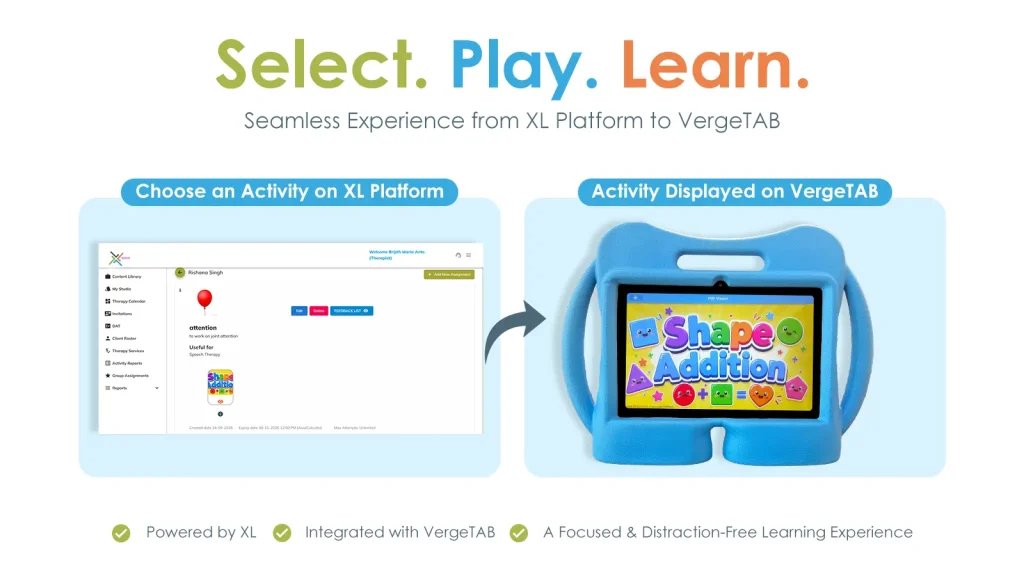
The XceptionalLEARNING Platform connects therapy planning, individualised learning goals, structured digital activities, and progress monitoring. Educators and therapists can assign activities aligned with a learner’s developmental and educational needs, while parents can support practice beyond therapy and classroom sessions.
When used as part of an appropriate educational or intervention programme, these digital resources provide additional opportunities for learners to practise skills and work towards their individual goals. Where included in a learner’s programme, assigned activities can be delivered through VergeTAB, a locked digital learning device powered by the XL Platform. It provides a focused environment for structured digital activities.
XceptionalLEARNING Platform screen showing activity selection and assignment aligned to a learner’s goals
Technology does not replace teaching. Used purposefully, it creates access, participation, and greater independence.
Related: How Interactive Digital Worksheets Can Make Special Education Classrooms More Engaging
7. Myth: Special Education Is Only About Academics and Marks
The Truth
Academic achievement matters, but it is only one part of a child’s development. Depending on the learner’s needs, education may also focus on:
- Communication
- Social skills
- Self-care and daily living skills
- Emotional regulation
- Motor development
- Functional academics
- Vocational skills
- Community participation
- Self-advocacy and independent decision-making
For many learners, meaningful progress looks like communicating a need, following a routine, making an independent choice, waiting for a turn, taking part in a group, improving handwriting, completing a self-care task, or trying a new activity.
Example
A child who once needed full help to finish a worksheet now completes three questions independently. Those three questions may represent a major developmental milestone. Likewise, teaching a student to identify money, follow a shopping list, and make a purchase may do more for future independence than memorising a formula.
Progress should be measured against the learner’s own journey, not only against a standard benchmark.
Related: Small Wins in Special Education: Why Every Step of Progress Matters | Why Special Education Is Important for Real-Life Skill Development in Children
8. Myth: Therapy Sessions Alone Are Enough
The Truth
Therapy is valuable, but children learn and practise skills throughout their daily lives. A speech therapist may teach communication skills, an occupational therapist may build functional abilities, and a special educator may work on academic and developmental goals. Skills become meaningful when children can practise them in everyday settings.
Parents, teachers, therapists, and caregivers each play an important part in this.
Example
A therapist teaches a child to request “water” using a word, sign, picture, or communication device. The skill can then be practised:
- During meals at home
- In the classroom
- During therapy
- During community outings
Repeated opportunities across settings help the child use the skill consistently.
Supporting Continuity Between Therapy, School and Home
The XceptionalLEARNING Platform supports continuity between therapy sessions, school activities, and home practice through individualised goals, assigned digital activities, and progress monitoring. This helps the professionals and families involved in a child’s development work towards shared learning objectives.
Clinics and hospitals can read more about this approach on our page for therapy clinics and hospitals, and you can see the full workflow on the XL Platform overview.
Specific therapy plans should always be designed by qualified professionals who know the child.
Therapy introduces and develops a skill. Everyday life gives the child chances to use it.
Related: Rehabilitation Begins at Home: The Role of Families in Long-Term Success
9. Myth: Challenging Behaviour Should Always Be Punished
The Truth
Behaviour often communicates something. A child may show challenging behaviour because of:
- Frustration
- Communication difficulties
- Sensory overload
- Difficulty understanding instructions
- Changes in routine
- Anxiety
- Fatigue
- Pain or discomfort
- Difficulty expressing a need
Punishment alone does not address the underlying reason. Instead, parents, educators, and caregivers can look at what happened before the behaviour, what the child may be trying to communicate, and what skill or support might help.
Example
A child repeatedly leaves the classroom when it gets noisy. Rather than simply punishing the child, the team can check whether the noise is overwhelming and consider supports such as a quieter space, visual supports, planned breaks, or communication tools.
Understanding why a behaviour happens helps us respond with more effective support.
Related: Positive Reinforcement in Special Education: Encouraging Learning and Positive Behaviour
10. Myth: Inclusive Education Only Benefits Children with Disabilities
The Truth
Inclusive education can benefit everyone. Children with disabilities gain participation, peer interaction, and a sense of belonging. Their classmates can develop empathy, cooperation, patience, communication skills, and respect for individual differences. The Salamanca Statement described regular schools with an inclusive orientation as the most effective means of combating discriminatory attitudes and building welcoming communities and an inclusive society.
Inclusive classrooms also show children that diversity is a natural part of society and that people learn, communicate, and participate in different ways.
Example
In a group project, each learner contributes according to their strengths. One child draws, another writes, another organises materials, and another presents. Everyone contributes differently, and everyone has something valuable to offer.
Inclusion teaches children that being different does not mean being less capable or less valuable.
11. Myth: Special Education Is the Teacher’s Job Alone
The Truth
Teachers play an essential role, but supporting a child with special educational needs works best as teamwork. A child’s support network may include:
- Parents and caregivers
- Special educators and general educators
- Therapists
- Psychologists
- Medical professionals
- School administrators
- Peers
- Community members
Each person brings different knowledge and perspective to support the child’s development. The Salamanca Statement calls for the participation of parents, communities, and organisations of persons with disabilities in planning and decision-making, and the 2023 WHO and UNICEF report calls for inclusive, multisectoral care systems for children with developmental disabilities.
Example
A special educator identifies an academic goal, a therapist suggests strategies for functional skills, parents share what works at home, and the classroom teacher adapts activities for regular practice. When everyone communicates and works towards shared goals, the child receives consistent support across environments.
A child’s progress is strongest when the people supporting them work together as a team.
Related: Why Multidisciplinary Collaboration Is Crucial in Neurodevelopmental Care
Looking Beyond the Myths
Breaking myths is not only about correcting information. It is about changing how we see, teach, communicate with, and support people with disabilities.
- Instead of asking, “What can’t this child do?” ask, “What can this child do, and how can we build on their strengths?”
- Instead of asking, “Why does this child need extra support?” ask, “What barriers can we remove to help this child participate and succeed?”
- Instead of asking, “Why is this child different?” ask, “How can we understand, respect, and support these differences?”
And instead of focusing only on what a child has not yet achieved, let us pause to recognise how far they have come and celebrate every meaningful step forward.
Creating a More Inclusive Future
Inclusion is not the responsibility of one person or one profession.
- It begins with families who believe in their children.
- It grows through teachers who adapt their teaching to diverse learning needs.
- It becomes stronger when therapists, families, and educators work together.
- It expands when technology removes barriers and creates access.
- It becomes meaningful when classmates offer friendship, understanding, and acceptance.
- It becomes sustainable when society creates spaces where everyone has the opportunity to participate.
Our responsibility is not to make everyone the same. It is to build a world where differences do not stop anyone from learning, belonging, contributing, or dreaming.
Conclusion
Special education is not about limitations. It is about possibilities.
- A diagnosis does not define a child.
- A learning difficulty does not define intelligence.
- A need for support does not mean a lack of potential.
- Using assistive technology does not mean giving up independence.
- Small progress is never insignificant.
Children take different routes toward learning and development, and different paths can still lead to meaningful progress and fulfilling lives. The most powerful change happens when we stop asking, “What can this child not do?” and start asking, “What can we do to help this child participate, learn, grow, and succeed?”
Every learner deserves more than an opportunity to learn. Every learner deserves to be seen, heard, respected, included, and encouraged to shine.
Frequently Asked Questions
Sources and Further Reading
- UNESCO (1994). The Salamanca Statement and Framework for Action on Special Needs Education. Used for: access to regular schools for children with special educational needs, investment in early identification and intervention, the role of inclusive schools in building inclusive communities, and participation of parents and communities.
- United Nations. Convention on the Rights of Persons with Disabilities, Article 24 (Education). Used for: the right to education, an inclusive education system, and reasonable accommodation.
- Government of India (2016). The Rights of Persons with Disabilities Act, 2016 (India Code). Used for: the definition of inclusive education (Section 2), duties of institutions and governments (Sections 16 and 17), and free education for children with benchmark disabilities (Section 31).
- Ministry of Education, Government of India (2020). National Education Policy 2020. Used for: inclusive education provisions for children with disabilities (Section 6.11).
- WHO and UNICEF (2023). Global Report on Children with Developmental Disabilities: From the Margins to the Mainstream (also available from UNICEF). Used for: barriers and inequalities faced by children with developmental disabilities, and the case for inclusive, multisectoral care systems.
This article is for general information and awareness. It is not a substitute for assessment or advice from qualified professionals.
More to Read
- Small Wins in Special Education: Why Every Step of Progress Matters
- What If We Saw the Person First?
- Empowering Parents at Home: Building a Structured Digital Learning Ecosystem for Children
- How Digital Therapy Platforms Improve Outcomes for Children with Special Needs
Ready to Support More Meaningful Learning?
Explore how the XL Platform connects therapy planning, individualised learning goals, structured digital activities and progress monitoring.