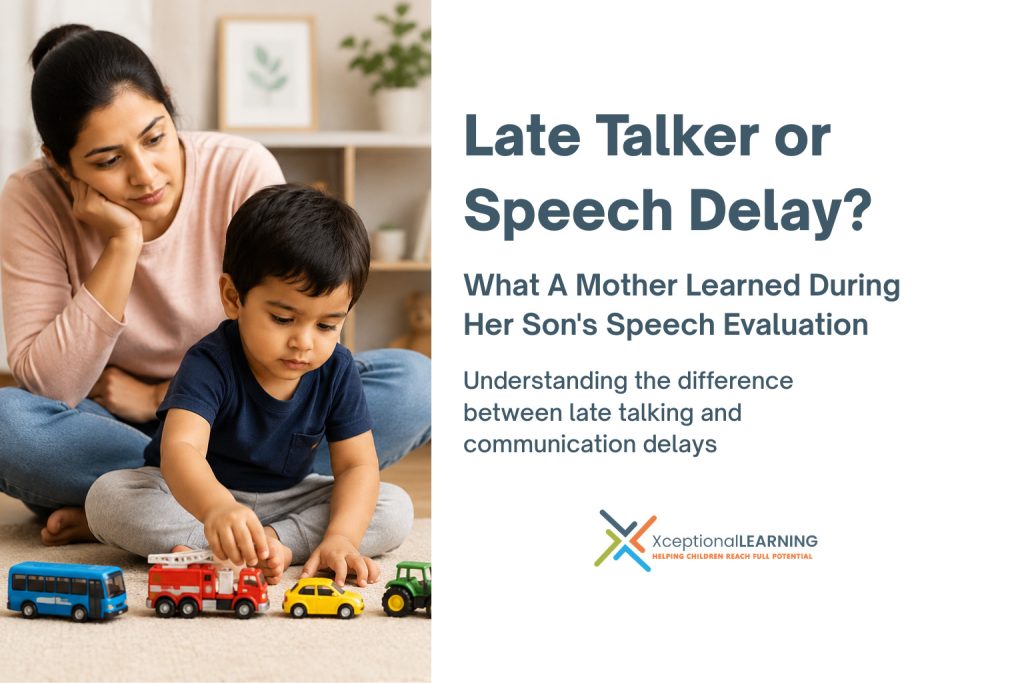
Late Talker or Speech Delay? What A Mother Learned During Her Son’s Speech Evaluation
admin June 23rd, 2026

Clinically Reviewed by
Elba Rose James
Speech Therapist
When Meera worried about her son’s speech, she thought the answer would be found in a milestone chart. Instead, a speech evaluation taught her that communication is about much more than words. Here’s what parents should know about late talking, speech delays, and the signs therapists look for.
“Everyone Told Me to Wait.”
The first thing Meera said when she sat down for her son’s speech evaluation was surprisingly simple: everyone had told her to wait.
For nearly a year, she had heard the same advice from relatives, neighbours, friends, and even strangers at family gatherings — that boys talk late, that she shouldn’t worry, that their own sons hadn’t spoken properly until age three, and that one day he would start talking and never stop.
At first, those comments helped. They gave her permission to believe everything was fine.
After all, her son Arjun, at just over two years old, seemed bright in so many ways. He could identify almost every vehicle on the road. He knew the difference between a bus, a lorry, a tractor, and a van long before most children his age. If Meera mentioned going outside, he ran straight to the front door. If she asked him to bring his shoes, he usually returned with the correct pair.
He understood far more than he could say, and that was exactly what confused her. If he understood so much, why did communication still feel difficult?
Every evening before dinner, Arjun lined up his vehicles across the living room floor. The blue bus always came first. The red fire engine had to be next. If one was moved out of place, he quietly put it back before continuing his game.
When he wanted something, he rarely used words. Instead, he would take Meera by the hand and lead her to whatever he needed. If a toy had rolled under the sofa, he would point toward it and make sounds, expecting her to understand.
Sometimes she understood immediately. Other times she didn’t, and both of them ended up frustrated.
One evening, Arjun stood beside a shelf reaching toward something he wanted. Meera handed him a toy car. He pushed it away. She offered another vehicle. Again, he shook his head. Within moments, both of them were frustrated. Arjun began to cry, and Meera found herself trying to solve a puzzle without enough clues.
Moments like that happened more often than people realised.
To relatives, Arjun seemed perfectly fine. They saw a bright little boy who understood instructions, recognised objects, and enjoyed playing. What they didn’t see were the small communication struggles that filled ordinary moments at home.
It wasn’t that Arjun wasn’t communicating. He was. He pointed. He gestured. He looked toward things he wanted. He pulled his mother’s hand when he needed help. But there were still many times when he couldn’t clearly express what he was thinking, and those moments left both of them frustrated.
The concern didn’t appear overnight. It grew slowly over months. Every time Meera watched children his age chatting with their parents, she found herself wondering whether she was worrying unnecessarily or missing something important.
She had no intention of seeking a diagnosis. She had no intention of labelling her child. All she wanted to know was whether Arjun was just a late talker or if there was more going on. This question had been silently haunting her for months.
It Was Never Really About the Number of Words
As many parents worried about a possible speech delay, Meera became focused on milestones. She searched online late at night, compared developmental charts, and read countless parenting forums.
Some sources reassured her, while others made her worry more. One article suggested waiting, while another recommended seeking professional advice.
The more information she found, the less certain she became.
What frustrated her most was that Arjun didn’t seem to fit neatly into any category. He understood instructions, recognised familiar objects, and appeared bright and engaged. Yet communication still felt harder than it should have.
Eventually, Meera realised she wasn’t looking for another article or milestone chart. She was looking for clarity. She wanted someone trained in child communication to help her understand whether Arjun was simply developing at his own pace or whether he needed additional support.
That decision led her to schedule a speech evaluation — one that would change the way she thought about communication altogether.
A Birthday Party Changed What She Noticed
A few weeks before the evaluation, Meera took Arjun to a birthday party. Most of the children were around his age, and for much of the afternoon, she watched them play while chatting with other parents.
At first, nothing seemed unusual. The children ran across the garden chasing balloons, climbed over play equipment, and crowded around the snack table whenever treats appeared.
Then a small moment caught her attention.
Someone had brought a bubble machine, and suddenly, dozens of bubbles drifted across the yard. One little boy spotted them and immediately pointed toward the sky. Then he turned to his mother with a huge smile on his face before pointing again. His mother laughed and told him she could see them too, and the boy smiled even wider and continued watching the bubbles float overhead.
It lasted only a few seconds, but Meera found herself thinking about it on the drive home. At a traffic signal, she glanced in the rear-view mirror and saw Arjun quietly watching the vehicles passing by.
Arjun noticed interesting things all the time. He could spend several minutes watching a bird on a fence or tracking a large lorry as it moved down the road. He loved anything that moved.
But as she replayed the afternoon in her mind, she realised something she had never consciously noticed before. When Arjun saw something interesting, he usually enjoyed it on his own. He watched carefully and paid close attention, but he rarely turned to someone else as if to say, did you see that too?
The little boy at the party had been so eager to share what he saw. The comparison stayed with her long after the party ended. She couldn’t explain why it felt important, but it was one more observation she couldn’t quite dismiss.
The Evaluation Wasn’t What She Expected
When the day of the evaluation arrived, Meera expected something that looked like a test. She imagined flashcards, questions, and perhaps someone keeping track of how many words Arjun could say.
Instead, the speech therapist sat down on the floor and pulled out a box of toys.
For the first few minutes, it hardly looked like an assessment at all. A toy car rolled across the room. Arjun chased after it and pushed it back. They looked through a picture book together. A tower of blocks was built, knocked over, and built again.
As the session continued, Meera found herself wondering when the actual evaluation would begin. Then she realised it already had.
While Arjun played, the therapist was paying attention to things Meera had never thought to watch for. She noticed how he responded when someone tried to engage him in a game. She watched whether he looked between an object and another person. She observed how he communicated when he needed help or wanted something to continue.
At one point, Arjun happily pushed a toy car back and forth with the therapist several times. He was clearly enjoying himself. The therapist smiled and made a quick note. Meera wasn’t entirely sure why. To her, it looked like ordinary play, but the therapist was gathering information from every interaction.
A little later, the therapist asked a question that caught her by surprise — whether Arjun pointed to show her things. The question seemed simple, and Meera replied that of course he did: he pointed at snacks he wanted, toys that were out of reach, and anything else he needed.
But as the conversation continued, she realised that wasn’t quite what the therapist meant. What the therapist was asking was something more specific: did he point to things he found interesting, and then look back at Meera to see if she was watching too?
Meera paused.
She thought about the birds Arjun loved watching from the window. She thought about the buses and lorries that captured his attention whenever they passed by. He definitely noticed those things. But did he try to share them? She wasn’t sure.
The therapist explained that communication begins long before children speak in full sentences. Sometimes the most important moments are surprisingly small — a child pointing at an aeroplane, looking back at a parent, and silently inviting them to share the experience.
As she listened, Meera found herself thinking back to the birthday party a few weeks earlier and the little boy excitedly pointing at the bubbles. For months, she had been focused on words. The therapist was looking at the bigger picture of communication.
What Speech Therapists Often Notice Before Parents Do
As the evaluation continued, Meera began to understand why simply counting words doesn’t tell the whole story.
The therapist wasn’t focused on how many words Arjun could say. Instead, she paid attention to dozens of small interactions that most parents would never think to measure. She watched how he tried to get someone’s attention during play, whether he looked toward another person when something interesting happened, how he communicated when he needed help, and whether he naturally used gestures or copied actions demonstrated by others.
To Meera, many of these moments seemed ordinary. To the therapist, they provided important clues about how communication was developing.
That was one of the biggest surprises of the evaluation: speech therapists don’t evaluate only speech. They evaluate communication.
Two children can have a similar number of words but communicate in very different ways. One child may actively seek interaction, share experiences, and use gestures confidently, while another may rely on adults to interpret their needs. Looking at vocabulary alone rarely tells the full story.
In some children, speech difficulties are not always related to vocabulary alone but may involve motor planning and speech coordination challenges that require a different therapeutic approach.
“But He Understands Everything”
This was one of the comments Meera heard most often from family members — that if he understood everything, he was probably fine.
And in many ways, they had a point. Arjun understood a lot. He followed familiar routines, recognised everyday objects, and usually knew what people were asking him to do. Those were all encouraging signs.
But during the evaluation, Meera learned something she had never fully considered: understanding language and expressing language are not the same thing.
A child may understand far more than they can communicate. In Arjun’s case, that gap was part of what made everyday situations so frustrating. He often knew what was happening around him and understood what others were saying, but expressing his own thoughts, needs, and experiences was much harder.
That is why speech therapists evaluate both understanding and expression. Looking at only one side of communication can leave important pieces of the picture unexplored.
So, Was Arjun a Late Talker or Was It Something More?
This was the question Meera had been carrying for months.
The answer, she learned, wasn’t based on a single milestone or a specific number of words.
Some children speak later than expected but continue to show strong communication skills in other ways. They use gestures naturally, seek interaction, share experiences, and find ways to connect with the people around them, even before their vocabulary grows.
For other children, the challenges extend beyond speech itself. Difficulties with gestures, interaction, imitation, play, or social communication can provide important clues about how communication is developing.
That is why evaluations focus on the whole child rather than a single milestone. Rather than asking how many words a child can say, therapists work to understand how that child communicates overall.
Three Months Later
Three months after the evaluation, Meera noticed something she hadn’t expected. She had stopped counting words.
For nearly a year, every new word had felt important. She tracked them mentally and compared them to milestones she found online. Now she was noticing different things.
Arjun brought books to her and waited for her to read with him. When he needed help, he looked toward her instead of struggling alone. During walks, he pointed excitedly at birds, buses, and aeroplanes.
Sometimes, after pointing, he looked back at her as if to make sure she was seeing them too.
The moments were small, and most people probably wouldn’t have noticed them. Meera noticed everything.
Communication was becoming easier. The words were still developing, but something else was growing alongside them: connection.
For the first time in a long while, she felt she understood what the therapist had been looking for all along.
Why Waiting Isn’t Always the Best Plan
Some children are simply late talkers. Others benefit from early support. The challenge is that parents rarely know which situation applies by reading milestone charts or comparing their child to others.
That was exactly where Meera found herself. She wasn’t looking for someone to predict the future. She was looking for clarity.
A speech evaluation doesn’t automatically mean therapy will be recommended. Sometimes families leave reassured. Sometimes they receive practical strategies to support communication at home. Sometimes additional support is advised.
In every case, the goal is the same: to better understand a child’s communication strengths, challenges, and developmental needs. And that understanding often replaces months of uncertainty with confidence.
Research and clinical practice continue to highlight the value of early intervention and structured communication opportunities during the early years of development.
Supporting Communication at Home
One of the most reassuring things Meera learned was that communication development doesn’t happen only during therapy sessions.
Many opportunities already exist in everyday life — while reading books, sharing meals, taking walks, or playing together. These simple interactions help children learn how to express needs, share experiences, ask for help, and connect with others.
Parents play the most important role in this process. Consistent, meaningful interaction throughout the day often creates powerful opportunities for communication growth.
For families seeking additional support, structured learning tools such as XceptionalLEARNING and VergeTAB can complement everyday experiences by providing engaging activities that reinforce communication, listening, and language skills alongside professional guidance.
See Communication Growth in Action
Parents often ask what meaningful communication progress actually looks like in everyday life.
The video below features Speech-Language Pathologist Chinnu Thomas and highlights how structured intervention, engagement-focused activities, and technology-supported learning experiences can help children strengthen communication skills over time.
Final Thoughts
Months earlier, Meera believed the most important question was how many words her child should be saying. The evaluation taught her to ask a different question: how is my child communicating?
That shift changed everything.
For months, she had focused on milestones and word counts. What she eventually learned was that understanding communication involves much more than measuring vocabulary alone.
Some children are simply late talkers. Others benefit from additional support. The value of a speech evaluation is not in predicting the future but in helping families better understand where a child is today.
For Meera, that understanding replaced uncertainty with confidence. And for many families, it can be the first step toward helping a child communicate, connect, and thrive.
Concerned About Your Child’s Communication Development?
If you’re wondering whether your child is simply a late talker or whether a speech delay may benefit from professional guidance, a speech and language evaluation can provide valuable insight into your child’s communication strengths and needs.