Parent-Teacher Collaboration in Special Education: How Families and Teachers Can Work Together
admin October 7th, 2026

Written by Anjuna.M
Special Educator
Every child learns in their own unique way. For children with diverse learning needs, learning is not limited to the classroom. It happens through communication, play, daily routines, social interaction, technology, and meaningful experiences at home and in the community.
This is why strong parent-teacher collaboration is one of the most important parts of special education. When parents and teachers work together, they create a consistent and supportive learning environment where children can build skills with greater confidence and independence.
Parents and Teachers: Two Perspectives, One Goal
Teachers spend time observing children in the classroom and understand their learning patterns, strengths, challenges, and educational needs. Parents know their child beyond the classroom: their interests, routines, preferences, communication styles, and everyday experiences.
When these two perspectives come together, teachers gain a more complete understanding of the child. Regular communication lets both sides share what is working, identify challenges early, and see how a child responds to different strategies across environments.
What Effective Collaboration Looks Like
Effective collaboration is more than occasional updates. It involves regular two-way communication, shared goals, and a willingness to understand the child’s needs across different settings.
Parents and teachers can collaborate by:
- Sharing observations about the child’s strengths, interests, and challenges
- Discussing strategies that work at home and at school
- Setting clear, realistic goals together
- Keeping important routines and expectations consistent
- Communicating changes that may affect the child’s learning or participation
- Reviewing progress and adjusting strategies when needed
Collaboration does not mean using exactly the same methods everywhere. Parents and teachers can work toward the same goals while adapting strategies to each environment. The strongest collaboration is a two-way process: teachers bring educational expertise, and parents bring deep knowledge of their child.
Active Parent Involvement Makes Learning More Meaningful
Parent involvement goes beyond attending meetings or reading updates. Parents can be active partners in the learning journey.
Simple activities at home, such as counting household objects, identifying colours, practising communication, following daily routines, or building self-care skills, can reinforce what a child learns at school. When parents understand the child’s learning goals and the strategies teachers are using, everyday moments become natural practice opportunities. This creates continuity between school learning and real-life learning.
PRACTICAL TIP
Choose One Skill to Practise at Home
Instead of trying to practise everything, choose one skill that is currently being worked on at school. Ask the teacher how the skill is being practised, then look for one simple opportunity to use it during an everyday routine at home.
Example: If the goal is requesting help, create a natural opportunity for the child to request help while preparing a meal, getting dressed, or completing a household task.
Consistency Between Home and School
Children often find it easier to use and generalise new skills when they meet connected expectations and strategies across different environments.
For example, if a child is encouraged to request help using a word, picture, gesture, or AAC (Augmentative and Alternative Communication) at school, the same opportunity can be encouraged during everyday activities at home. Similarly, a child learning to follow a visual sequence for a classroom routine may benefit from visual supports for routines at home.
Consistency does not mean making home and school identical. It means creating connected opportunities to practise and use skills in different places.
HOME–SCHOOL CONNECTION
A simple way to strengthen collaboration is to connect one school goal with one everyday opportunity at home.
School goal: Following a visual sequence
Home opportunity: Use a visual sequence for getting ready in the morning
School goal: Communication
Home opportunity: Encourage the child to request a preferred item
School goal: Counting
Home opportunity: Count objects during a daily routine
Technology Can Connect the Classroom and Home
Digital learning gives children access to interactive, visual, and engaging experiences that can be adapted to their individual needs. It can also help bridge the gap between teachers and parents, so learning no longer stays within the four walls of the classroom.
When teachers use digital activities to target specific learning goals, parents can better understand which skills are being practised and create similar opportunities in daily life. This is especially valuable for children who benefit from visual learning, repetition, interactive activities, and personalised experiences.
Platform in Action: Connecting Goals, Activities and Progress
XceptionalLEARNING brings different parts of the learning and intervention journey into a connected workflow. From understanding the learner’s profile and assessment findings to setting goals, planning intervention, delivering structured activities and reviewing progress, the platform helps professionals organise support around individual needs.
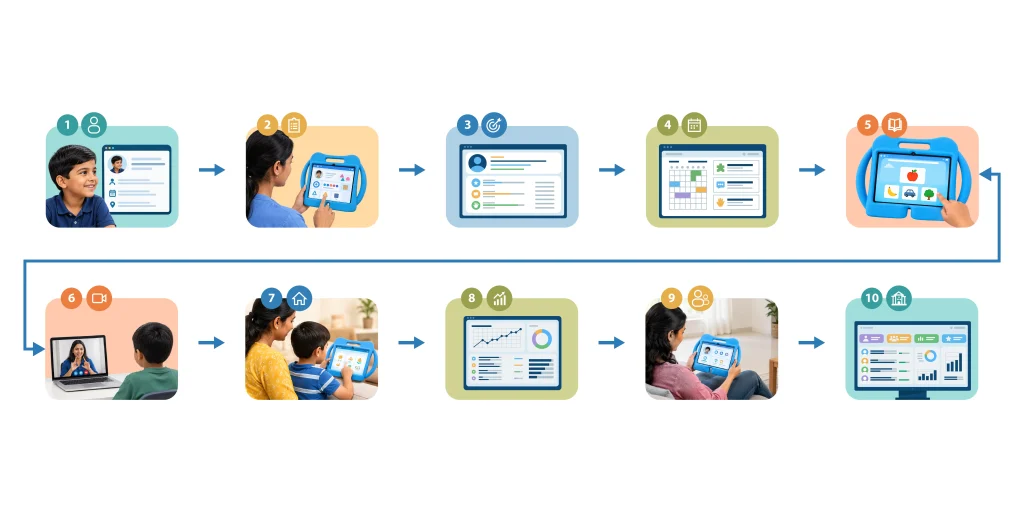
The workflow can be adapted to each learner’s needs, and not every learner will follow every step in this order.
This connected workflow can help maintain continuity between intervention, home practice and progress review. Parents can gain greater visibility into relevant learning goals and activities, while teachers and therapists can use observations and progress information to review learning and adjust support plans when appropriate.
Digital Learning with XceptionalLEARNING and VergeTAB
Digital tools can help connect classroom learning with practice at home when they are used as part of a structured learning approach. Through the XceptionalLEARNING Platform, educators can plan learning activities around individual goals and assign structured digital activities for children to practise.
VergeTAB, the locked digital learning device powered by the XceptionalLEARNING Platform, provides controlled access to these activities without the distractions of general-purpose device use.
Here is how that can look in practice:
A teacher assigns a counting activity through XceptionalLEARNING as part of a child’s number-recognition goal. At home, the parent, aware of the goal, invites the child to count spoons while setting the table or count steps on the way to the door. The parent can then share observations from home, helping the teacher understand how the child is applying the skill beyond the classroom.
For teachers, XceptionalLEARNING provides a structured way to plan and assign digital activities according to a child’s individual goals. For parents, understanding the learning goals and activities being worked on can make it easier to create meaningful practice opportunities at home.
The value of technology is not simply in the device. It is in how the platform, device, educators, and families work together to support the child’s individual learning journey.
Connecting Parents, Teachers, and Children
A successful digital learning ecosystem brings together three partners:
- The teacher plans and supports learning.
- The parent understands everyday life and extends learning beyond school.
- The child remains at the centre of the entire process.
When these three work together, technology becomes a bridge rather than a barrier. Teachers share learning objectives and observations; parents share feedback on interests, responses, and progress at home. This two-way exchange helps teachers make better-informed decisions and adapt learning to the child.
Individual Goals, Not One-Size-Fits-All Learning
Every child is different, so collaboration should focus on individual goals rather than comparing one child with another. A goal might be to recognise numbers, communicate a need, follow a simple instruction, improve social interaction, develop motor skills, or complete a daily living activity independently. When parents and teachers identify meaningful goals and support them consistently, children have more opportunities to practise and apply their skills.
When Collaboration Is Challenging
Parents and teachers will not always see things the same way. A child may behave differently at home and at school, or a strategy that works in one place may not work in another. These differences can become opportunities for discussion rather than conflict.
By listening to each other and keeping the focus on the child’s needs, families and educators can find practical solutions together. The goal is not to decide who is right, but to understand what will best support the child.
Celebrating Progress Together
Progress can look different across settings. A skill shown at school may later appear at home, and a strategy that works at home may help a child participate more successfully at school. Sharing these moments lets parents and teachers recognise progress together and spot the next opportunity for practice.
3 Ways to Start This Week
- Start a shared communication notebook or message thread. Exchange one short note a week: something that went well and something to watch.
- Schedule a brief goals check-in. Agree on one or two priority goals and how each side will support them.
- Link one home activity to one school goal. If the goal is counting, count objects during a daily routine. If it is communication, create one extra chance to request something.
Collaboration Creates a Stronger Future
Parent-teacher collaboration is not just about exchanging information. It is about building shared understanding, shared responsibility, and a shared vision for the child.
Technology can make this collaboration more accessible, but the foundation remains human connection. A device or platform can support learning, but a parent’s encouragement and a teacher’s guidance give that learning its purpose.
The most effective special education journey is one where parents are not merely observers, teachers are not working alone, and technology is not just a tool, but where everyone works together as a team. Ultimately, the goal is not simply to teach a child what to learn, but to help them discover how they can learn, communicate, participate, and become more independent in their own world.
“When parents, teachers, and technology work together, learning moves beyond the classroom and becomes a part of everyday life.”
Explore Structured Learning with XceptionalLEARNING
See how XceptionalLEARNING helps educators and therapists organise learning and intervention around individual goals, structured activities, home practice, and progress review.