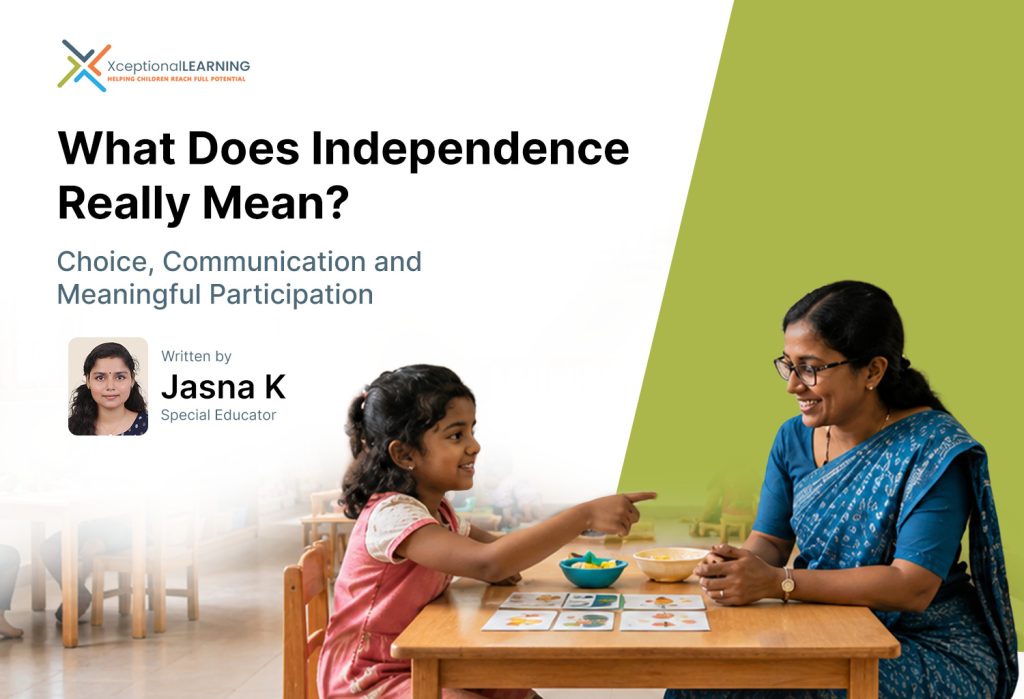
Beyond Doing It Alone: What Independence Really Means for Children with Special Needs
admin November 18th, 2026

Written By:
Jasna K
Special Educator
Rethinking independence through communication, decision-making, support, and meaningful opportunities.
1. The Independence We Think We See
Imagine two children.
The first child can dress without help but struggles to communicate discomfort, express preferences, or ask for help when needed.
The second child needs physical assistance to get dressed but can choose what to wear, show when something feels uncomfortable, and tell an adult what they prefer.
Which child is more independent?
Many of us instinctively choose the first, because that child completes the task without assistance. But this overlooks something important about the second child: the capacity to influence what happens in their own life.
For children with special needs, independence is often measured by how much they can do without help. Dressing, eating, personal hygiene, travelling, and vocational skills are important goals that expand a child’s opportunities. But completing a task alone is only one part of the picture. We must also ask whether children can express preferences, make decisions, and take part in the activities that affect them.
2. The Skills Are Not the Problem. The Measuring Tool Is.
Functional skills remain essential. The concern is not that we teach children everyday activities, but that we may miss other forms of progress when task completion becomes our only measure.
Consider a child learning to complete a classroom activity. Progress might mean finishing it with less assistance. It might also mean choosing which activity to attempt, saying that it is too difficult, or asking for help before continuing. These forms of progress complement functional-skill learning by recognising growth in both performance and participation.
Independence and autonomy are related, but not the same
- Independence is the ability to perform activities, manage everyday situations, and carry out tasks with as much self-direction as possible.
- Autonomy is having a meaningful say in decisions that affect one’s life.
Independence
What a child can do.
Autonomy
How much say a child has in what happens.
Both matter when supporting meaningful participation.
The two overlap, but a child may develop them at different rates and may need support in either area. This distinction echoes a long line of work on self-determination in disability education, which stresses that people with significant support needs can still act as causal agents in their own lives (Wehmeyer, 1998). It also reflects the UN Convention on the Rights of Persons with Disabilities (CRPD), which affirms that children with disabilities have the right to express their views freely on matters affecting them, with disability- and age-appropriate assistance to do so (UN CRPD, 2006, Article 7(3)). India’s Rights of Persons with Disabilities Act, 2016 was enacted to give effect to that Convention.
What progress beyond task completion looks like
The following is a composite example, drawn from common practice in special education settings rather than a single identifiable child.
A child needs physical assistance to get dressed. Each morning, an adult selects the clothes and helps the child complete the routine. Because the priority is getting ready on time, the child has few chances to take part in decisions.
The adult begins offering two suitable clothing options, allowing the child extra time to respond, and paying closer attention to the child’s communication. The child indicates a preference and signals discomfort when an item feels unpleasant. The adult respects these responses while continuing to give the physical help the child needs.
The child has not suddenly learned to dress independently. But the routine has changed: the child now has a more active role in deciding what to wear and communicating personal needs.
A child’s support needs may stay the same even as their opportunities for autonomy grow.
For educators, this means looking beyond whether a task was completed. We can also ask:
- Did the child have a chance to express a preference?
- Could the child request help or a break?
- Could the child communicate discomfort?
- Did the child influence the activity in a meaningful way?
3. What Creates Dependence, and What Makes Participation Possible?
A child’s need for assistance may arise from physical, cognitive, sensory, communication, or learning-related difficulties. Some support needs may last throughout life. But the way adults organise activities can either add barriers or make participation more accessible.
A child who does not use speech may struggle to answer when only spoken responses are accepted. A child who needs more processing time may miss the chance to choose if the adult moves on too quickly. And when adults routinely make every decision, children have fewer chances to practise deciding.
| Practices that may limit participation | Practices that can support participation |
|---|---|
| Making every decision for the child | Offering meaningful, accessible choices |
| Completing tasks too quickly on the child’s behalf | Allowing time to attempt, respond, and participate |
| Expecting communication only through speech | Recognising the child’s available communication methods (gestures, pictures, eye gaze, devices, and other forms of augmentative and alternative communication) |
| Treating help as a sign of failure | Providing assistance while respecting the child’s preferences |
| Offering choices but disregarding the response | Considering the child’s views and explaining genuine limits |
Choices have limits, and that is okay
Offering a choice does not mean every preference can always be followed. Safety, health, and practical circumstances may limit what is possible.
Example: On a rainy day, a child may not be able to choose between a jacket and no jacket. But the child can still choose the colour of the jacket, and an adult can explain, in a way the child understands, why a jacket is needed today. The limit is real, and the child’s voice is still counted.
What matters is that a child’s views are considered rather than automatically overlooked.
Nor should necessary assistance be withdrawn to make a child appear independent. Some children will need substantial support throughout their lives. The goal is to build functional abilities wherever possible, while ensuring that support enables participation rather than unnecessarily limiting it.
Support is not the opposite of independence.
A child may continue to need physical, communication or learning support while developing the ability to express preferences, make decisions and participate in everyday activities.
The goal is not to remove necessary support, but to make participation possible.
Try this tomorrow
For educators
- Offer two clear choices at least once in every routine (activity, seat, material, or order of tasks).
- Count to ten silently after asking a question or offering a choice before stepping in.
- Accept and respond to every communication method the child uses, not only speech.
- Teach a simple way to ask for help or a break, such as a card, a gesture, or a word.
For parents
- Use everyday routines such as meals, bath time, and getting dressed to offer small choices (which cup, which towel, which song while brushing teeth).
- Notice how your child shows “yes,” “no,” “more,” and “stop,” even without words, and respond consistently.
- Let your child try a step before you help, and help in the way your child prefers.
- When you must say no (for safety or time), say why in simple words, and offer another choice if you can.
The question is not simply whether a child can complete a task alone, but whether the child has the support and opportunity to take part as meaningfully as possible.
4. Technology Can Help, but Only When It Connects to Real Life
Digital learning can give children additional ways to practise skills, explore concepts, and engage with learning materials. When activities are designed around children’s needs, they can complement classroom teaching and functional learning.
Here is how that might look in practice. Suppose a child works on a digital activity about choosing suitable clothes for different weather. The educator can then carry the learning into the daily routine:
- The child practises matching clothing items to weather on the screen.
- The next morning, the adult shows two real options that suit the day’s weather.
- The child indicates a choice using speech, pointing, a picture card, or another available method.
- Over time, the child takes a more active role in each step of getting dressed.
The educational value does not come from technology alone. It depends on how the activity is designed, how adults support the child, and whether the learning connects with everyday experiences. Selecting an answer on a screen is not the same as making a meaningful decision in daily life. Digital practice must be paired with responsive teaching, accessible communication, and real-world chances to apply skills.
This is the thinking behind our work at XceptionalLEARNING. Through the XL Platform, structured digital activities can complement individual learning goals and classroom instruction. VergeTAB, a locked digital learning device powered by the XL Platform, is designed to support that structured learning alongside educator-led teaching and everyday practice. The device is only the starting point: the real learning happens when the educator carries the activity into the child’s day.
Explore Structured Digital Learning
Discover how structured digital activities can complement individual learning goals and support continuity between learning and everyday experiences.
For educators and content developers, this raises an important question: How can learning resources help children apply what they learn to participate more meaningfully in everyday life?
5. Independence Must Include the Opportunity to Choose
Independence is not a single destination reached when assistance is no longer needed. It involves developing skills, accessing appropriate support, and having opportunities to influence everyday experiences.
Some children will gradually learn to complete activities with less help. Others will continue to need substantial support while developing their ability to express preferences, make decisions, and take part in daily life. Many will experience both kinds of progress.
Recognising these differences does not lower expectations. It helps us set more meaningful ones.
Choice-making is not a replacement for skill-building. The two grow best together: skills widen what a child can do, and autonomy ensures the child has a say in what they do and how.
Perhaps the true measure of independence is not how little help a child needs, but how effectively the child can take part in and influence their own life.
Because independence is not only the ability to do things alone. It is also the opportunity to have a say, even when you cannot do everything on your own.
Put It into Practice
Start small. Choose one everyday routine this week, offer one meaningful choice, allow time for a response, and notice how your child or student communicates their preference.
Whether you are a parent, educator or therapist, remember that meaningful independence develops through everyday opportunities to make choices, express preferences and participate with the support a child needs.
Small opportunities for choice can make a meaningful difference in a child’s everyday experiences.
Supporting Meaningful Learning and Independence
Every child deserves opportunities to learn, communicate, make choices and participate meaningfully in everyday life.
XceptionalLEARNING supports educators, therapists and families through structured digital learning resources and technology-enabled solutions for special education and therapy.
Further reading
- Wehmeyer, M. L. (1998). Self-determination and individuals with significant disabilities: Examining meanings and misinterpretations. Journal of the Association for Persons with Severe Handicaps, 23(1), 5-16. https://doi.org/10.2511/rpsd.23.1.5
- Ryan, R. M., & Deci, E. L. (2000). Self-determination theory and the facilitation of intrinsic motivation, social development, and well-being. American Psychologist, 55(1), 68-78. https://doi.org/10.1037/0003-066X.55.1.68
- United Nations. (2006). Convention on the Rights of Persons with Disabilities, Article 7: Children with disabilities. Paragraph 3 covers the right of children to express their views and receive appropriate assistance to do so.
- United Nations. (2006). Convention on the Rights of Persons with Disabilities, Article 12: Equal recognition before the law. A separate provision, concerned with legal capacity and supported decision-making, which is relevant background for the long-term goal of autonomy but is not the same right as Article 7.
- Government of India. (2016). The Rights of Persons with Disabilities Act, 2016 (Act No. 49 of 2016). India Code, official text.
About XceptionalLEARNING: XceptionalLEARNING develops digital learning resources and technology-enabled solutions for special education and therapy, supporting educators, therapists and families in structured learning and intervention.