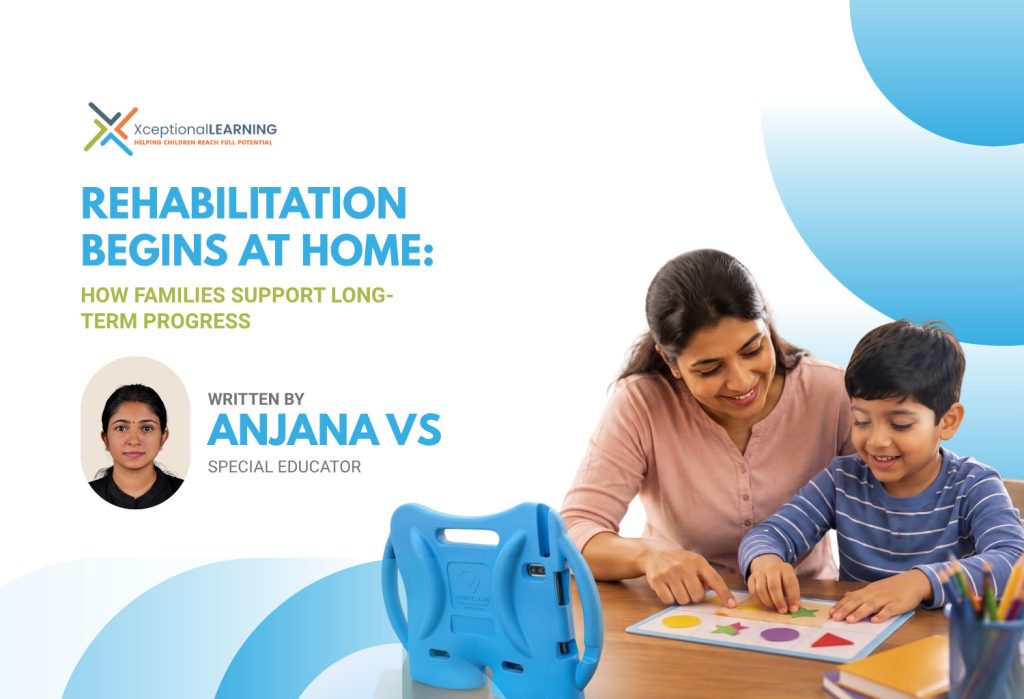
Rehabilitation Begins at Home: The Role of Families in Long-Term Success
admin September 2nd, 2026

Written By Anjana VS
Special Educator
Why Family Involvement Is the Missing Piece in Sustainable Rehabilitation
Rehabilitation is often imagined as something that happens inside therapy rooms, hospitals, or specialized centres, with trained therapists guiding people through carefully designed exercises, speech sessions, or occupational activities. These professional services are essential, but they represent only a fraction of a person’s rehabilitation journey.
The real transformation happens beyond clinic walls.
Every conversation at the dinner table, every encouraging smile after a difficult task, every patiently repeated instruction, and every small victory celebrated at home contributes to rehabilitation. Families aren’t simply caregivers. They’re partners, motivators, teachers, and emotional anchors. They create the environment where therapeutic skills become everyday habits and where confidence grows through consistent encouragement.
Whether rehabilitation is for a child with developmental disabilities, an adult recovering from a stroke, or someone managing a neurological condition, long-term success depends heavily on what happens after formal therapy ends.
Rehabilitation Doesn’t End with Therapy
Even when a child receives regular therapy, most of their day is spent outside the therapy setting. Those everyday hours hold countless natural opportunities to practise and reinforce what’s learned during intervention.
Therapists introduce strategies and goals. Families provide the everyday opportunities to put them into practice. A mealtime can strengthen communication. A household chore can improve motor skills. An outing can build social confidence. Rehabilitation becomes truly effective when skills learned in therapy carry over into daily routines.
Professional therapists bring specialized knowledge. Families bring something equally valuable: continuous presence. Parents, siblings, and caregivers witness challenges no professional could observe in a limited appointment. They understand routines, interests, fears, and motivations, which lets them reinforce therapy in ways that stick.
Families contribute by:
- Encouraging independence instead of completing every task
- Creating structured daily routines
- Celebrating small achievements
- Providing emotional reassurance and consistency in therapy goals
- Helping children generalise learned skills into real-life situations
- Sharing observations about what works and what is still challenging at home
The strongest outcomes happen when therapists and families work toward common goals together.
Small Daily Moments Create Big Progress
Progress doesn’t only happen during formal exercises — everyday routines offer natural practice opportunities:
- Breakfast: Practising requests using words, signs, or communication devices
- Dressing: Building fine motor skills through buttons and zips
- Play: Developing problem-solving, attention, and social interaction
- Shopping: Reinforcing money concepts, communication, and community awareness
- Cooking: Learning sequencing, measurement, and sensory exploration
The goal isn’t to turn every family activity into a therapy session — it’s to recognise the everyday moments that can naturally reinforce therapeutic goals.
Everyday Routines Can Reinforce Skills
| Everyday Moment | Skills Supported |
|---|---|
| Breakfast | Communication and Requesting |
| Dressing | Fine Motor Skills and Independence |
| Play | Problem-Solving and Social Interaction |
| Shopping | Communication and Community Skills |
| Cooking | Sequencing and Following Instructions |
Emotional Support Accelerates Recovery
Rehabilitation isn’t only physical or cognitive. It’s deeply emotional too. Children may feel discouraged when they can’t communicate effectively, while adults recovering from injury may experience anxiety or reduced confidence.
A supportive family provides patience during setbacks, encouragement after challenges, and a safe environment where mistakes are treated as part of learning. When people feel understood, they’re more willing to keep practising and trying new skills. That consistent encouragement can be what keeps someone motivated throughout a long rehabilitation journey.
Consistency Makes Rehabilitation Successful
Consistency doesn’t mean spending hours on formal therapy at home. It means using agreed strategies regularly and building practice into everyday routines. Imagine learning a new language by practising only once a week. Progress would be slow. Rehabilitation works in much the same way.
Families help maintain consistency by following therapy recommendations, scheduling regular practice, reinforcing positive behaviours, tracking improvements, and sharing meaningful observations with professionals. This is what helps a person use learned skills across different people, places, and situations.
Supporting Independence in Everyday Life
Families naturally want to help, but excessive assistance can unintentionally reduce opportunities for growth. Rehabilitation encourages providing the right level of support and gradually stepping back as independence develops:
- Instead of feeding a child immediately, encourage them to hold the spoon independently
- Instead of answering every question, allow extra time for communication
- Instead of completing an assignment for a child, guide them through each step
Families can prompt when needed and reduce assistance as confidence builds. Every independent success becomes a stepping stone toward long-term self-reliance.
Communication Between Families and Professionals Matters
Therapists observe performance during sessions; families observe it in real life. Combining both perspectives helps professionals understand how skills are actually being used outside the clinic — and lets them modify goals, address challenges, and suggest practical activities accordingly.
Open communication also lets families ask questions instead of implementing strategies without enough guidance. Knowledge empowers participation.
Using Digital Tools to Support Home Practice
Digital tools can make learning resources and guided activities more accessible beyond formal therapy sessions. However, technology is only one part of effective home-based support. Interactive activities, digital assessments, and visual supports can help families reinforce selected goals, and children often respond well to engaging digital experiences that combine learning with motivation.
Technology should never replace human relationships. It works best as a supportive tool within a broader family–professional partnership.
How XceptionalLEARNING Supports Family-Centered Rehabilitation
Families often want to support their child’s learning at home but aren’t always sure how to reinforce goals in an engaging, structured way. XceptionalLEARNING can help bridge professional guidance and home practice by providing digital learning resources that support a child’s educational and developmental goals.
The focus stays on collaboration: professionals guide the goals and strategies, while families support the opportunities to practise them in everyday life. This includes:
- Structured learning activities — educators and therapists select appropriate digital activities to reinforce specific skills
- Engaging home practice — interactive activities make repetition of targeted concepts more motivating
- Parent participation — when families understand the purpose of an activity, they can offer encouragement and prompts without stepping into the professional’s role
- Continuity across environments — skills introduced in sessions get reinforced through matching activities at home
- Progress awareness — digital tools can help families and professionals discuss what is easy, difficult, or motivating for the learner.
Technology can support family involvement without changing the central message: meaningful rehabilitation depends on human guidance, everyday practice, and collaboration.
Supporting the Whole Family
Rehabilitation isn’t only about the individual receiving services. Families need support too. Caregiving is emotionally and physically demanding, and parents often juggle appointments, work, school commitments, and household duties, while siblings navigate their own shifts in family dynamics.
Clear guidance, realistic strategies, room to ask questions, and emotional support all help caregivers feel less overwhelmed. When caregivers feel supported, they’re better equipped to support others. Supporting the family is therefore an important part of supporting the individual’s long-term progress.
Celebrating Every Small Victory
Long term rehabilitation is rarely defined by dramatic breakthroughs. It is built through countless small ones: a new word spoken, a shirt buttoned independently, eye contact made, a few extra steps walked, or a classroom activity completed without help.
Celebrating progress isn’t about comparing one person to another. It’s about recognising meaningful improvement based on that person’s own starting point and goals. Success is measured not only by reaching the destination, but also by appreciating every step taken along the way.
Rehabilitation Is A Partnership
Professional Guidance
↓
Family Involvement
↓
Everyday Practice
↓
Greater Continuity of Learning
Progress is strengthened when professional guidance and family participation come together in everyday life.
Conclusion: Rehabilitation Continues in Everyday Life
Therapy sessions may begin the rehabilitation journey, but everyday environments provide the ongoing opportunities to practise, reinforce, and generalise what’s learned. Professional expertise provides direction; family involvement provides the repetition, encouragement, and real-life context that turns direction into meaningful progress.
Rehabilitation isn’t confined to clinics. It continues in the living room, at the dining table, during playtime, on family walks, and in every everyday opportunity to communicate, participate, and become more independent.
Ready to bring structured, everyday practice into your child’s routine?
XceptionalLEARNING helps families turn therapy goals into daily habits, with guided activities, progress tracking, and support that works alongside your child’s therapist rather than instead of them.