Preparing for Annual Reviews in Special Education: How to Use Progress Data to Measure Outcomes
admin November 25th, 2026

Clinically Reviewed by
Jinson Alias
Consultant Psychologist | Special Educator | Digital Therapy Trainer
Quick Summary
- A pile of session notes shows activity. An outcomes report shows change: where each learner started, where they are now, and how that difference was measured.
- India has no single reporting calendar for special education. Academic-year reviews, the 31 March financial-year close and calendar-year programme reports can all apply, so the safest approach is to build the evidence once and use it at every review point.
- A good annual review answers different questions for four audiences: families, teachers and therapists, institutional leaders, and funders or government partners.
- You can build one in five stages: establish the baseline, set measurable goals, record progress, analyse outcomes, and plan the next intervention cycle.
- A connected digital platform keeps goals, activities and progress records organised, but the outcomes report itself still depends on your team’s measures, judgement and interpretation.
Introduction
As the year progresses towards its close, principals, clinic heads and programme coordinators often take stock of an important question: what has the institution achieved, and how much progress have its learners made?
Most institutions already hold the raw material to answer it. Therapists have session notes. Special educators have observations. Parents have stories about what their child can do now that they could not do at the start of the year. But a pile of notes describes activity, not change. What parents, trustees and funders want to know is a before-and-after question: where did each learner start, what were we aiming for, where are they now, and how do we know the difference is real?
When a parent asks whether therapy is working, when a trustee asks what the institution has delivered, or when a CSR partner or government department asks for evidence, “the children seem to be doing well” is not enough. What persuades is a result: a baseline recorded at the start, a measurable goal, a comparison at the review point, and a clear account of what happens next.
That is an outcomes report: a structured summary of where each learner started, what was targeted, what changed, and what the team will do differently. This guide explains how special schools, therapy centres and inclusive programmes in India can build one from the progress data they already collect, and how to use it for annual reviews, parent conversations and planning.
Annual Reviews in India: Context and Reporting Cycles
The Indian special-school and therapy-centre context
Many special schools and therapy centres in India are run by NGOs, charitable trusts and congregations, often with small teams of special educators, speech-language pathologists, occupational therapists and physiotherapists working with large caseloads. Records tend to live in several places: a classroom register, a therapist’s notebook, a WhatsApp group with parents. At review time, someone has to bring them together by hand.
The policy context makes clear records more valuable. The Rights of Persons with Disabilities Act, 2016 gave statutory backing to inclusive education in India, and research by the National Institute of Educational Planning and Administration found individualised education plans in common use for monitoring the learning outcomes of children with disabilities in West Bengal, Chandigarh and Gujarat. At the same time, experts and parents quoted in press coverage say that disability legislation often lags in practice. That is one more reason for institutions to keep clear, checkable records of what each learner has achieved.
Reporting cycles differ, so build the evidence once
December is not a universal year-end for special education in India. Three cycles commonly overlap, and which one matters most depends on who runs the institution and who it reports to.
| Cycle | Typical rhythm | Matters most to |
|---|---|---|
| Academic year | Many Indian schools follow an April to March academic year, with annual student progress reviews and academic reporting aligned to the end of that cycle. Some institutions also review each term. | Principals, special educators, parents |
| Financial year | India’s financial year ends on 31 March, and NGO, CSR and government-supported programmes often prepare financial and programme reports around then. CSR reporting is tied to the company’s financial year, and larger CSR projects can require an impact assessment placed before the company’s board. | Trustees, programme managers, CSR and government partners |
| Calendar year | Some clinics, NGOs and individual programmes report January to December. This is common in some settings, but it is not a universal special education practice. | Therapy centres and programmes with their own cycles |
Review schedules inside special education vary as well. Orders from the Delhi Directorate of Education on individualised education plans (IEPs) show how different the rhythms can be: one order (circa 2018) refers to IEP review meetings in February and July, a 2022 order requires IEPs to be revised at least twice a year or when goals are achieved, and a 2020 order asks teachers to evaluate, update and review each child’s IEP monthly. These are Delhi government orders, not a national rule. Other states, boards, private special schools and therapy centres follow their own schedules.
The practical lesson is not to wait for a date on the calendar. If baselines, goals and progress records are kept in the same way all year, then whenever a review falls (a February parent meeting, a March report, a CSR submission or a programme evaluation), the evidence is already there and only needs to be cut for the audience. A mid-cycle check, whenever you choose to hold it, is also the best moment to find gaps while there is still time to fix them.
What international guidance adds
Where individualised plans are formalised in other systems, notably the United States, the review logic is consistent, and it offers a useful template. Every learner has measurable annual goals. The plan states how progress will be measured. Data is gathered along the way, and the team meets at least once a year to check whether the goals have been met and whether the support is working. If a learner is not making the expected progress, the plan is revised rather than simply continued. These sources are not Indian requirements, but the reasoning applies wherever individualised plans are used, and we draw on them as supporting references throughout this guide.
The decisions that depend on the same data
- Parent meetings: families want to know what changed and what to practise at home next.
- Staffing and training: leaders need to know which areas need more therapist or special educator time.
- Budgeting: devices, training and programme expansion need an evidence-based case.
- Funding and partnerships: NGO, CSR and government-supported programmes are expected to show reach, engagement and progress.
If the data is only pulled together when someone asks for it, the report is rushed and incomplete. If it is pulled together as a planned exercise, the same data does a lot more work.
Progress Records vs. Outcomes Reports
These two are easy to confuse, so it helps to separate them.
Progress documentation is the day-to-day record: what the learner did in a session, what level of support was needed, which strategy was used. (We cover this in our guide to progress documentation in special education.)
An outcomes report sits one level up. It takes those records and answers: Against the goals we set, what changed over the period, for whom, and what should we do differently now?
The first is raw material. The second is the finished product that parents, leaders and funders can actually use.
The clearest way to see the difference is to compare an activity statement with an outcome statement. These examples are illustrative, not real learner data.
| Activity statement | Outcome statement: baseline, result at review, same measure |
|---|---|
| “Attended 40 speech therapy sessions.” | “Named 6 common objects at baseline and 20 at review, without prompts.” |
| “Worked on following classroom instructions.” | “Followed one-step instructions with physical prompts at baseline. Follows two-step instructions with one verbal prompt at review.” |
| “Took part in a daily-living skills group.” | “Needed adult help at every step of a hand-washing routine at baseline. Completes it with one visual cue at review.” |
Every outcome statement has the same three parts: a baseline, a result at the review point, and one measure used at both. If any part is missing, the statement describes effort rather than change.
What an Annual Review Should Answer, and for Whom
One report rarely fits every reader. A better approach is one body of data, presented four ways.
| Audience | Questions they are really asking | What to show |
|---|---|---|
| Parents and families | Is my child improving? What can they do now? What should we practise at home? | Goal-by-goal summary in plain language and the family’s own language, examples of new skills, home-practice suggestions |
| Teachers and therapists | Which goals were met? Which strategies worked? Which goals need to change? | Baseline to current performance, support levels, patterns across settings, recommended adjustments |
| Principals and therapy centre heads | Which areas are improving across the institution? Where do we need more resources or training? | Class or group-level view by skill area, engagement trends, caseload and goal-status summaries |
| Funders, CSR teams and government partners | What was the reach? What was the progress? Is the programme worth continuing? | Baseline and endline comparison, aggregated results, a structured annual programme summary |
The data behind all four is the same. What changes is the level of detail, the language and the date it is needed.
A Five-Stage Process for Outcomes Reporting
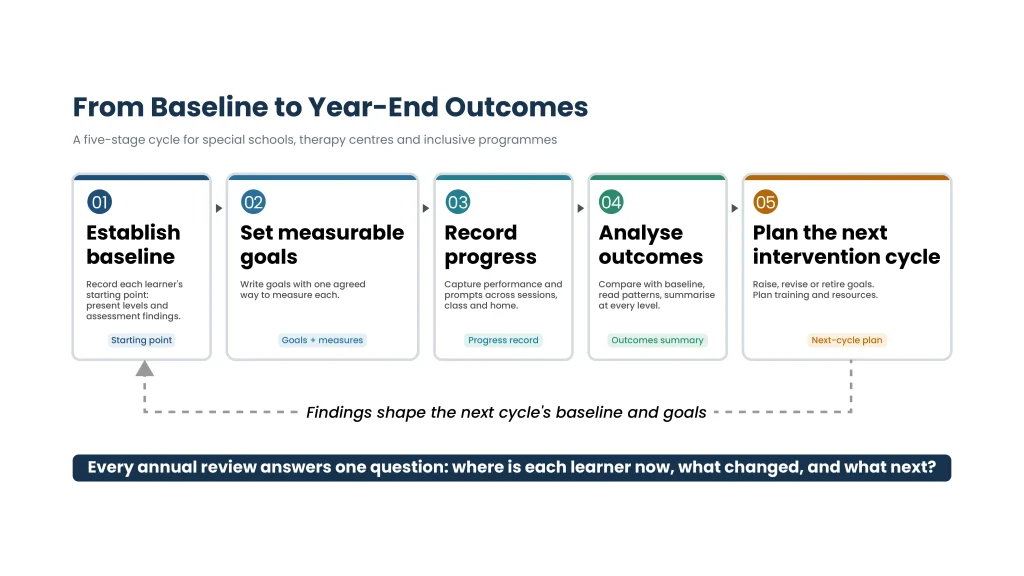
The process below follows the cycle shown in the infographic. Each stage produces something the next one needs, and the findings of the last stage become the starting point of the next cycle.
From Baseline to Year-End Outcomes: a five-stage cycle. 1 Establish baseline. 2 Set measurable goals. 3 Record progress. 4 Analyse outcomes. 5 Plan the next intervention cycle. Findings shape the next cycle’s baseline and goals.
Stage 1: Establish the baseline
Progress can only be judged against a starting point. For every learner, record the present level of performance, the assessment findings, the level of support currently needed, and the settings in which it was observed: classroom, therapy room, home.
Baselines are easy to lose when a learner moves between a special school, a therapy centre and home practice. Keep one record that every professional can see, so that the review comparison starts from the same point for everyone.
If you are reading this partway through a cycle and some learners have no baseline, note it now. Where an original baseline is unavailable, document the gap clearly. A recent assessment can establish a reference point for future monitoring, but it should not be presented as an original baseline or used as though it were a reliable starting measurement.
Stage 2: Set measurable goals, and agree how each will be measured
A goal can only be reported on if you can say what “achieved” looks like. For each goal, write down one agreed way of measuring it.
State guidance on progress monitoring stresses that data should be collected systematically and with the same method of measurement, so that actual progress can be compared with the baseline and with the expected rate of progress. If one therapist records accuracy as a percentage and another records “good / fair / poor,” the comparison at review becomes unreliable.
Depending on the goal, you might measure:
- Accuracy or mastery: the share of correct responses or the number of steps completed.
- Level of support: moving from physical or verbal prompting to a visual cue, then to independence.
- Frequency or duration: how often or how long a behaviour or participation occurs.
- Goal attainment: how far an individual goal was achieved compared with what was expected.
Goal Attainment Scaling (GAS) is worth knowing about, because it suits individualised goals well. It rates each goal on a five-point scale from -2 (much less than expected) to +2 (much more than expected), with 0 meaning the expected outcome was reached. Research in paediatric rehabilitation describes it as a responsive way to evaluate change, and it can be used alongside standardised instruments. Studies also note that relying on standardised measures alone can miss individual goals that were in fact achieved. The trade-off is effort: writing good GAS scales takes training and time, so teams usually adopt it for priority goals rather than every goal. The five outcome levels should be defined when the goal is established, so that the review rating is based on agreed expectations rather than retrospective judgement.
Here is a short, illustrative example of how one goal might look at a review point (a hypothetical example, not real learner data):
| Score | Meaning | Description for the goal “follows a two-step classroom instruction” |
|---|---|---|
| -2 | Much less than expected | Follows one-step instructions only, with physical prompts |
| -1 | Less than expected | Follows one-step instructions with a visual prompt |
| 0 | Expected | Follows two-step instructions with one verbal prompt, in 4 of 5 attempts |
| +1 | More than expected | Follows two-step instructions without prompts in class and therapy |
| +2 | Much more than expected | Follows two-step instructions in class, therapy and at home |
A rating of +1 at review tells a parent far more than “progress made.”
Remember: GAS scales require clearly defined outcomes and consistent professional judgement.
Stage 3: Record progress as you go
An outcomes report is only as good as the records behind it, and records are best made at the time. A short, consistent entry after each session or activity is more useful than a long entry that nobody has time to complete.
Record the same things in the same way: performance on the goal, the level of support needed, and the setting. Where you can, include:
- Observations from the classroom and the therapy room, not only one of them
- What the family reports from home practice
- Engagement and attendance patterns, which often explain why progress differs between learners
The aim is not to record everything. It is to record what will let you answer the review question: where did this learner start, and where are they now?
Stage 4: Analyse outcomes
Now the records become findings. Read them in three steps.
First, look for patterns, not single sessions. One good or bad session says little. Across the period, look for:
- Steady improvement, or gains that stall after a few months
- Performance that holds in therapy but not in class or at home
- A fall in prompting even when accuracy stays the same
- Goals that were met early and need to be raised
- Goals showing little movement despite regular practice
- Practice that was consistent for some learners and patchy for others, and how that relates to their progress
Second, summarise at three levels.
- Learner level. For each child: goals, baseline, current status, support level, strengths, and recommended next goals.
- Group level. For each class, therapy group or programme: the share of goals met, partly met or not yet met, and which skill areas moved most (communication, cognitive skills, motor skills, social and emotional skills, academic skills, self-regulation, independence and life skills, executive functioning, technology literacy).
- Institution level. Reach and engagement indicate the scale and participation of a programme, while learner outcomes demonstrate changes in skills, performance or independence. Reports should distinguish these measures rather than treating them as interchangeable
Third, write the interpretation. Numbers alone do not explain themselves. For each finding, add a sentence on what it means and what you think explains it. Avoid averages that hide individuals: a group figure helps planning, but each learner’s own story should stay visible beside it.
Stage 5: Plan the next intervention cycle
A report that does not change anything is just paperwork. For every finding, ask what you will do about it:
- Goals met consistently: raise the goal or move to a new skill.
- Skill strong in therapy but weak elsewhere: plan for generalisation across class, home and community.
- Little progress despite regular practice: review the strategy, the measurement and the goal itself, and consider a team discussion.
- Uneven home practice: invest in parent guidance and in ways to make practice easier to keep up.
- Strong results in one area: document what worked so other teams can use it.
Then carry the answers into the next plan: caseloads, training needs, device and resource requirements, and the goals to be set at the start of the next term or programme year. These become the new baseline and goals, and the cycle begins again.
Making the Annual Review Meeting With Parents Work
Data only helps a family if they can understand it. A few practices make the meeting more useful:
- Send the summary before the meeting so parents can read it and prepare questions.
- Prepare it in the family’s own language (for example Malayalam, Tamil, Hindi or English) as well as in the language of record.
- Invite whoever supports practice at home. In many families that is a parent, but it may be a grandparent or an older sibling.
- Use plain language and real examples (“now asks for help using a picture card”) alongside scores.
- Show progress in both performance and support level. A child who needs fewer prompts has made real progress even if the task has not changed.
- Agree two or three priorities for the next cycle, rather than a long list.
- Give specific home-practice suggestions linked to those priorities.
Guidance for IEP teams elsewhere makes the same point: the team should help parents understand the data well enough to judge for themselves whether their child is on track toward each annual goal.
Common Mistakes in Outcomes Reporting
- Reporting activity instead of outcomes. The number of sessions delivered shows effort, not results. An outcome needs a baseline, a result at review and one measure used at both.
- Using different measures for the same type of goal. Comparisons across learners or terms become meaningless.
- Starting the report in the last week. Data held in registers, notebooks and chat threads is slow and error-prone to compile.
- Assuming one calendar fits every audience. Parents, trustees and CSR partners may each need results at different times. Plan the data once and cut it for each.
- Reporting only successes. Goals that did not move are the most useful information for planning.
- Ignoring home and school data. Progress that appears in only one setting is an incomplete picture.
- Expecting software to write the report. Tools organise records; people interpret them.
- Treating the report as a one-off. The strongest institutions use the same structure every cycle, so each report can be compared with the last.
How a Connected Platform Supports Annual Reviews
Everything above is easier when records are kept in one place and updated as work happens. XceptionalLEARNING describes its platform as a connected workflow from assessment to goals, intervention planning, structured digital activities and progress review, with the XL Portal as its operational core.
According to the platform, the XL Portal brings together:
- Learner profiles and case information
- Assessment information and goal setting
- Therapy and intervention planning
- Digital activities that can be assigned to learners
- Progress information, session reports and intervention records
- Institutional oversight, with parent, therapist and institution views of the learner’s journey
By keeping learner information, assessment findings, goals, intervention plans and progress records connected, the XL Portal can help professionals refer to a more organised record during review meetings. This gives teams a clearer basis for discussing progress, identifying support needs and planning subsequent interventions.
XL’s school and clinic pages also describe dashboards for tracking engagement and progress. Where a VergeTAB is used, the activities assigned through XL are delivered on a locked, distraction-free device, while progress and reports are reviewed in the XL Portal. In India, this connected approach is applied in projects such as DESS (Digitalising Education in Special Schools), which focuses on special schools, digital education, therapy integration, teacher and therapist support, and parent involvement.
For NGO, CSR and government programmes, XL describes an evaluation approach that includes baseline and endline assessments, student-level progress tracking, cohort-based analytics, and annual impact documentation. These components belong to programme implementations. A demo is the best way to see which of them apply to your school, therapy centre or programme.
What a platform does not do is decide which goals matter, how progress should be measured, or what the data means. The outcomes report, with its measures, interpretation and recommendations, is still written by your team. What a connected system changes is where the team’s time goes: less on hunting for records in registers and chat threads, more on reading what they show.
Conclusion
A year of work with children and families deserves to be read as more than a stack of notes. An annual review that brings baselines, goals and progress data together lets parents see what changed, teams see what worked, leaders allocate resources, and partners see the impact.
The process is simple in outline: establish the baseline, set measurable goals, record progress, analyse outcomes, and plan the next cycle. Institutions that record and review data throughout the year find that every review, whether a February parent meeting, a March report or a programme evaluation, becomes a more focused conversation, and that each cycle’s report builds on the last.
The question every annual review exists to answer is a plain one: where did each learner start, where are they now, and what should we do next?
Frequently Asked Questions
References
India
- Vidhi Centre for Legal Policy, Towards an Inclusive Education Framework in India: the RPwD Act, 2016 and inclusive education in India.
- National Institute of Educational Planning and Administration, study on inclusive education monitoring: IEPs commonly used to monitor learning outcomes of children with disabilities in West Bengal, Chandigarh and Gujarat.
- Directorate of Education, Government of NCT of Delhi, orders on IEPs: instructions for parent meetings (circa 2018, IEP review meetings in February and July); order of 12 March 2020 (monthly IEP evaluation and review); order of 5 May 2022 (IEP revised at least twice a year).
- EY India, How well is your organization adjusting to the emerging paradigm of CSR?: amended CSR rules, March year-end reporting and impact assessment for larger projects.
- Deccan Herald, School gates closed for children with disabilities: experts and parents on the gap between disability legislation and practice.
- XceptionalLEARNING: Platform, Special Schools, Clinics and Therapists, NGOs / CSR / Government.
International (supporting references)
- Disability Rights California, “What Is Individualized Education Program (IEP) Progress?”: goals must be measurable, the plan must state how progress is measured, and the team reviews progress at least annually and revises the plan if progress is not adequate.
- Kentucky Department of Education, Progress Monitoring guidance: data should be collected consistently, systematically and with the same measurement method, and compared against baseline and expected progress.
- Nebraska Department of Education, Progress Monitoring (2022): checklist for annual IEP team review of progress data and interim reports.
- University of Hawaii, Methods to Monitor Progress: teams should help parents understand the data.
- McDougall & King, Goal Attainment Scaling: Description, Utility, and Applications in Pediatric Therapy Services: the five-point GAS scale and its use in paediatric therapy.
- Goal attainment scaling in paediatric rehabilitation (book chapter, 2014, Utrecht University record): GAS as an individualised outcome tool, useful alongside standardised measures.
- Goal Attainment Scaling in paediatric rehabilitation: a report on the clinical training of an interdisciplinary team (2008): GAS scale development remained time-consuming even with training.
Related Reading
- Progress Documentation in Special Education: From Observation to Informed Decision-Making
- Why Clear Results from Therapy Sessions Are Crucial for Parents
- Making Sense of Your Child’s Digital Therapy Report with the Parent Dashboard Revolution
- From Linear to Spiral Learning: Rethinking How Progress Is Measured in Children
- Reimagining Individualized Education Plans (IEPs) in a Hybrid Era
Turn Learner Progress into Meaningful Institutional Outcomes
Explore how XceptionalLEARNING connects assessment, intervention planning, structured activities and progress monitoring to support better-informed decisions across schools, clinics and programmes.