Your Child Has Been Screened. What Happens Next? 

Reading Time: 11 minutes

A Parent’s Guide to Assessment, Therapy, and Developmental Progress


Clinically Reviewed by
Jinson Alias
Consultant Psychologist | Special Educator | Digital Therapy Trainer


The Development Journey at a Glance

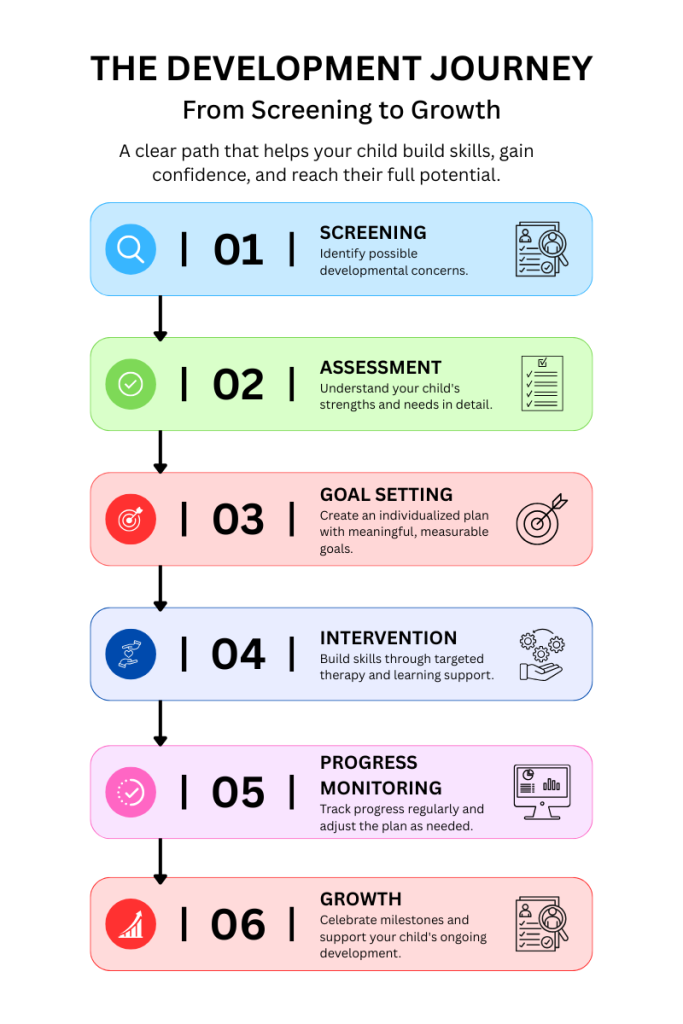
The child development journey from screening to growth.

Before anything else, it helps to see the full picture. Many parents receive a screening report and feel overwhelmed because they can’t see what comes after. Here is the journey from start to growth: 

Screening → Assessment → Goal Setting → Intervention →Progress Monitoring → Growth

Each stage builds on the one before it. Screening opens the door. Assessment provides the map. Goals set the destination. Intervention is the journey itself. Progress monitoring keeps everyone on course. And growth, growth that is real, meaningful, and observable, is what it all leads toward.

What a Developmental Screening Really Means 

A screening is a brief, structured observation designed to identify children who may benefit from a closer look. It measures whether a child’s development is broadly on track for their age, flagging areas where further evaluation might be valuable. Screenings look at communication, motor skills, learning readiness, social interaction, behaviour, and adaptive skills. 

But here is what many parents don’t initially understand: a screening is not a diagnosis. It does not tell you what is wrong, why a challenge exists, or what a child will or won’t be capable of. It is a signal, not a verdict. A flag raised in a screening simply means that a more detailed look would be worthwhile — nothing more, and nothing less. 

Receiving a screening recommendation is not confirmation that something is seriously wrong with your child. It is an invitation to gather better information so that the right support, if needed, can be put in place as early as possible.

Key Takeaway

When the Report Arrives, Many Parents Feel Stuck 

This is one of the most important things to acknowledge, because it is also one of the least spoken about: receiving a developmental screening report can be an emotionally difficult experience, even when the language in the report is calm and clinical. 

Many parents describe feeling confused because they are not sure what the results actually mean in practical terms. Others feel fear about what the future holds. Some feel a quiet guilt, wondering whether something they did or didn’t do contributed to the concern. And almost all parents experience uncertainty about what the right next step actually is. 

These reactions are completely normal. A developmental screening report touches on something deeply personal — a parent’s hopes and worries for their child’s future. What matters most is that the emotional weight of receiving a report doesn’t cause a parent to freeze. Because the most valuable thing a parent can do after a screening is to keep moving forward toward information, clarity, and support.

Does any of this sound familiar? 

  • “The teacher mentioned concerns, but I’m not sure how serious they are.” 
  • “Everyone is giving me different advice.” 
  • “I’m worried about waiting too long, but I don’t want to overreact.” 
  • “I just want to know what my child needs.” 

If you’ve had any of these thoughts, you’re not alone. Many families find themselves asking the same questions after a screening.

The “Wait and See” Trap: The Biggest Mistake Parents Make 

After receiving a screening report, one of the most common responses is to wait. To observe for a few more months. To hope the concern resolves on its own. 

This instinct is understandable. No parent wants to make a big deal out of something that might turn out to be nothing. But the evidence on early intervention is clear and consistent: the earlier appropriate support begins, the better the outcomes tend to be. 

The brain is at its most adaptable in the early years of life. Waiting means missing months, or sometimes even years, during this critical window. In many cases, children who receive support earlier have more opportunities to build skills during critical periods of development. 

Acting early is not overreacting. If further assessment reveals that a child is developing typically and no support is needed, nothing has been lost. But if support is needed and it begins early, the difference it makes can be profound and lasting.

Step 1: Comprehensive Assessment — Looking Deeper Than the Screening  

The next step after a screening recommendation is a comprehensive assessment conducted by qualified professionals. Where a screening casts a wide net, an assessment looks in depth at specific areas of development to understand not just whether a challenge exists, but its nature, its degree, and how it shows up in the child’s daily life.

A full assessment may explore several domains:

  • Speech and language — receptive language, expressive language, articulation, and social communication
  • Motor skills — fine motor control (handwriting, grip, cutting) and gross motor skills (balance, coordination, movement)
  • Sensory processing — how the child’s nervous system processes and responds to sensory input
  • Learning and cognition — problem-solving, memory, attention, and how the child processes new information
  • Behaviour — patterns of response, self-regulation, and emotional management
  • Social skills — how the child interacts with peers, reads social cues, and engages in group settings

This assessment is conducted by a team that may include a speech-language pathologist, an occupational therapist, a special educator, or a psychologist — depending on what the screening flagged and what the child’s specific needs appear to be. The result is not a label. It is a detailed, individualized profile of how this child learns, communicates, and engages with the world.

Step 2: Understanding Your Child’s Strengths — Not Just Challenges  

A good assessment does not only map what a child finds difficult. It also identifies what a child does well — and this matters more than many parents initially realise.

Every child brings a unique combination of strengths, interests, and learning preferences to any therapeutic or educational setting. A child who struggles with spoken language may be a remarkably strong visual learner. A child who finds sitting still difficult may show exceptional creativity or spatial reasoning. A child with challenges in social interaction may demonstrate deep focus and an extraordinary memory for things that interest them.

These strengths are not merely encouraging anecdotes. They are practical tools. Effective intervention is built on a foundation of what a child can already do, using their interests and natural abilities to create pathways toward the skills they are still developing. Understanding your child’s learning style, what motivates them, and where their confidence already exists allows therapists and educators to create support that feels less like struggle and more like genuine progress.

Step 3: Setting Meaningful Goals — From Information to Action  

Once assessment is complete, the findings are translated into individualized goals. This is where the plan begins to take concrete shape. Goals are prioritized based on what will most meaningfully improve a child’s daily life in communication, independence, participation at school, and engagement at home.

Goals should be specific, measurable, and time-bound. Not “improve communication” but “will use two-word phrases to request preferred items in four out of five opportunities.” Not “improve attention” but “will remain on task during a structured activity for ten minutes with minimal prompting.”

Understanding the IEP  

For many children receiving developmental support, goals are formalized in an Individualized Education Program (IEP) — a documented plan that outlines what a child is working toward, what support they will receive, and how progress will be measured. The IEP is developed collaboratively by the therapeutic team, the school, and the family.

Family involvement at the goal-setting stage is not optional; it is essential. Parents bring knowledge of a child’s daily context, home environment, and personal motivations that professionals cannot fully access from a clinical setting. The best goals are always built with parents, not just for them.

Many schools and therapy teams now use digital platforms such as XceptionalLEARNING to document goals, coordinate intervention plans, and monitor progress across settings.

Assessment → Goals → Activities → Progress Review → Updated Goals

Step 4: Beginning Intervention — Putting the Plan Into Practice  

Intervention is where the goals a child and their team have set begin to be actively worked toward. Not every child needs the same combination of services, and not every child needs intensive support across all areas. What intervention looks like depends entirely on the individual child’s profile.

Common types of intervention include:

  • Speech Therapy — building communication, language comprehension, articulation, and social language skills
  • Occupational Therapy — developing fine motor control, sensory processing, daily living skills, and postural stability
  • Special Education Support — personalized academic learning and classroom participation strategies
  • Behavioural Support — developing self-regulation, focus, emotional management, and adaptive behaviour

The most effective intervention is always individualized. Two children with similar screening results may need very different approaches, different intensities of support, and different combinations of services. This is why the assessment stage matters so much — it ensures that intervention is targeted, relevant, and genuinely matched to the child in front of the therapist.

What Happens Between Therapy Sessions?  

Most children attending therapy spend perhaps two hours a week in sessions, which means the remaining 150-plus waking hours happen at home, at school, and in the everyday moments of daily life. Development doesn’t pause between appointments. Skills are reinforced or they fade. Progress is consolidated or it stalls.

The consistency of what happens between sessions is often the single most important factor in how quickly a child moves forward. Parents receive recommendations during sessions but don’t always have clear guidance on how to carry them into daily routines. Teachers want to support therapy goals but rarely have direct access to what a child is currently working on.

XceptionalLEARNING‘s Digital Activity Book (VergeTAB) and home activity tools help bridge that gap — giving parents structured, therapist-approved activities to use between sessions, and giving therapists visibility into how those activities are going.

How Do You Know If Therapy Is Actually Working?  

Developmental progress is rarely sudden or dramatic. It tends to be gradual, sometimes uneven, and easy to miss in the busyness of daily life — particularly when a parent is too close to their child’s day-to-day experience to see the larger arc of change. Progress often appears first in everyday life rather than during formal testing.

Progress shows up in ways that might seem small but aren’t. A child who struggled with dressing independently may now complete the whole routine with just one prompt. A child who rarely initiated conversation may now be the one asking questions. These are significant milestones in a child’s growing independence and confidence — and they deserve to be recognised as such.

For example, a child who once needed repeated reminders to complete a morning routine may begin doing most steps independently. Small changes like these are often early signs that intervention is having an impact.

Progress tracking also supports good decision-making. When progress is measured and recorded consistently, therapists and families can see what is working, identify what needs to be adjusted, and ensure that intervention continues to be well-matched to the child’s current level and next steps.

Signs of Meaningful Progress  

As a parent, knowing what to look for makes it easier to recognise progress as it happens:

  • Better attention and focus during tasks
  • Improved communication — more words, clearer speech, or richer sentences
  • Greater independence in daily routines
  • Better participation in family activities
  • Improved classroom engagement
  • Greater confidence in social situations
  • More willingness to try new tasks
  • Fewer emotional outbursts or quicker recovery from them
How XceptionalLEARNING Tracks Progress  

The XceptionalLEARNING platform gives therapists structured tools to document session observations, track goal completion, and share updates with parents and teachers — all in one place. Parents have access to progress information in real time rather than waiting until the next appointment. And the data captured over time supports evidence-based decisions about when to adjust goals, introduce new areas of focus, or celebrate a milestone that has genuinely been reached.

A Development Journey Is Not Always a Straight Line  

This is one of the most important things for any parent to understand — and one of the most relieving once it truly sinks in: developmental progress is not linear.

It plateaus. It doubles back. It accelerates for a few weeks and then seems to stall. A child may make strong gains in one area and then appear to plateau when a new environment introduces different demands. These are not signs that intervention has stopped working. They are a normal, expected part of how children develop.

Small gains matter. A child who takes two steps forward and one step back is still one step ahead of where they started. Recognising and celebrating incremental progress, rather than measuring a child only against where you hope they will eventually be, is one of the most important things a parent can do to sustain energy through the longer journey. Trusting the process, staying consistent, and holding a long view: these are the habits that distinguish families who see meaningful outcomes over time.

Frequently Asked Questions  

Does every child who is screened need therapy? 

No. A screening recommendation leads to assessment, and assessment determines whether intervention is appropriate — and if so, what form it should take. Some children may only need monitoring, minor support, or a conversation with a specialist to rule out concerns entirely.

How soon should assessment happen after a screening recommendation? 

As promptly as possible, particularly for younger children. The earlier a challenge is identified and understood, the more time there is to intervene during the years when the brain is most responsive. Waiting several months without a specific reason is generally not advisable.

Can developmental delays actually improve with the right support? 

Yes, significantly. Many children make substantial progress with consistent, individualized intervention, particularly when support begins early and is reinforced at home and school. The nature and degree of progress varies between children, but early and consistent support consistently improves outcomes compared to no intervention.

What can parents realistically do at home to support progress? 

Home practice is one of the highest-impact things a parent can contribute. Following through on therapist recommendations, using structured activities between sessions, creating consistent daily routines, and maintaining open communication with the therapeutic team all make a measurable difference in a child’s rate of progress.

My child seems to do well some weeks and struggle others. Is that normal?

Completely. Variability from week to week is entirely expected. Factors like sleep, illness, changes in routine, and emotional stress all influence how a child performs on any given day. What matters is the trend over weeks and months, not performance on any single day.

Every Journey Starts With Understanding  

A developmental screening report can feel like a lot to carry. Many parents expect answers and instead receive more questions, more appointments, and more uncertainty before clarity begins to emerge. That is completely normal, and it is not a sign that something has gone wrong.

Screening is not the destination. It is the first step on a path that, with the right support, leads somewhere genuinely hopeful. Assessment provides the picture. Goal setting creates the direction. Intervention builds the skills. Progress monitoring reveals how far a child has come. And growth, growth that is real, measurable, and life-changing, is what every one of those steps is working toward.

Children who receive early, consistent, individualized support go on to communicate more effectively, participate more fully, learn more confidently, and live more independently than they would have without it. The developmental journey is not always quick or smooth, but it is always worth taking.

Your child’s potential is not defined by a screening result. It is shaped by the support, consistency, and love that come after it.

Every child develops at their own pace. The goal is not to compare children with one another, but to understand where a child is today and what support will help them move forward.

Where Is Your Child on the Journey Right Now?  

Every family reading this is at a different point. Wherever you are, the right next step exists — and you don’t have to figure it out alone.

  • Recently screened
  • Waiting for assessment
  • Beginning intervention
  • Tracking progress
  • Looking for additional support

No matter where your family is today, understanding the next step can help you move forward with greater confidence.

Your Child’s Screening Is Only the Beginning  

If your child has recently been screened and you’re unsure what the next step should be, you don’t have to figure it out alone. Our team can help you understand the recommendations, explore support options, and create a plan that fits your child’s needs.

One challenge many families face is keeping assessments, therapy goals, home practice, and school support connected. When information is scattered, progress becomes harder to track and harder to act on.

From digital screening and assessment to therapy planning, home activities, and progress documentation and review — XceptionalLEARNING connects every stage of your child’s developmental journey in one place, keeping families, therapists, and educators aligned every step of the way.

Therapy Mapping: Turning Limitations Into Real-Life Skills

Reading Time: 6 minutes

Clinically Reviewed by

Aswathy Ponnachan

Medical and Psychiatric Social Worker

How structured therapy planning helps children build independence, confidence, and everyday abilities

When we think of therapy, the first thing that comes to mind is usually fixing what’s broken—helping someone overcome a limitation, difficulty, or challenge. That’s important, of course. But what if therapy could go beyond just addressing problems? What if it could help people discover their potential, explore possibilities, and build real-life skills that matter?

This is where therapy mapping and horizon expansion come in. Instead of just looking at what a person cannot do, this approach focuses on strengths, interests, and achievable goals. It’s about creating a roadmap for growth that is practical, measurable, and empowering.

In this blog, we’ll explore how therapy mapping works, how it can be applied in everyday settings, and how it opens up possibilities that were once thought impossible.

Understanding Therapy Mapping

Therapy mapping is about getting a full picture of an individual’s abilities, challenges, and environment, and using that information to design a personalized plan. Unlike a rigid therapy schedule, it focuses on functional, real-world outcomes.

Think of therapy mapping as creating a personalized map for growth. It helps identify not only the obstacles but also the pathways that lead to independence and confidence.

Core Elements of Therapy Mapping:
  • Identify Strengths: Skills, interests, and natural abilities
  • Recognize Challenges: Areas needing support or adaptation
  • Set Goals: Short-term, achievable wins and long-term aspirations
  • Plan Strategies: Tailored activities, exercises, and environmental adjustments
  • Track Progress: Continuous monitoring and adjustments to the plan
Need Guidance on Therapy Planning?

If you’re exploring therapy strategies for children or individuals with developmental needs, our specialists can help you understand how structured therapy tools and personalized plans work in real-life situations.
Chat with our team on WhatsApp to ask questions, get expert guidance, or learn how the right therapy approach can support your child’s development.

Expanding Horizons: Looking Beyond Limitations

Traditional therapy often concentrates on deficits. Expanding horizons shifts the focus to possibilities and potential. It encourages individuals to build on what they can do and gradually move into new areas of skill and independence.

Practical Ways to Expand Horizons:
  • Strength-Based Activities: Focus on natural interests to engage and motivate
  • Environmental Adjustments: Modify spaces to support success, such as structured routines or quiet areas.
  • Collaborative Planning: Involve families, teachers, or caregivers in setting goals
  • Integrated Approaches: Combine multiple therapy methods to address physical, cognitive, and emotional needs.

Step-by-Step Guide to Therapy Mapping

Here’s a practical approach to making therapy mapping work in everyday life:

1. Observe and Assess
  • Spend time understanding the individual in different settings: home, school, playground
  • Take note of strengths, interests, challenges, and stress triggers
Example:

A child may struggle with following instructions but show strong creativity in art or building activities. Recognizing both the challenge and the strength helps plan meaningful therapy activities.

2. Set Meaningful Goals
  • Use SMART goals (Specific, Measurable, Achievable, Relevant, Time-bound)
  • Include both skill-based and functional goals that impact daily life.
Example Goals:
  • Skill: Improve hand coordination to dress independently
  • Functional: Participate in group play for at least 10 minutes without prompts
3. Select Practical Tools and Techniques
  • Choose activities that match the individual’s strengths and challenges.
  • Use multi-sensory approaches: visual cues, tactile activities, hands-on tasks
  • Incorporate real-life tasks into therapy exercises
Example:

Instead of only practising hand movements on paper, a child could help set the table, fold laundry, or organize small objects—practical skills that reinforce coordination.

4. Implement and Monitor
  • Break sessions into manageable, consistent routines
  • Track progress through journals, observations, or simple charts
  • Adjust strategies as needed based on results and motivation
5. Review and Expand Horizons
  • Conduct regular reviews to track progress and identify new goals
  • Introduce more complex tasks gradually as skills improve
  • Focus on transferring skills to daily life
Example:

A child who learns basic problem-solving through puzzles could progress to planning small projects, such as helping prepare a snack or organizing a small activity at home.

Case Studies: Therapy Mapping in Action

Below are three practical examples showing how therapy mapping works in real-life situations. Each case includes the situation, mapped strengths and challenges, intervention plan, and outcomes — presented in a clear, professional model you can reuse anywhere.

Case 1: Autism Spectrum Disorder

Situation

A 7-year-old child has limited verbal communication but shows strong visual–spatial strengths.

Therapy Mapping Approach
Strengths
  • Strong visual learning
  • Good pattern recognition
  • High engagement with structured visual tasks
Challenges
  • Limited speech
  • Difficulty initiating social interactions
  • Trouble expressing needs verbally
Intervention Strategy
  • Use visual schedules, picture cards, and structured visual activities
  • Engage in guided play sessions to build turn-taking and joint attention
  • Introduce non-verbal communication routines, then gradually add simple verbal prompts
  • Create predictable routines to reduce anxiety and support communication
Outcome
  • Improved use of gestures and non-verbal communication
  • Increased participation in small-group activities
  • Better eye contact, turn-taking, and engagement
  • Gradual acceptance and use of simple verbal prompts

Case 2: ADHD and Executive Function Challenges

Situation

A 10-year-old has difficulty focusing, organizing tasks, and completing school assignments.

Therapy Mapping Approach
Strengths
  • High curiosity and enthusiasm
  • Enjoys hands-on and movement-based activities
  • Learns quickly through practical engagement
Challenges
  • Poor sustained attention
  • Difficulty planning tasks
  • Low task completion without support
Intervention Strategy
  • Short, structured work intervals with movement breaks in between
  • Task breakdown methods (one step at a time)
  • Use timers, checklists, and visual planners
  • Hands-on activities integrated into learning tasks
  • Teach self-monitoring strategies such as “check-in and check-out” routines
Outcome
  • Increased ability to complete tasks independently
  • Improved focus during short bursts of work
  • Better organization and planning skills
  • Classroom tasks become more manageable and less stressful.

Case 3: Physical Therapy Integration

Situation

A teenager recovering from a sports injury needs to regain strength, balance, and coordination.

Therapy Mapping Approach
Strengths
  • Strong motivation to return to sports
  • Good previous athletic conditioning
  • High willingness to follow routine exercises
Challenges
  • Reduced range of motion
  • Limited endurance during prolonged activity
  • Pain during specific movements
Intervention Strategy
  • Personalized physical therapy exercises focusing on strength, balance, and movement control
  • Gradual progression of exercise intensity based on tolerance
  • Use of simple tracking logs or charts to monitor repetitions, strength gains, and mobility
  • Goal-based milestones (e.g., “walk pain-free for 10 minutes,” “complete 20 assisted squats”)
  • Encourage cross-training activities to rebuild confidence without re-injury
Outcome
  • Faster recovery supported by consistent progression
  • Increased motivation through visible progress tracking
  • Improved endurance and coordination
  • Restored confidence to resume sports participation slowly
See Therapy Mapping in Real Sessions

Understanding therapy strategies becomes much easier when you see how therapists apply them in real-life sessions. Explore our therapy video library to learn how structured activities, guided exercises, and digital therapy tools support children with communication, attention, and motor development challenges.
Watch Therapy Videos

Tools and Strategies to Support Therapy Mapping

  • Multi-Sensory Activities: Combine visual, auditory, and tactile exercises to reinforce learning
  • Structured Routines: Predictable schedules help individuals focus and adapt
  • Progress Tracking: Journals, charts, or digital logs to measure improvement
  • Collaborative Support: Involve caregivers, teachers, and therapists for consistency and reinforcement

Tips for Caregivers and Therapists

  • Focus on practical, real-life outcomes
  • Celebrate small achievements to boost confidence
  • Make therapy part of daily routines, not just formal sessions
  • Encourage self-awareness and independence
  • Use tools and activities purposefully, ensuring they match the individual’s abilities and goals

Daily Checklist for Therapy Practice:

  • Review progress from the previous day
  • Conduct focused therapy activities
  • Include a functional, real-world task
  • Record observations and update plans
  • Identify new opportunities to expand skills

Why This Approach Works

  • Holistic Development: Addresses cognitive, emotional, and physical growth
  • Independence: Skills transfer to daily activities
  • Motivation: Strength-based focus increases engagement
  • Family Participation: Consistency across environments improves outcomes
  • Flexible: Can be adapted to any age or condition

Principles to Keep in Mind

  • Start with strengths, not just deficits
  • Integrate skills across multiple domains
  • Focus on functional, real-life outcomes
  • Continuously monitor and adjust goals
  • Gradually expand horizons with achievable challenges

Conclusion: From Limitations to Possibilities

Therapy mapping and horizon expansion shift the focus from limitations to potential and growth. By recognizing strengths, setting meaningful goals, integrating practical strategies, and involving caregivers, therapy becomes more empowering, functional, and motivating.

This approach supports children, teens, and adults alike—whether addressing communication difficulties, attention challenges, or physical coordination. By mapping skills and creating practical pathways for growth, therapy becomes a journey of possibilities rather than just a set of exercises.

Start today:
  • Map strengths and challenges
  • Integrate therapy into daily routines
  • Set achievable, functional goals
  • Track progress and expand horizons gradually

With therapy designed around possibilities rather than limitations, growth becomes real, measurable, and meaningful.

At XceptionalLEARNING, we support therapists, schools, and families through innovative solutions like VergeTAB, our digital therapy platform, along with digital tools for inclusive education and online therapy services for children. As a forward-thinking therapy technology company, we aim to make therapy more accessible and effective across learning environments.

If you’d like to explore how these solutions can support your therapy journey, Contact Us or connect with our team on WhatsApp for quick assistance.

Why Multidisciplinary Collaboration Is Crucial in Neurodevelopmental Care

Reading Time: 3 minutes

Written by

Kavya S Kumar

Speech Language Pathologist

Neurodevelopmental conditions—such as autism spectrum disorder (ASD), ADHD, intellectual disability, learning disorders, and motor or communication challenges—are rarely one-dimensional. They impact communication, movement, learning, behavioural, and daily participation simultaneously. Because of this complexity, isolated intervention models often fall short. That’s where multidisciplinary collaboration becomes not just helpful, but essential.

Understanding the Complexity of Neurodevelopmental Needs

Neurodevelopmental profiles vary widely, even within the same diagnosis. Two children with ASD, for example, may have entirely different strengths, challenges, sensory profiles, and family needs. One may struggle primarily with speech and social communication, while another may face motor planning issues, behavioural regulation difficulties, or academic challenges.

A multidisciplinary approach brings together professionals such as:

  • Speech-Language Pathologists (SLPs)
  • Occupational Therapists (OTs)
  • Physiotherapists (PTs)
  • Special Educators
  • Psychologists / Behavior Therapists
  • Social workers/ Counselors
  • Developmental Pediatricians
  • Audiologists and Vision Specialists (when required)

Each professional contributes a unique lens—creating a 360-degree understanding of the individual.

Holistic Assessment Leads to Accurate Intervention Planning

When assessments are done collaboratively:

  • Overlapping concerns are identified early
  • Gaps in care are minimized
  • Goals across domains are aligned

For example, a child’s speech delay may not improve optimally unless underlying sensory processing issues (addressed by OT) or attention and executive functioning challenges (addressed by psychology or special education) are also targeted.

This prevents:

  • Disconnected intervention goals
  • Inconsistent therapeutic strategies
  • Redundant or duplicated efforts

Instead, it results in cohesive, realistic, and functional intervention plans.

Looking to implement a structured multidisciplinary therapy system in your school or clinic?

Explore how XceptionalLEARNING’s Digital Therapy Platform supports coordinated planning, shared documentation, and cross-disciplinary goal alignment to ensure seamless collaboration across your entire team.
Watch How the Platform Works in Real Therapy Environments.
WhatsApp Us for quick inquiries and support.

Consistency Across Settings Improves Outcomes

Children with neurodevelopmental needs often struggle with generalization—using skills learned in therapy across home, school, and community settings. Multidisciplinary collaboration ensures that:

  • Therapists and educators use consistent strategies and cues
  • Parents receive unified guidance, not conflicting advice
  • Skills taught in one domain are reinforced in others

For instance, a communication strategy introduced by an SLP can be embedded into classroom routines by a special educator and supported during daily activities by parents. Research consistently shows that coordinated, team-based intervention models lead to better long-term developmental and functional outcomes compared to isolated service delivery.

Family-Centered Care Becomes Stronger

Families are central to neurodevelopmental care. When professionals collaborate:

  • Parents are not overwhelmed by multiple, uncoordinated recommendations
  • Progress is easier to understand and track
  • Trust in the care team increases

A united team helps families feel supported rather than burdened, turning them into active partners in the intervention process.

Efficient Use of Time and Resources

Multidisciplinary teamwork reduces:

  • Duplication of assessments
  • Conflicting therapy priorities
  • Delays in decision-making

When professionals communicate regularly—through shared documentation, case discussions, or digital platforms—intervention becomes more efficient and cost-effective, without compromising quality.

Preparing Individuals for Real-Life Participation

The ultimate goal of neurodevelopmental care is not just skill acquisition, but meaningful participation in real life—school readiness, social inclusion, independence, and quality of life.

This can only happen when:

  • Communication goals align with academic expectations
  • Motor skills support classroom and daily activities
  • Behavioral strategies complement learning and social interaction

Multidisciplinary collaboration ensures therapy is functional, contextual, and future-focused.

Collaboration as a Standard, Not an Option

In modern neurodevelopmental care, collaboration should not be an “add-on.” It should be the standard of practice. Whether delivered in clinics, schools, hospitals, or through technology-enabled platforms, multidisciplinary teamwork:

  • Enhances clinical outcomes
  • Strengthens family engagement
  • Promotes ethical, evidence-based practice

When professionals work together, individuals with neurodevelopmental needs don’t just receive services—they receive structured, coordinated support that maximizes their developmental potential and long-term independence.

If your organization is ready to move from uncoordinated therapy services to a fully integrated digital ecosystem, explore XceptionalLEARNING’s multidisciplinary therapy solutions. See exactly how it works before you decide through our detailed platform walkthrough videos, Book a Demo for a personalized presentation, or WhatsApp Us for quick institutional inquiries and implementation support.

From Linear to Spiral Learning: Rethinking How Progress Is Measured in Children

Reading Time: 6 minutes

Clinically Reviewed by

Chinnu Thomas 

Speech language pathologist

Imagine you are teaching your child to tie their shoes. One day, they do it right— loop, swoop, and pull — and you are so happy they have learnt it at last. The next day, they’re struggling again, and we wonder why. Developmental knowledge tells us that they haven’t actually forgotten. Learning is not always a straight line. 

For decades, we’ve measured children’s progress in therapy and education like a checklist — step one, then step two, then step three. But real development doesn’t work that way. Children grow in cycles. They circle back to old skills, reinforce what they’ve learned, and build on those foundations in ways that are anything but linear.

This is where the spiral learning model comes in. Instead of expecting children to climb a ladder of skills in a straight line, spiral learning acknowledges that progress may reevaluate, deepen, and expand with time. This approach has become particularly powerful in therapy and education for children with developmental, speech, and behavioral challenges.

Curious how this theory applies to real child progress tracking?

XceptionalLEARNING uses structured digital pathways to measure progress in a way that reflects spiral learning — capturing growth, mastery, and skill revisits over time. Our platform helps therapists, parents, and schools see real progress, not just linear milestones.
Talk to our team on WhatsApp

Linear vs. Spiral Learning: What’s the Difference?  

Linear Learning  
  • Follows a step-by-step sequence (like a checklist).
  • Each stage is considered “complete” before moving on.
    • Example: A child must master identifying letters before learning to read short words.
Spiral Learning  
  • Revisits earlier skills at higher and deeper levels.
  • Assumes children may pause, return, and reapply skills in new contexts.
    • Example: A child learns letters, tries words, returns to letter recognition with greater understanding, then builds longer sentences.

In therapy and education, spiral learning mirrors how children truly grow—not in straight lines, but in waves and circles.

Why Spiral Learning Fits Children’s Development Best  

Children don’t learn like machines; they grow like trees—branching out, circling back, and reinforcing old skills in new ways. Spiral learning respects this natural rhythm.

Here’s why this mode of learning is beneficial to their development:

  • Encourages deeper understanding instead of surface-level memorization.
  • Reduces pressure on children to “get it right the first time.”
  • Acknowledges regression as progress (a child may repeat a step but with new insight).
  • Supports individualized growth, especially in therapy settings.
  • Improves engagement, since skills are revisited in fresh, creative, and playful ways.

How Digital Learning Captures Spiral Progress

Traditional measurement often misses progress loops, back-and-forth skills, and mastery builds. With XceptionalLEARNING’s digital activity tracking and child progress dashboards, caregivers and therapists see week-by-week gains that reflect real learning cycles.
See a live demo

The Spiral Model of Measuring Growth  

Traditional progress reports look at skills through a Yes/No lens. But spiral learning demands more flexible and layered ways to measure progress. Let’s explore a few ways in which this measurement can be facilitated:

Focus on Milestones, Not Checklists

Instead of asking “Has the child mastered this skill?” ask:

  • Is the child showing emerging skills?
  • Can the child apply the skill in different contexts?
  • Does the child return to the skill with greater independence?
Track “Loops of Learning”

Every time a child revisits a skill, it’s not a failure—it’s reinforcement. For example:

  • Week 1: Child says “ba.”
  • Week 4: Child struggles but reattempts “ba.”
  • Week 8: Child says “ball” spontaneously.
Value Small Wins

Count each smile, gesture, and attempt as progress, because consistency matters more than speed. For example:

  • A child gripping a pencil correctly is progress, even before clear writing.
Look at Transfer of Skills

Measure growth by the application of a skill in new situations. For example:

  • Counting blocks in class leads to later counting spoons at home.
Observe Independence Levels

Look at progress not just as accuracy, but as needing lesser and lesser of external support. For example:

  • A child may start first with hand-over-hand help, then move on to prompting level, and finally become independent.

Practical Applications of Spiral Learning in Different Areas  

1. Speech Therapy  

Linear model: First learn sounds → then words → then sentences.

Spiral model: Return to sounds multiple times while trying words, blending skills naturally.

Practical Example:

Child practices “s” sound → attempts “sun” → struggles → returns to “s” sound with a therapist’s game → later says “sun” fluently.

2. Classroom Learning  

Linear model: Teach addition → then subtraction → then multiplication.

Spiral model: Revisit addition while learning multiplication to see patterns.

Practical Example:

The teacher introduces 2 + 2.

Months later, while teaching 2 × 2, the teacher reminds students how multiplication links to repeated addition.

3. Occupational Therapy  

Linear model: Hold crayon → draw lines → form letters.

Spiral model: Cycle between grip, hand strength, and drawing until skills integrate.

Practical Example:

  • Child struggles to draw a straight line.
  • Therapist switches to a clay activity to build hand strength.
  • Later returns to crayon grip practice using a game.
  • Eventually, the child draws lines more confidently and begins forming simple letters.

Tools and Strategies to Support Spiral Learning

Digital Therapy Tools

Platforms like XceptionalLEARNING and therapy tools like Digital Activity Book allow therapists and educators to revisit activities in varied forms.

  • Same skill, different games.
  • Builds engagement while reinforcing loops.
Play-Based Learning

Play naturally creates spiral patterns. For example:

  • Building blocks: stack → fall → rebuild stronger.
  • Pretend play: repeat roles but add new complexity each time.
Parent and Teacher Involvement
  • Encourage celebrating repeated attempts instead of worrying about setbacks.
  • Use journals or simple apps to track loops of progress.
Multi-Sensory Approaches

Present the same concept through sight, sound, touch, and movement to reinforce learning loops. For example: 

  • Teaching letters by tracing sandpaper letters (touch), singing alphabet songs (sound), and writing with markers (sight/movement).
Flexible Assessment Methods

Replace rigid testing with observation, portfolios, and ongoing feedback. For example:

  • Instead of a one-time test on shapes, track how a child identifies, draws, and uses shapes in art or play over time.

    Practical Tips for Parents 

    Encourage Repetition Without Pressure
    • Reread the same story but ask new questions each time.
    • Let children play the same game in different ways.
    Celebrate Attempts, Not Just Successes
    • Applaud effort, even if results aren’t perfect. (“You tried saying that word again—great job!”)
    Create Flexible Routines

    Instead of strict steps, allow space for looping back.

    • For example: If a child can’t button a shirt today, revisit tomorrow with playful practice.
    Use Spiral-Friendly Materials
    • Puzzle sets with varying difficulty.
    • Digital therapy platforms with levels that revisit old skills.

    Practical Tips for Educators 

    Curriculum Design

    Revisit concepts in cycles, each time adding depth.

    • Example: Teach fractions in Grade 3, revisit with decimals in Grade 4, and link to percentages in Grade 5.
    Assessment Style
    • Use portfolios showing progress over time.
    • Replace “pass/fail” with “developing/mastering/expanding.”
    Group Activities

    Use projects where students repeat roles but expand responsibilities.

    • Example: In a group presentation, a shy child first holds up a chart, later introduces the topic, and finally explains a part.

      Practical Tips for Therapists 

      Plan Loops, Not Straight Lines

      Build sessions that return to earlier activities with fresh twists.

      • Example: A speech therapist reintroduces the same word set through songs, flashcards, and digital games.
      Track Cycles, Not Just Outcomes
      • Record how many times a child revisited a skill.
      • Note if attempts were easier, quicker, or more confident.
      Family Collaboration
      • Educate families about spiral progress so they don’t panic during regressions.
      • Share small wins frequently.

        Case Study 

        Meet Vihaan (6 years old, speech delay)  
        • Linear expectation: Vihaan should move from sounds → words → sentences in order.
        • Spiral reality: Vihaan often circled back to practicing sounds even after forming words.
        Journey:
        1. Started with the “m” sound.
        2. Built to say “mama.”
        3. Regressed to just “m.”
        4. The therapist reintroduced “m” with songs and picture games.
        5. Vihaan later used “mama” confidently, then expanded to “mama come.”

        Outcome: By honoring spiral learning, Vihaan gained confidence without being labeled as “stuck.”

        The Future of Measuring Progress in Children  

        Spiral learning has the potential to redefine how schools and therapy centers track success. Instead of asking “Did the child achieve the goal?” the better question is:

        • How many times has the child returned to this skill?
        • What new depth is being added each time?
        • How can we support the next loop instead of rushing forward?
        • Is the child showing more confidence or independence with each revisit?
        • Can the child transfer this skill to different settings (home, school, play)?

        Applied Progress Tracking in Practice

        Educators and therapists using structured digital measurement tools — such as those in XceptionalLEARNING — report clearer insights into children’s evolving skills, personalized feedback loops, and better parent communication.
        Talk with our team

        Conclusion

        Progress in children’s learning is rarely a straight road—it’s a spiral staircase. Each loop may look like repetition, but in reality, it’s a deeper, stronger step upward. By shifting from linear to spiral learning, parents, teachers, and therapists can better support children’s natural growth. 

        At XceptionalLEARNING, we make the spiral journey of learning simple, visible, and empowering. With interactive games, guided sessions, and personalized digital exercises, children revisit skills, strengthen foundations, and build new abilities with confidence. If you want meaningful progress measurement that goes beyond traditional linear checkboxes and truly reflects how children learn and grow, XceptionalLEARNING can help. Our platform supports spiral learning progress tracking, personalized plans, and data-driven insights for parents, therapists, and special schools.
        Chat with us on WhatsApp