Your Child Has Been Screened. What Happens Next? 

Reading Time: 11 minutes

A Parent’s Guide to Assessment, Therapy, and Developmental Progress


Clinically Reviewed by
Jinson Alias
Consultant Psychologist | Special Educator | Digital Therapy Trainer


The Development Journey at a Glance

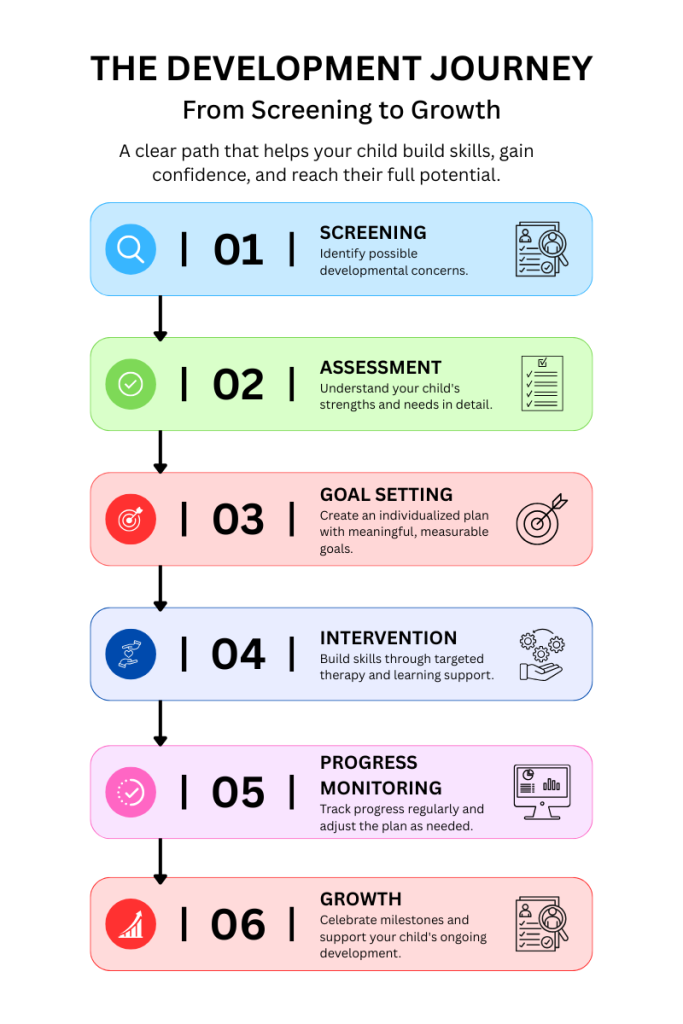
The child development journey from screening to growth.

Before anything else, it helps to see the full picture. Many parents receive a screening report and feel overwhelmed because they can’t see what comes after. Here is the journey from start to growth: 

Screening → Assessment → Goal Setting → Intervention →Progress Monitoring → Growth

Each stage builds on the one before it. Screening opens the door. Assessment provides the map. Goals set the destination. Intervention is the journey itself. Progress monitoring keeps everyone on course. And growth, growth that is real, meaningful, and observable, is what it all leads toward.

What a Developmental Screening Really Means 

A screening is a brief, structured observation designed to identify children who may benefit from a closer look. It measures whether a child’s development is broadly on track for their age, flagging areas where further evaluation might be valuable. Screenings look at communication, motor skills, learning readiness, social interaction, behaviour, and adaptive skills. 

But here is what many parents don’t initially understand: a screening is not a diagnosis. It does not tell you what is wrong, why a challenge exists, or what a child will or won’t be capable of. It is a signal, not a verdict. A flag raised in a screening simply means that a more detailed look would be worthwhile — nothing more, and nothing less. 

Receiving a screening recommendation is not confirmation that something is seriously wrong with your child. It is an invitation to gather better information so that the right support, if needed, can be put in place as early as possible.

Key Takeaway

When the Report Arrives, Many Parents Feel Stuck 

This is one of the most important things to acknowledge, because it is also one of the least spoken about: receiving a developmental screening report can be an emotionally difficult experience, even when the language in the report is calm and clinical. 

Many parents describe feeling confused because they are not sure what the results actually mean in practical terms. Others feel fear about what the future holds. Some feel a quiet guilt, wondering whether something they did or didn’t do contributed to the concern. And almost all parents experience uncertainty about what the right next step actually is. 

These reactions are completely normal. A developmental screening report touches on something deeply personal — a parent’s hopes and worries for their child’s future. What matters most is that the emotional weight of receiving a report doesn’t cause a parent to freeze. Because the most valuable thing a parent can do after a screening is to keep moving forward toward information, clarity, and support.

Does any of this sound familiar? 

  • “The teacher mentioned concerns, but I’m not sure how serious they are.” 
  • “Everyone is giving me different advice.” 
  • “I’m worried about waiting too long, but I don’t want to overreact.” 
  • “I just want to know what my child needs.” 

If you’ve had any of these thoughts, you’re not alone. Many families find themselves asking the same questions after a screening.

The “Wait and See” Trap: The Biggest Mistake Parents Make 

After receiving a screening report, one of the most common responses is to wait. To observe for a few more months. To hope the concern resolves on its own. 

This instinct is understandable. No parent wants to make a big deal out of something that might turn out to be nothing. But the evidence on early intervention is clear and consistent: the earlier appropriate support begins, the better the outcomes tend to be. 

The brain is at its most adaptable in the early years of life. Waiting means missing months, or sometimes even years, during this critical window. In many cases, children who receive support earlier have more opportunities to build skills during critical periods of development. 

Acting early is not overreacting. If further assessment reveals that a child is developing typically and no support is needed, nothing has been lost. But if support is needed and it begins early, the difference it makes can be profound and lasting.

Step 1: Comprehensive Assessment — Looking Deeper Than the Screening  

The next step after a screening recommendation is a comprehensive assessment conducted by qualified professionals. Where a screening casts a wide net, an assessment looks in depth at specific areas of development to understand not just whether a challenge exists, but its nature, its degree, and how it shows up in the child’s daily life.

A full assessment may explore several domains:

  • Speech and language — receptive language, expressive language, articulation, and social communication
  • Motor skills — fine motor control (handwriting, grip, cutting) and gross motor skills (balance, coordination, movement)
  • Sensory processing — how the child’s nervous system processes and responds to sensory input
  • Learning and cognition — problem-solving, memory, attention, and how the child processes new information
  • Behaviour — patterns of response, self-regulation, and emotional management
  • Social skills — how the child interacts with peers, reads social cues, and engages in group settings

This assessment is conducted by a team that may include a speech-language pathologist, an occupational therapist, a special educator, or a psychologist — depending on what the screening flagged and what the child’s specific needs appear to be. The result is not a label. It is a detailed, individualized profile of how this child learns, communicates, and engages with the world.

Step 2: Understanding Your Child’s Strengths — Not Just Challenges  

A good assessment does not only map what a child finds difficult. It also identifies what a child does well — and this matters more than many parents initially realise.

Every child brings a unique combination of strengths, interests, and learning preferences to any therapeutic or educational setting. A child who struggles with spoken language may be a remarkably strong visual learner. A child who finds sitting still difficult may show exceptional creativity or spatial reasoning. A child with challenges in social interaction may demonstrate deep focus and an extraordinary memory for things that interest them.

These strengths are not merely encouraging anecdotes. They are practical tools. Effective intervention is built on a foundation of what a child can already do, using their interests and natural abilities to create pathways toward the skills they are still developing. Understanding your child’s learning style, what motivates them, and where their confidence already exists allows therapists and educators to create support that feels less like struggle and more like genuine progress.

Step 3: Setting Meaningful Goals — From Information to Action  

Once assessment is complete, the findings are translated into individualized goals. This is where the plan begins to take concrete shape. Goals are prioritized based on what will most meaningfully improve a child’s daily life in communication, independence, participation at school, and engagement at home.

Goals should be specific, measurable, and time-bound. Not “improve communication” but “will use two-word phrases to request preferred items in four out of five opportunities.” Not “improve attention” but “will remain on task during a structured activity for ten minutes with minimal prompting.”

Understanding the IEP  

For many children receiving developmental support, goals are formalized in an Individualized Education Program (IEP) — a documented plan that outlines what a child is working toward, what support they will receive, and how progress will be measured. The IEP is developed collaboratively by the therapeutic team, the school, and the family.

Family involvement at the goal-setting stage is not optional; it is essential. Parents bring knowledge of a child’s daily context, home environment, and personal motivations that professionals cannot fully access from a clinical setting. The best goals are always built with parents, not just for them.

Many schools and therapy teams now use digital platforms such as XceptionalLEARNING to document goals, coordinate intervention plans, and monitor progress across settings.

Assessment → Goals → Activities → Progress Review → Updated Goals

Step 4: Beginning Intervention — Putting the Plan Into Practice  

Intervention is where the goals a child and their team have set begin to be actively worked toward. Not every child needs the same combination of services, and not every child needs intensive support across all areas. What intervention looks like depends entirely on the individual child’s profile.

Common types of intervention include:

  • Speech Therapy — building communication, language comprehension, articulation, and social language skills
  • Occupational Therapy — developing fine motor control, sensory processing, daily living skills, and postural stability
  • Special Education Support — personalized academic learning and classroom participation strategies
  • Behavioural Support — developing self-regulation, focus, emotional management, and adaptive behaviour

The most effective intervention is always individualized. Two children with similar screening results may need very different approaches, different intensities of support, and different combinations of services. This is why the assessment stage matters so much — it ensures that intervention is targeted, relevant, and genuinely matched to the child in front of the therapist.

What Happens Between Therapy Sessions?  

Most children attending therapy spend perhaps two hours a week in sessions, which means the remaining 150-plus waking hours happen at home, at school, and in the everyday moments of daily life. Development doesn’t pause between appointments. Skills are reinforced or they fade. Progress is consolidated or it stalls.

The consistency of what happens between sessions is often the single most important factor in how quickly a child moves forward. Parents receive recommendations during sessions but don’t always have clear guidance on how to carry them into daily routines. Teachers want to support therapy goals but rarely have direct access to what a child is currently working on.

XceptionalLEARNING‘s Digital Activity Book (VergeTAB) and home activity tools help bridge that gap — giving parents structured, therapist-approved activities to use between sessions, and giving therapists visibility into how those activities are going.

How Do You Know If Therapy Is Actually Working?  

Developmental progress is rarely sudden or dramatic. It tends to be gradual, sometimes uneven, and easy to miss in the busyness of daily life — particularly when a parent is too close to their child’s day-to-day experience to see the larger arc of change. Progress often appears first in everyday life rather than during formal testing.

Progress shows up in ways that might seem small but aren’t. A child who struggled with dressing independently may now complete the whole routine with just one prompt. A child who rarely initiated conversation may now be the one asking questions. These are significant milestones in a child’s growing independence and confidence — and they deserve to be recognised as such.

For example, a child who once needed repeated reminders to complete a morning routine may begin doing most steps independently. Small changes like these are often early signs that intervention is having an impact.

Progress tracking also supports good decision-making. When progress is measured and recorded consistently, therapists and families can see what is working, identify what needs to be adjusted, and ensure that intervention continues to be well-matched to the child’s current level and next steps.

Signs of Meaningful Progress  

As a parent, knowing what to look for makes it easier to recognise progress as it happens:

  • Better attention and focus during tasks
  • Improved communication — more words, clearer speech, or richer sentences
  • Greater independence in daily routines
  • Better participation in family activities
  • Improved classroom engagement
  • Greater confidence in social situations
  • More willingness to try new tasks
  • Fewer emotional outbursts or quicker recovery from them
How XceptionalLEARNING Tracks Progress  

The XceptionalLEARNING platform gives therapists structured tools to document session observations, track goal completion, and share updates with parents and teachers — all in one place. Parents have access to progress information in real time rather than waiting until the next appointment. And the data captured over time supports evidence-based decisions about when to adjust goals, introduce new areas of focus, or celebrate a milestone that has genuinely been reached.

A Development Journey Is Not Always a Straight Line  

This is one of the most important things for any parent to understand — and one of the most relieving once it truly sinks in: developmental progress is not linear.

It plateaus. It doubles back. It accelerates for a few weeks and then seems to stall. A child may make strong gains in one area and then appear to plateau when a new environment introduces different demands. These are not signs that intervention has stopped working. They are a normal, expected part of how children develop.

Small gains matter. A child who takes two steps forward and one step back is still one step ahead of where they started. Recognising and celebrating incremental progress, rather than measuring a child only against where you hope they will eventually be, is one of the most important things a parent can do to sustain energy through the longer journey. Trusting the process, staying consistent, and holding a long view: these are the habits that distinguish families who see meaningful outcomes over time.

Frequently Asked Questions  

Does every child who is screened need therapy? 

No. A screening recommendation leads to assessment, and assessment determines whether intervention is appropriate — and if so, what form it should take. Some children may only need monitoring, minor support, or a conversation with a specialist to rule out concerns entirely.

How soon should assessment happen after a screening recommendation? 

As promptly as possible, particularly for younger children. The earlier a challenge is identified and understood, the more time there is to intervene during the years when the brain is most responsive. Waiting several months without a specific reason is generally not advisable.

Can developmental delays actually improve with the right support? 

Yes, significantly. Many children make substantial progress with consistent, individualized intervention, particularly when support begins early and is reinforced at home and school. The nature and degree of progress varies between children, but early and consistent support consistently improves outcomes compared to no intervention.

What can parents realistically do at home to support progress? 

Home practice is one of the highest-impact things a parent can contribute. Following through on therapist recommendations, using structured activities between sessions, creating consistent daily routines, and maintaining open communication with the therapeutic team all make a measurable difference in a child’s rate of progress.

My child seems to do well some weeks and struggle others. Is that normal?

Completely. Variability from week to week is entirely expected. Factors like sleep, illness, changes in routine, and emotional stress all influence how a child performs on any given day. What matters is the trend over weeks and months, not performance on any single day.

Every Journey Starts With Understanding  

A developmental screening report can feel like a lot to carry. Many parents expect answers and instead receive more questions, more appointments, and more uncertainty before clarity begins to emerge. That is completely normal, and it is not a sign that something has gone wrong.

Screening is not the destination. It is the first step on a path that, with the right support, leads somewhere genuinely hopeful. Assessment provides the picture. Goal setting creates the direction. Intervention builds the skills. Progress monitoring reveals how far a child has come. And growth, growth that is real, measurable, and life-changing, is what every one of those steps is working toward.

Children who receive early, consistent, individualized support go on to communicate more effectively, participate more fully, learn more confidently, and live more independently than they would have without it. The developmental journey is not always quick or smooth, but it is always worth taking.

Your child’s potential is not defined by a screening result. It is shaped by the support, consistency, and love that come after it.

Every child develops at their own pace. The goal is not to compare children with one another, but to understand where a child is today and what support will help them move forward.

Where Is Your Child on the Journey Right Now?  

Every family reading this is at a different point. Wherever you are, the right next step exists — and you don’t have to figure it out alone.

  • Recently screened
  • Waiting for assessment
  • Beginning intervention
  • Tracking progress
  • Looking for additional support

No matter where your family is today, understanding the next step can help you move forward with greater confidence.

Your Child’s Screening Is Only the Beginning  

If your child has recently been screened and you’re unsure what the next step should be, you don’t have to figure it out alone. Our team can help you understand the recommendations, explore support options, and create a plan that fits your child’s needs.

One challenge many families face is keeping assessments, therapy goals, home practice, and school support connected. When information is scattered, progress becomes harder to track and harder to act on.

From digital screening and assessment to therapy planning, home activities, and progress documentation and review — XceptionalLEARNING connects every stage of your child’s developmental journey in one place, keeping families, therapists, and educators aligned every step of the way.

How Therapy Avatars and Digital Twins Are Becoming Your Child’s Emotional Coaches

Reading Time: 5 minutes

Clinically Reviewed by

Jinson Alias

Consultant Psychologist, Special Educator & Digital Therapy Trainer

The world of child development, therapy, and emotional growth is undergoing rapid change. Traditional approaches—such as face-to-face counselling, talk therapy, or classroom-based interventions—remain important, but they are no longer the only tools available. With advancements in artificial intelligence (AI), machine learning, and interactive technology, Therapy Avatars and Digital Twins are emerging as powerful allies for children’s emotional well-being.

  • Therapy Avatars act as virtual coaches, guiding children through emotions, social interactions, and daily challenges.
  • Digital Twins replicate a child’s developmental journey in a digital environment, helping therapists, parents, and educators track emotional patterns and predict needs.

Together, they are redefining what it means to support a child’s growth—not just in therapy rooms but in everyday life.

Understanding Therapy Avatars

What Are Therapy Avatars?

Therapy avatars are AI-powered virtual characters designed to interact with children therapeutically. Unlike static applications, they can respond, adapt, and provide emotional support

  • They can take forms children connect with—cartoon characters, friendly animals, or human-like guides.
  • They use natural language processing (NLP) to converse with children.
  • They offer real-time feedback, emotional validation, and skill-building exercises.
Why Avatars Work with Children  

Children are naturally drawn to storytelling and interactive play. A therapy avatar combines these two elements:

  • Engagement through play – Kids feel less pressured than in face-to-face therapy.
  • Safe space – Children often share more openly with avatars than with adults.
  • Consistency – Avatars provide steady responses without judgment.

Exploring Digital Twins in Therapy

What Is a Digital Twin for Children?

A Digital Twin is a digital replica of a child’s developmental profile. It collects and analyzes data to create a living model of the child’s learning style, behaviour, and emotional patterns.

  • Tracks emotional responses over time.
  • Predicts when a child may face stress, frustration, or disengagement.
  • Suggests tailored strategies for parents and therapists.
How Digital Twins Support Therapy  
  • Data-driven insights – Therapists gain a clearer picture of what strategies work.
  • Personalization – Every child gets tailored therapy recommendations.
  • Early intervention – Warning signs of anxiety, ADHD, or other concerns are spotted early.

Why Emotional Coaching Matters

Emotional Intelligence in Children

Children who develop strong emotional intelligence are better equipped for school, friendships, and life challenges. Key skills include:

  • Recognizing and naming feelings.
  • Managing emotions during stress.
  • Building empathy and social awareness.
  • Problem-solving in relationships.
The Role of Emotional Coaches  

Traditionally, parents, teachers, and therapists take on the role of emotional coaches. But avatars and digital twins extend this role by:

  • Providing 24/7 support when human guidance isn’t available.
  • Reinforcing lessons between therapy sessions.
  • Creating fun practice spaces for children to role-play emotions.

How Therapy Avatars Coach Children Emotionally

Key Features of Therapy Avatars
  • Interactive Conversations
    • Children can talk about their day.
    • Avatars respond with empathy and suggestions.
  • Emotional Games and Exercises
    • Breathing exercises for calming down.
    • Storytelling prompts for emotional expression.
  • Reward Systems
    • Encouragement through stars, badges, or digital praise.
    • Helps build confidence and self-esteem.
Practical Scenarios Where Avatars Help  
  • Managing Daily Routines
    • Morning Anxiety Before School – Avatar guides calming exercises and boosts confidence with positive affirmations.
    • Bedtime Struggles – Leads a mindfulness routine, storytelling, and worry-release before sleep.
  • Building Social Skills
    • Conflict with Friends – Role-play conversations to practice problem-solving and apology skills.
    • Shyness in Social Situations – Simulates greetings, conversation starters, and builds confidence for playdates or class.
  • Managing Emotions Effectively
    • Handling Big Emotions (Anger, Frustration) – Encourages naming feelings and teaches calming outlets like breathing or drawing.
    • Handling Disappointment – Models empathy and helps the child reframe situations with positive alternatives.
  • Supporting Learning and Growth
    • Homework & Test Stress – Breaks tasks into smaller steps and teaches calming strategies during study.
    • Learning New Skills – Provides step-by-step guidance (e.g., tying shoes) while rewarding effort, not just success.
  • Facing Transitions and Challenges
    • Separation Anxiety – Offers comforting strategies and “bravery mantras” to manage time apart from parents.
    • Preparing for Medical/Dental Visits – Role-play visits in a friendly way, practising relaxation to reduce fear.

How Digital Twins Act as Emotional Mirrors

Building a Child’s Emotional Profile

Digital twins gather data from:

  • Speech patterns.
  • Facial expressions (via devices with cameras).
  • Engagement with therapy apps.
Benefits for Parents and Therapists  
  • Progress Tracking – See improvements or setbacks clearly.
  • Personalized Roadmaps – Suggests goals like “improve frustration tolerance.”
  • Collaboration – Parents and teachers access insights in real time.

The Science Behind Therapy Avatars and Digital Twins

  • AI and Machine Learning
    • Avatars learn how children respond and adapt their communication style over time.
    • Digital twins use predictive analytics to forecast emotional challenges and developmental needs.
  • Psychology Meets Technology
    • Combines evidence-based Cognitive Behavioural Therapy (CBT) strategies with AI-driven interactions.
    • Incorporates play therapy techniques into digital platforms to make learning and emotional practice fun.

Advantages Over Traditional Therapy Alone

  • Accessibility
    • Available anytime, anywhere—even in rural or underserved areas.
    • Gives children consistent access to emotional support outside clinic hours.
  • Consistency
    • Reinforces therapy lessons through daily practice and reminders.
    • Helps children build habits and routines instead of waiting for weekly sessions.
  • Cost-Effectiveness
    • Reduces the need for frequent, expensive in-person therapy sessions.
    • Provides affordable ongoing support for families.
  • Child Comfort
    • Many children feel safer and more relaxed opening up to a friendly avatar.
    • Encourages expression without fear of judgment.

Addressing Concerns and Limitations

Concerns Parents May Have
  • Screen Time: Use avatars for short, focused sessions (5–10 minutes).
  • Privacy: Choose platforms with strong data protections.
  • Over-Reliance: Keep human interaction central—use avatars as helpers, not replacements.
Expert Recommendations
  • Use avatars and twins as supplements, not replacements.
  • Encourage joint use with parents for shared experiences.
  • Regularly review data with therapists to guide real-life strategies.

Future of Emotional Coaching with Avatars and Twins

  • Integration with Wearables
    • Smartwatches and fitness trackers monitor stress signals such as heart rate or sleep patterns.
    • Avatars adjust their guidance in real time based on this live data.
  • Virtual Reality Therapy
    • Children practice real-life scenarios like classroom presentations or social interactions in safe VR environments.
    • Provides a low-risk space to build confidence and emotional regulation skills.
  • Cross-Cultural Adaptation
    • Avatars adapt to local languages, traditions, and cultural norms for more relatable interactions.
    • Ensures therapy tools remain inclusive and effective for diverse families.

Tips for Parents Considering These Tools

  • Research Platforms – Choose trusted, child-focused therapy apps.
  • Balance Digital and Human Time – Use technology as a bridge, not a replacement.
  • Stay Involved – Review insights and practice emotional lessons together.
  • Ask Your Therapist – Discuss how these tools can complement your child’s care.

Conclusion: A New Era of Emotional Coaching

Therapy Avatars and Digital Twins are no longer science fiction—they are practical tools transforming child therapy. Acting as emotional coaches, they provide safe spaces for children to express themselves, build coping skills, and grow resilience. Simultaneously, they give parents and therapists valuable insights into emotional development, enabling personalized care and earlier interventions. Therapy is no longer limited to weekly sessions—it’s becoming a daily journey supported by compassionate AI companions, helping children thrive emotionally, socially, and academically.

XceptionalLEARNING is trying to bring such an advanced system to its working form. As this system of XceptionalLEARNING reaches perfection, children will have a safe space to understand their feelings, strengthen emotional skills, and grow more resilient every day. Parents can easily contact us to explore how these innovative tools can support their child’s unique needs. For families looking for specialized therapy services, the platform offers tailored programs that adapt to each child’s progress. Parents can also connect with licensed therapists online, ensuring professional guidance whenever it’s needed. Therapists can expand their therapy practice online, bringing their expertise to more children, while hybrid therapy services combine digital and in-person sessions to make therapy more flexible, effective, and engaging.

Why Early Interventions in Pediatric Therapy Are Crucial for Growth

Reading Time: 5 minutes

Clinically Reviewed by

Aswathy Ponnachan

Medical and Psychiatric Social Worker

Early childhood is a critical time for a child’s physical, cognitive, social, and emotional development. During these years, any delays or challenges can have long-term effects. Pediatric therapy is key in identifying and addressing these issues early, helping children reach their full potential, and minimizing the need for intensive treatments later. This blog highlights the importance of early intervention, the benefits it offers, and the types of therapies that can make a significant impact on a child’s growth.

Wondering how early intervention and growth milestones is implemented consistently in real therapy sessions?

XceptionalLEARNING supports therapists, schools, and parents with structured activity plans, goal-based programs, and progress tracking tools that help children achieve measurable improvements.
Chat with our team on WhatsApp

Understanding Early Intervention  

Early intervention involves identifying and addressing developmental delays or health issues in children under five. It includes speech, physical, occupational, and behavioral therapy to support a child’s growth and reduce future challenges. Addressing concerns early improves outcomes by helping children with developmental, physical, and emotional issues reach their full potential.

The Science Behind Early Intervention  

In the early years, a child’s brain is highly adaptable due to neuroplasticity, making it an ideal time for early intervention. Therapeutic support during this period helps reshape neural pathways, address developmental concerns, and promote optimal growth. By leveraging the brain’s flexibility, early intervention can significantly impact a child’s future abilities and independence.

Benefits of Early Pediatric Therapy Interventions  

  • Enhanced Developmental Outcomes: The most significant benefit of early intervention is its ability to improve developmental outcomes. Whether it’s speech, motor skills, cognitive abilities, or social behaviors, timely interventions can help children catch up with their peers in areas where they may have been delayed. This leads to increased self-esteem, improved academic performance, and better social interactions as the child grows.
  • Prevention of Secondary Complications: By addressing developmental concerns early, pediatric therapy can prevent secondary complications that may arise from untreated delays. For example, a child with untreated speech delays may develop social isolation, frustration, or academic challenges as they enter school. Early speech therapy can prevent these issues and help the child develop communication skills that are essential for future success.
  • Better Long-Term Outcomes: Children who receive early interventions are more likely to achieve better long-term outcomes. Studies have shown that children who receive early therapy services are less likely to require special education services later in life and are more likely to thrive in mainstream education settings. This not only improves their academic and social development but also enhances their quality of life.
  • Cost-Effectiveness: Early intervention is often more cost-effective than waiting until developmental issues become more pronounced. Treating delays and disabilities early on can reduce the need for more expensive interventions later in life, including special education services, therapy, and medical treatments. Additionally, the earlier a child receives therapy, the more likely they are to achieve milestones quickly, reducing the overall duration and cost of treatment.

Bridge Theory With Structured Digital Support

Real progress happens when therapeutic strategies are supported with consistent routines and measurable tracking. With XceptionalLEARNING, caregivers and professionals can monitor development, align goals, and ensure continuity beyond sessions.
Book a free demo

Key Types of Early Intervention Therapies  

1) Speech Therapy:

Speech therapy is one of the most commonly utilized early intervention therapies. It addresses speech and language delays, articulation problems, and communication difficulties that may affect a child’s ability to express themselves. Early speech therapy helps children develop the necessary language skills to communicate effectively with others, which is vital for academic success and social interactions.

Applications:
  • Language Delays: Children with language delays may struggle to form sentences, understand vocabulary, or express their thoughts clearly. Early intervention can help them build these foundational skills.
  • Articulation Disorders: Children with articulation disorders may struggle with pronouncing words. Speech therapy can help correct these issues, making communication more effective.
  • Social Communication: For children with autism spectrum disorder (ASD) or other social challenges, speech therapy focuses on improving social communication skills, such as turn-taking in conversation, understanding body language, and engaging in meaningful exchanges.

2) Physical Therapy:

Physical therapy helps children with physical disabilities or motor delays improve their movement, strength, balance, and coordination. Early physical therapy interventions can address issues like muscle weakness, motor coordination problems, or delays in walking and crawling. It is particularly beneficial for children with conditions such as cerebral palsy, developmental coordination disorder, and congenital muscular dystrophy.

Applications:
  • Motor Delays: Children who experience delays in reaching motor milestones such as sitting, crawling, or walking can benefit from physical therapy to improve their coordination and muscle strength.
  • Postural Control: Some children may have difficulty maintaining balance or proper posture. Physical therapy helps them improve their core strength and stability.
  • Rehabilitation from Injuries: If a child has suffered an injury, physical therapy can facilitate healing and help them regain strength and mobility.

3) Occupational Therapy:

Occupational therapy focuses on helping children develop the skills necessary for daily activities or “occupations,” including fine motor skills, sensory integration, self-care tasks, and academic performance. Children with sensory processing issues, ADHD, autism, or developmental disabilities often benefit from occupational therapy.

Applications:
  • Sensory Processing Disorder: Children with sensory processing issues may have difficulty processing and responding to sensory stimuli. Occupational therapy can help them develop strategies for managing sensory input.
  • Fine Motor Skills: Developing fine motor skills such as grasping, drawing, and using utensils is essential for academic and self-care activities. Occupational therapists help children strengthen these skills.
  • Self-Care Skills: Children who struggle with daily self-care activities, such as dressing, grooming, and feeding, can benefit from occupational therapy to increase their independence.

4) Behavioral Therapy:

Behavioral therapy focuses on modifying problematic behaviors and teaching children appropriate coping mechanisms. It is commonly used for children with autism, ADHD, and other behavioral conditions. Early behavioral therapy can address issues such as tantrums, aggression, and non-compliance while teaching positive behaviors and emotional regulation.

Applications:
  • Autism Spectrum Disorder: Early behavioral therapy, such as Applied Behavior Analysis (ABA), helps children with ASD develop social skills, language abilities, and appropriate behaviors.
  • Attention Deficit Hyperactivity Disorder (ADHD): Behavioral therapy helps children with ADHD manage impulsivity, improve attention, and develop organizational skills.
  • Social Skills Training: Children who struggle with social interactions can benefit from behavioral therapy, which teaches them how to communicate and interact effectively with others.

The Role of Parents in Early Intervention  

Parents play a crucial role in the success of early intervention therapies. By being actively involved in their child’s therapy sessions, parents can manage the strategies and techniques learned in therapy at home. This consistent practice helps the child progress more quickly and effectively. Additionally, parents can advocate for their children’s needs, ensuring that they receive the support and resources necessary for their development.

Applying Therapy With Digital Structure

Combining therapy techniques with digital structure helps improve clarity, consistency, and collaboration between therapists and families, leading to better outcomes for children.
WhatsApp our team

Conclusion: Early Intervention Makes a Difference

The benefits of early intervention are clear: better developmental outcomes, prevention of complications, improved success, and cost-effective treatment. Whether it’s speech therapy, physical therapy, occupational therapy, or behavioral therapy, early intervention helps children reach their full potential with the support of professionals. If you are looking for ways to turn therapeutic insights into measurable, trackable progress for your child or students, XceptionalLEARNING can help. Our digital platform offers guided therapy-aligned activities, progress dashboards, and caregiver-friendly tools that transform therapy into consistent daily practice.
Chat with us on WhatsApp