What If We Saw the Person First?

Reading Time: 7 minutes
Written By:

Jasna K
Special Educator

Looking Beyond the Diagnosis to Recognize Identity, Strength, and Potential  

Imagine meeting someone for the very first time.

Before you learn their name, someone tells you, “He’s autistic.” Or perhaps, “She has cerebral palsy.” Maybe it’s, “He has dyslexia.”

What picture comes to your mind?

Without realizing it, many of us begin to form expectations based on a diagnosis. We imagine limitations before possibilities, challenges before strengths, and support needs before personality. The diagnosis becomes the introduction, often overshadowing everything else that makes that person unique.

But what if we chose a different way?

What if, before mentioning a diagnosis, we introduced the person?

“She loves painting landscapes and dreams of becoming an artist.”

“He can spend hours learning about space and never misses a chance to make someone laugh.”

“She is a compassionate friend, an excellent dancer, and an enthusiastic learner.”

And then, almost as an additional detail:

“She also has autism.”

It may seem like a small difference in language, but it reflects a profound difference in perspective. The words we choose influence how we see others, and often, how they come to see themselves.

Understanding the Purpose of a Diagnosis

A diagnosis can be life-changing, not because it defines a person, but because it helps us understand how to support them better.

In education, healthcare, and rehabilitation, a diagnosis plays a vital role. It helps educators adapt teaching strategies, therapists design individualized intervention plans, healthcare professionals provide appropriate care, and families better understand their loved one’s unique needs. More importantly, it opens the door to essential services, accommodations, and opportunities that can significantly improve an individual’s quality of life.

In rehabilitation, a diagnosis helps answer important questions:

  • What support does this person need?
  • Which interventions are most appropriate?
  • How can barriers to learning, participation, and independence be reduced?
  • What strengths can be nurtured to help this individual thrive?

These questions are not about defining a person. They are about understanding how to empower them.

However, while a diagnosis provides valuable insight into an individual’s strengths, challenges, and support needs, it was never meant to become their identity. A diagnosis may explain certain aspects of how a person learns, communicates, or experiences the world, but it cannot capture the richness of who they are.

It cannot describe their dreams, passions, kindness, creativity, resilience, sense of humour, relationships, or aspirations. These qualities are discovered only when we choose to look beyond the label and take the time to know the person.

The true purpose of a diagnosis is not to limit expectations, but to remove barriers, create opportunities, and enable every individual to reach their fullest potential.

Beyond the Label: The Person Behind It

Every person has a story that cannot be captured by a diagnosis.

Think about the people who matter most in your own life.

How would you describe them?

Would you begin with a medical condition?

Or would you talk about the way they make you laugh, the kindness they show, the dreams they pursue, the challenges they have overcome, or the memories you have shared together?

What makes a person who they are is never found in an assessment report.

It is found in their curiosity, compassion, resilience, relationships, passions, and dreams.

Long before an assessment, there is a child who laughs at silly jokes, a teenager who dreams of becoming a musician, an adult who enjoys travelling, a parent who works tirelessly for their family, or a friend who is always there when someone needs support.

Unfortunately, society often notices the diagnosis before it notices the person.

When we introduce someone by saying, “He has autism,” or “She has cerebral palsy,” we unintentionally encourage others to see that individual through a single lens. Their interests, talents, and aspirations become secondary to a label that was never intended to define them.

Every one of us carries labels.

Teacher, Student, Parent, Engineer, Artist, Athlete.

None of these labels fully describe who we are.

Disability is no different. It is one part of a person’s identity, but it should never become their entire identity.

Every individual deserves the opportunity to be known for who they are, not just for the challenges they experience.

Seeing Potential Instead of Limitations

Throughout history, there have been remarkable individuals whose contributions remind us that potential cannot be predicted by a diagnosis.

Stephen Hawking transformed our understanding of black holes, cosmology, and the universe while living with ALS.

Temple Grandin revolutionized livestock welfare through innovative designs and became one of the world’s most influential voices on autism.

Helen Keller became an author, educator, and advocate whose work continues to inspire generations across the world.

These individuals are remembered for their ideas, discoveries, leadership, and contributions. Their diagnoses are part of their stories, but they are not the reason the world remembers them.

However, we must be careful not to use extraordinary success stories as the only way to demonstrate potential. Not every individual needs to become famous, achieve something exceptional, or meet society’s definition of success to have a meaningful and valuable life.

Success Looks Different for Everyone

For every famous scientist, author, or advocate, there are millions of people quietly making a difference in their own communities.

  • A child learning to communicate their needs for the first time.
  • A student gaining the confidence to answer a question in class.
  • A young adult securing their first job.
  • A parent learning to live independently.
  • A neighbour who brings joy to everyone around them with their kindness.

These stories may never appear in newspapers or history books, but they are no less meaningful.

Success should never be measured only by awards, wealth, or worldwide recognition. For one individual, success may mean publishing groundbreaking research. For another, it may mean making a friend, completing school, travelling independently, expressing their thoughts, or living with confidence and dignity.

Every achievement deserves to be celebrated because every journey is unique.

The true purpose of rehabilitation and inclusive education is not to create extraordinary people. It is to ensure that every person can become the best version of themselves, according to their own aspirations and abilities.

Every milestone carries a different meaning for different people. The joy of speaking a first word, making a first friend, completing school, finding meaningful employment, or living independently may seem ordinary to some, but for others, these moments represent years of determination, support, and perseverance. They deserve to be celebrated with the same respect as society celebrates extraordinary achievements.

Changing the Way We Introduce People

Perhaps the greatest change we can make begins with something remarkably simple: the way we introduce one another.

Instead of saying,

“She has Down syndrome.”

We could say,

“She loves baking, dreams of opening her own cafe, enjoys making people smile, and happens to have Down syndrome.”

Instead of,

“He’s autistic.”

We could say,

“He’s fascinated by astronomy, enjoys solving complex puzzles, and is autistic.”

The diagnosis remains important. It helps us understand how to provide support and create inclusive opportunities.

But it no longer becomes the first, or the only, thing we know about the person.

How Can Therapists and Educators See the Person First?

Awareness is a starting point, but practice is what makes it real. In day-to-day therapy, teaching, and caregiving, seeing the person first can look like:

  1. Learn the individual’s interests and preferences before building a plan around them—not after.
  2. Include their strengths when setting therapy goals, so goals are built on what they can already do, not only on what needs correcting.
  3. Ask how they prefer to communicate, and use that method consistently, rather than defaulting to what is easiest for the professional.
  4. Measure meaningful functional progress, not only clinical outcomes. Clinical milestones are important, but they may not always capture what matters most in a person’s daily life.
  5. Involve the individual in decisions about their own support whenever possible, so the plan is done with them, not just for them.

None of these steps require extra time or resources. They require a shift in habit: treating the person in front of us as the expert on their own life, and the diagnosis as one useful piece of information among many.

Seeing the Person First: 5 Practical Reminders

Know the person beyond their diagnosis.
Identify strengths alongside support needs.
Ask about interests and preferences.
Respect how they communicate and how they describe themselves.
Set meaningful goals based on what matters to the individual.

A Note on Language: Person-First and Identity-First

This essay leans toward person-first language, “a person with autism” rather than “an autistic person,” because that framing supports its central argument: introduce the individual before the diagnosis. But it’s worth being honest that language preference is not settled, and it varies by community and by individual.

Some people in the disability community, including autistic self-advocates, prefer identity-first language. Their view is that a trait like autism is not an accessory separate from the self but an integral part of how a person thinks, perceives, and moves through the world, so “autistic person” honours that integration rather than distancing the person from it. Other communities and individuals feel differently, and prefer person-first phrasing precisely because they don’t want a diagnosis to feel definitional.

There is no single correct answer that applies to everyone. The most respectful approach is not a fixed rule but a habit: ask the person, or their family, if they are not yet able to express a preference, how they would like to be described, and follow their lead. What matters most is not which grammatical structure we use, but the intention behind it: naming the whole person, in whatever words they choose for themselves.

Seeing the Person First

Labels have a purpose. They guide assessment, intervention, education, and rehabilitation. They help us understand support needs and remove barriers to participation.

However, labels should never replace identity.

Every person deserves to be recognised for their character, dreams, strengths, and potential, not reduced to a diagnosis or condition.

Perhaps the question we should ask is no longer,

“What diagnosis does this person have?”

Instead, let us begin with a different question:

Who is this person? What do they love? What are they capable of becoming?

When we choose to ask these questions first, we move beyond labels and begin to see people as they truly are: not as diagnoses to be understood, but as individuals to be respected, empowered, and celebrated.

A diagnosis can help us understand a person’s condition and guide appropriate support, but it can never define the whole person.

Every Person Deserves Support That Sees Beyond the Diagnosis

Every individual has unique strengths, needs, interests, and goals. With personalised therapy, meaningful goals, and the right digital tools, we can create opportunities for every person to participate, learn, communicate, and grow.

Explore Personalised Therapy and Learning Solutions

Small Wins in Special Education: Why Every Step of Progress Matters

Reading Time: 6 minutes
Written By 

Sruthy S Kumar
Special Educator

“Success is not always measured by giant leaps. Sometimes, it begins with a single glance, a single word, or a single step.”

In most classrooms, success gets measured in high scores, completed assignments, academic excellence. In special education, it looks different, and that difference is exactly what makes it meaningful.

For many children with disabilities, learning isn’t a race to a finish line. It’s a journey made of hundreds of tiny milestones. A child who makes eye contact for the first time, responds to their name, holds a pencil independently, or communicates a need without falling apart — that child has done something extraordinary.

These moments can look small from the outside. But behind each one are countless hours of patient teaching, repeated practice, and adults who kept believing even when nothing seemed to be changing.

What counts as a “small win”?  

A small win is any meaningful step that moves a child closer to independence, communication, confidence, or learning.

Small Wins Can Look Like:

Responding to their name
Sitting for a few extra minutes
Sharing a toy
Writing one letter
Following a simple instruction independently

Traditional education measures progress in grades. Special education measures it in individual growth — and every child’s path looks different. A small win might be responding when their name is called, sitting attentively for five extra minutes, sharing a toy, writing one letter correctly, or following a single instruction without help.

None of these look like much on paper. But each one is often the result of weeks, sometimes months, of consistent teaching and encouragement.

Aarav’s first words  

The following is a composite example, created to illustrate how small wins can emerge during a child’s learning journey.

To understand what a small win really means, It helps to hear about Aarav, a six-year-old with mild autism.

When Aarav first joined the classroom, every morning began with tears. The room was unfamiliar. The teachers were unfamiliar. The routine was unfamiliar. He avoided eye contact, kept to himself, and showed almost no interest in the people around him. He never tried to communicate with his teacher.

His teacher understood something important early on: learning couldn’t begin until trust did. So instead of pushing for responses, she focused on making the room feel safe and predictable. She greeted him with a smile every day, spoke to him gently, kept the routine the same.

Slowly, the crying eased. He got comfortable walking in. He started sitting near her.

But he still wasn’t talking.

For nearly four months, there was no verbal response at all. Every day, she sat beside him with a set of colourful flashcards, held one up, and named it plainly. This is an apple. This is a ball. This is a cat. She never asked him to repeat it back. She just showed the card, said the word, smiled, and moved to the next one.

A week became two. Two became a month. Four months passed this way, and still, nothing.

Anyone watching from outside might have assumed the activity wasn’t working. Learning and skill development can sometimes be happening long before progress becomes visible to others.

Then came an ordinary afternoon. No lesson planned, no expectation in the air — just the two of them sitting in the classroom cabin with the same flashcards lying on the table as they had a hundred times before. The teacher picked one up, almost out of habit.

Very softly, almost a whisper, Aarav said the name of the object.

She paused. Showed him another card. He named that one too. And another.

For the first time in four months, he responded. She didn’t cheer or make a fuss, just smiled, praised him gently, and kept going, careful not to overwhelm the moment.

That whisper became one of the most memorable moments of his time in that classroom. Although his verbal responses hadn’t been visible before that day, the repeated exposure and steady routine may well have been supporting his learning underneath the surface. The whisper wasn’t necessarily the start of learning; it was the first clear sign of progress his teacher could actually observe.

In the weeks that followed, Aarav opened up. He tried new words, interacted more, grew more confident. None of it happened suddenly. It was built on hundreds of small, invisible moments that came before the whisper — the whisper was just the first one anyone could see.

Why Small Wins Support Learning  

There’s a reason celebrating small achievements works, and it isn’t just sentiment. Successful experiences can strengthen motivation and encourage children to keep trying. When a child receives meaningful feedback after completing a task, that experience can make future practice feel more achievable.

This matters enormously for children with autism, intellectual disabilities, ADHD, developmental delays, or communication challenges, who often need repeated opportunities before a new skill becomes visible from the outside. For these children, moments of success, even small ones, can help sustain engagement and participation over time, gradually building the sense that trying again is worthwhile.

Aarav’s story fits this pattern closely. He stayed quiet for four months, but the consistent routine and repeated practice appear to have laid the groundwork for what came next. The whisper wasn’t necessarily where his learning began; it was simply the moment it became visible to the people around him.

Why the small stuff matters more than it seems  

It’s easy to only celebrate the big milestones — reading independently, solving a maths problem. But every big achievement rests on a stack of smaller ones nobody applauds.

Take something as simple as writing your name. Before a child gets there, they need hand strength, the right pencil grip, letter recognition, an understanding of left-to-right movement, sustained visual attention, coordinated hand movement, and memory for the sequence of letters. Skip past all of that in your head, and you miss most of the actual work. Recognizing these steps, instead of only the finish line, keeps both the child and the family motivated through a process that can otherwise feel painfully slow.

Small wins can also ease behavioural distress. For some children, difficult behaviour is linked to frustration — especially when they struggle to communicate a need or understand what’s expected of them. A child who learns to request water with a picture card no longer needs to cry to get that need met. Aarav’s flashcards worked toward something related but distinct: rather than functional communication, they helped build his confidence in responding at all. Once he realized he could respond successfully, the interactions that followed came more easily.

They also make teachers sharper. Tracking daily change, such as a longer attention span, better fine motor control, or more independent task completion, gives teachers real information to work with rather than waiting weeks for a big, obvious outcome. And they change what parents hear. A note home that says “she greeted her classmates without being asked today” or “he named two flashcards after months of practice” tells a very different story than silence, even when the underlying pace of progress hasn’t changed at all.

Celebrating progress doesn’t need to be complicated  

None of this requires expensive rewards or elaborate systems. Praising effort in the moment, keeping a simple progress journal, sharing wins with parents as they happen, displaying a child’s work, setting one achievable goal at a time, these go a long way. The point isn’t to reward every single action a child takes. It’s to notice the progress that’s actually meaningful and let the child feel that it was noticed.

Technology’s role in catching what we’d otherwise miss  

One practical challenge with small wins is that they’re easy to miss — a child completing a matching activity with slightly less prompting, or holding attention for eight minutes instead of three, isn’t always obvious in the moment. Digital learning tools and progress-tracking platforms have made this easier to catch. Platforms such as XceptionalLEARNING, together with VergeTAB as a purpose-built digital activity device, can help educators deliver structured activities and monitor changes in participation and performance over time. It doesn’t replace the teacher’s judgment, but it does make the invisible a little easier to notice.

What Technology Can Help Track

Activity participation
Accuracy and performance
Level of assistance needed
Changes in attention and independence

The bigger shift  

Special education teaches something that’s easy to forget elsewhere: growth is rarely instant. It’s built through patience, repetition, trust, and hundreds of small victories that mostly go unnoticed by anyone outside the room.

Four months without a visible verbal response did not necessarily mean four months without progress. Every flashcard, every repeated word, every patient afternoon — together, they built the moment Aarav finally spoke. That whisper wasn’t just a couple of words. It was proof that persistence and belief eventually catch up with a child’s potential.

The first spoken word. The first independent step. The first smile after finishing something hard. None of these are small achievements, no matter how they look from outside the classroom. They’re the building blocks of everything that comes after.

In special education, progress doesn’t always arrive as a breakthrough. Sometimes, it arrives as one small win at a time, and every one of those wins deserves to be seen.

See How XL Can Support Your Child’s Progress

Every child’s journey is different. XceptionalLEARNING helps educators and families track progress, support learning, and build on every small win.
See how XL can support your child’s learning journey.

Beyond the Classroom: Why Accessible Rehabilitation Matters

Reading Time: 8 minutes

Written by

Jasna K
Special Educator


Introduction  

A child’s development is shaped by far more than what happens inside a classroom. While education provides opportunities to learn, communicate, and participate, it cannot, on its own, address every developmental challenge a child may face. A child may receive high-quality instruction at school and still struggle with communication, sensory processing, motor coordination, behaviour, attention, or independent living skills. These challenges are not a reflection of poor teaching; rather, they highlight the need for rehabilitation alongside education.

For many children with developmental disabilities, learning difficulties, or other developmental challenges, meaningful progress depends not only on education but also on timely rehabilitation. Yet for countless families, accessing rehabilitation remains one of the greatest barriers to a child’s development. Understanding why requires us to look beyond classrooms and examine how rehabilitation is delivered, accessed, and connected within our communities.

The Role of a Special Educator: More Than Teaching  

The role of a special educator is often misunderstood. To many, a special educator is simply a teacher who works with children with disabilities or learning difficulties. While teaching is certainly an important part of the profession, it represents only one aspect of a much broader responsibility. In practice, special educators function as observers, facilitators, advocates, coordinators, and collaborators who help ensure that every child receives the support necessary for meaningful participation in learning and everyday life.

Their responsibilities extend far beyond classroom instruction and include:

  • Early identification of developmental concerns through continuous observation in natural learning environments.
  • Monitoring children’s progress across communication, behaviour, social interaction, academic readiness, motor skills, and adaptive functioning.
  • Adapting the learning environment by modifying teaching methods, classroom routines, and learning materials to meet individual needs.
  • Referring children for multidisciplinary assessment when additional support from rehabilitation professionals is required.
  • Collaborating with therapists by sharing classroom observations and reinforcing therapeutic goals during everyday school activities.
  • Facilitating carry-over of skills learned during therapy into classroom routines, helping children generalize skills across different settings.
  • Partnering with families by communicating concerns, sharing progress, and providing guidance that supports learning and rehabilitation at home.
  • Monitoring functional outcomes, focusing not only on academic achievement but also on communication, participation, independence, and quality of life.
  • Advocating for inclusive practices and ensuring that children receive the services and accommodations necessary to participate meaningfully in education.

Ultimately, special educators are more than teachers. They are the vital link connecting children, families, schools, and rehabilitation professionals, ensuring that education and rehabilitation work together to support every child’s overall development.

Understanding Rehabilitation: Beyond Individual Therapies  

When people hear the word rehabilitation, they often think of therapy sessions. However, rehabilitation is much more than a weekly visit to a therapist. According to the World Health Organization (WHO), rehabilitation is a coordinated set of interventions that helps individuals optimize functioning, reduce disability, and participate more independently in education, family life, work, and the community.

For children with developmental disabilities, rehabilitation is not about “fixing” limitations but about building abilities, removing barriers, and improving participation in everyday life. It is a multidisciplinary process involving professionals such as speech-language pathologists, occupational therapists, physiotherapists, psychologists, behaviour therapists, special educators, assistive technology specialists, and, most importantly, families.

Effective rehabilitation depends on collaboration rather than isolated interventions. Skills learned during therapy become meaningful only when they are reinforced at home, in school, and within the community. This shared approach ensures continuity of care and promotes better functional outcomes.

Rehabilitation is also an ongoing process that evolves with a child’s changing needs. Ultimately, its success is measured not by the number of therapy sessions provided, but by how effectively children are empowered to communicate, learn, participate, and live as independently as possible.

The Real Challenge: Accessibility Is More Than Distance  

When we talk about rehabilitation accessibility, the first question is often, “Is there a rehabilitation centre nearby?” While distance is an important factor, accessibility is much more than geographical proximity. A rehabilitation centre may exist, yet families may still struggle to access services because of several interconnected challenges.

Some of the major barriers include:

  • Limited availability of services: Rehabilitation centres and specialists are often concentrated in urban areas, leaving rural and remote communities with fewer options.
  • Shortage of professionals: The demand for speech-language pathologists, occupational therapists, physiotherapists, psychologists, and other specialists often exceeds the available workforce, leading to heavy caseloads and delayed intervention.
  • Long waiting periods: Children may wait weeks or even months for assessment or therapy, reducing the benefits of early intervention.
  • Fragmented service delivery: Schools, hospitals, rehabilitation centres, and private clinics often work independently, with limited communication and coordination.
  • Parents as care coordinators: Families are frequently responsible for managing appointments, carrying reports, and coordinating communication between different professionals.
  • Geographic barriers: Long travel distances, especially for rural families, make regular rehabilitation difficult and time-consuming.
  • Financial burden: Beyond therapy fees, families must often manage transportation, accommodation, assistive devices, repeated assessments, and loss of income due to frequent appointments.
  • Time constraints: Parents balance work, household responsibilities, school schedules, and multiple therapy appointments, while limited appointment slots and waiting lists add further delays.
  • Lack of awareness: Many families are unsure where to seek help, which professional to consult, or what rehabilitation services are available.
  • Poor continuity of care: Therapy may be interrupted by financial difficulties, transportation issues, therapist changes, family relocation, or poor coordination among professionals, affecting a child’s long-term progress.

A rehabilitation centre being nearby doesn’t guarantee a child receives coordinated care — accessibility depends just as much on whether professionals, schools, and families are actually working from the same page.

Consider a family in a small town whose child is referred for both speech therapy and occupational therapy. The nearest clinic offering both is over an hour away, with separate waitlists for each. By the time both assessments are complete, months have passed, and the two therapists have never spoken to one another, leaving the parents to relay progress notes back and forth by hand. This is not a story about a lack of services; it is a story about a lack of coordination — and it plays out, in some form, for countless families every day.

Accessibility is therefore not simply about the presence of rehabilitation centres. It is about ensuring that children receive timely, affordable, coordinated, and continuous support. Achieving this requires an integrated system where healthcare, education, rehabilitation professionals, families, and communities work together to support every child’s development. Families who are unsure where to start can use resources such as Find a Therapist to connect with the right professional more quickly.

Building a More Accessible Rehabilitation System: The Role of Government  

Improving rehabilitation accessibility requires more than expanding infrastructure; it demands systemic reforms that place children and families at the centre of service delivery. Governments can strengthen public rehabilitation by recruiting more rehabilitation professionals, establishing multidisciplinary teams, integrating education and healthcare, and creating clear referral pathways that connect schools, hospitals, and rehabilitation centres. Reducing waiting periods through increased service capacity, community-based rehabilitation, and efficient referral systems is equally important, particularly for early intervention.

Digital solutions such as tele-rehabilitation can further improve access, continuity of care, and support for families in underserved areas. At the same time, community outreach, developmental screening, and public awareness programmes can promote early identification and timely intervention. Building an accessible rehabilitation system therefore requires coordinated action across health, education, and social welfare sectors, supported by policies that encourage collaboration, digital innovation, workforce development, and child-centred care rather than fragmented service delivery.

Digital Rehabilitation: Building a Connected Ecosystem of Care  

Digital rehabilitation is more than online therapy — it is a connected ecosystem that uses technology to improve access, continuity, and collaboration in rehabilitation. Through tele-rehabilitation, digital assessments, home programmes, progress tracking, AI-assisted intervention planning, and digital activity libraries, rehabilitation can extend beyond clinical settings into homes and schools. It also enables real-time communication among therapists, special educators, families, and healthcare professionals, ensuring coordinated, multidisciplinary care and reducing fragmentation. By supporting parent training, monitoring outcomes, and reinforcing intervention across environments, digital rehabilitation transforms rehabilitation from isolated therapy sessions into a continuous, child-centred process.

Platforms such as XceptionalLEARNING demonstrate how digital technologies can successfully integrate remote service delivery, collaborative care, and data-driven intervention. Rather than replacing conventional rehabilitation, digital rehabilitation strengthens it by creating a more accessible, connected, and sustainable system that helps children receive consistent support wherever they are.

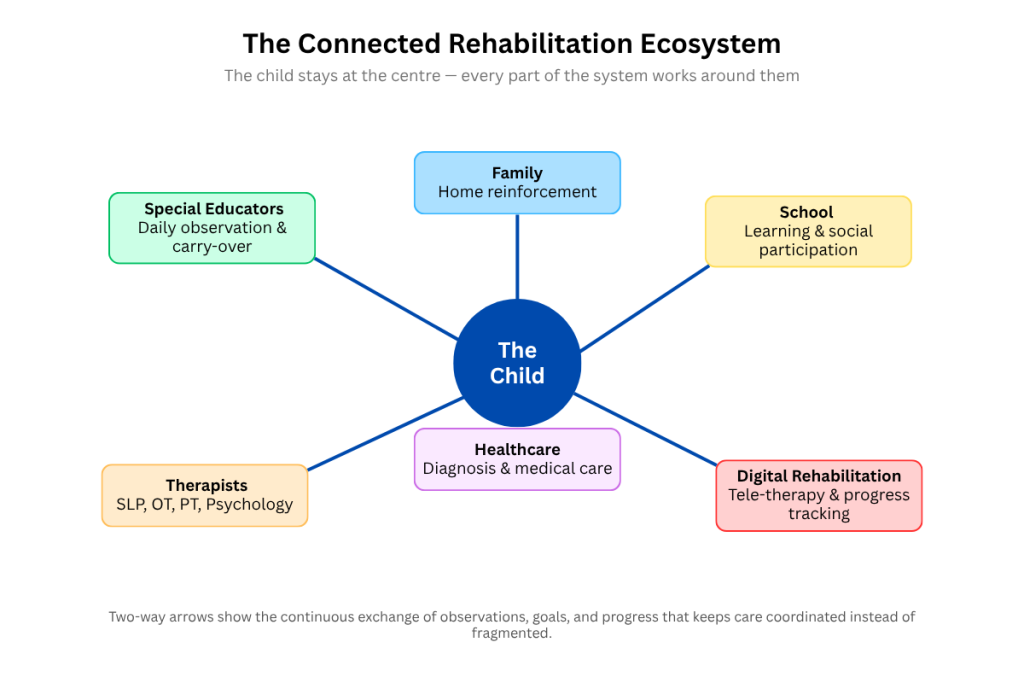
The diagram below shows how this ecosystem holds together, with the child at the centre and every other part working in coordination around them.

 The Connected Rehabilitation Ecosystem — the child stays at the centre while family, school, healthcare, special educators, therapists, and digital rehabilitation work in coordination around them. 

Traditional vs. Connected Rehabilitation Delivery  

AspectTraditional (Isolated) DeliveryConnected / Digital Rehabilitation
Coordination between professionalsTherapists, educators, and doctors often work separately, with reports passed by handReal-time communication and shared progress tracking across the care team
Geographic reachLimited to families who can travel to a centreExtends to rural and underserved areas via tele-rehabilitation
Waiting periodsLong waits for assessment and therapy slotsFaster scheduling and remote assessment options reduce delays
Continuity of careEasily disrupted by relocation, therapist changes, or missed appointmentsProgress history and goals persist digitally, supporting continuity
Parent involvementParents relay updates manually between providersParents access real-time progress and guided home activities
Skill generalisationDepends on informal communication between school and clinicStructured carry-over between therapy, classroom, and home

Why Special Educators Matter in This Ecosystem  

An accessible rehabilitation system depends on collaboration, and special educators are at its centre. Unlike therapists who may see a child periodically, special educators interact with children daily, allowing them to observe progress, identify emerging needs, and reinforce therapeutic goals within natural learning environments. They bridge the gap between home, school, and rehabilitation services by collaborating with families, therapists, and healthcare professionals to ensure consistent, child-centred intervention. As digital rehabilitation expands, their role in monitoring progress, facilitating communication, and promoting continuity of care becomes even more significant.

Conclusion: Looking Beyond the Classroom  

A child’s development does not occur within the boundaries of a classroom or a rehabilitation centre. It is shaped by the collective efforts of families, educators, therapists, healthcare professionals, policymakers, and communities working towards a common goal. When any one of these systems functions in isolation, children are left navigating fragmented services rather than receiving the coordinated support they deserve.

Closing the gaps described above calls for stronger public rehabilitation systems, closer collaboration between education and healthcare, empowered families, multidisciplinary teamwork, and thoughtful integration of digital technologies that extend support beyond traditional service settings.

Within this ecosystem, special educators play a uniquely significant role. Their daily interactions with children, close partnerships with families, and collaboration with rehabilitation professionals position them as the bridge connecting assessment, intervention, education, and participation. Their work reminds us that rehabilitation is not confined to therapy sessions; it becomes meaningful only when it is carried into classrooms, homes, playgrounds, and communities where children learn, communicate, and grow.

Rehabilitation should no longer be viewed as a service that children travel to receive. Instead, it should become a system that reaches children wherever they are through schools, communities, government institutions, digital technologies, and coordinated multidisciplinary care. When rehabilitation becomes accessible rather than exceptional, inclusion moves beyond policy and becomes a lived reality.

When our systems are designed around real outcomes such as confident participation, effective communication, greater independence, and a sense of belonging, rehabilitation becomes more than a service. It becomes an investment in every child’s right to learn, participate, and reach their full potential.


Your Child Has Been Screened. What Happens Next? 

Reading Time: 11 minutes

A Parent’s Guide to Assessment, Therapy, and Developmental Progress


Clinically Reviewed by
Jinson Alias
Consultant Psychologist | Special Educator | Digital Therapy Trainer


The Development Journey at a Glance

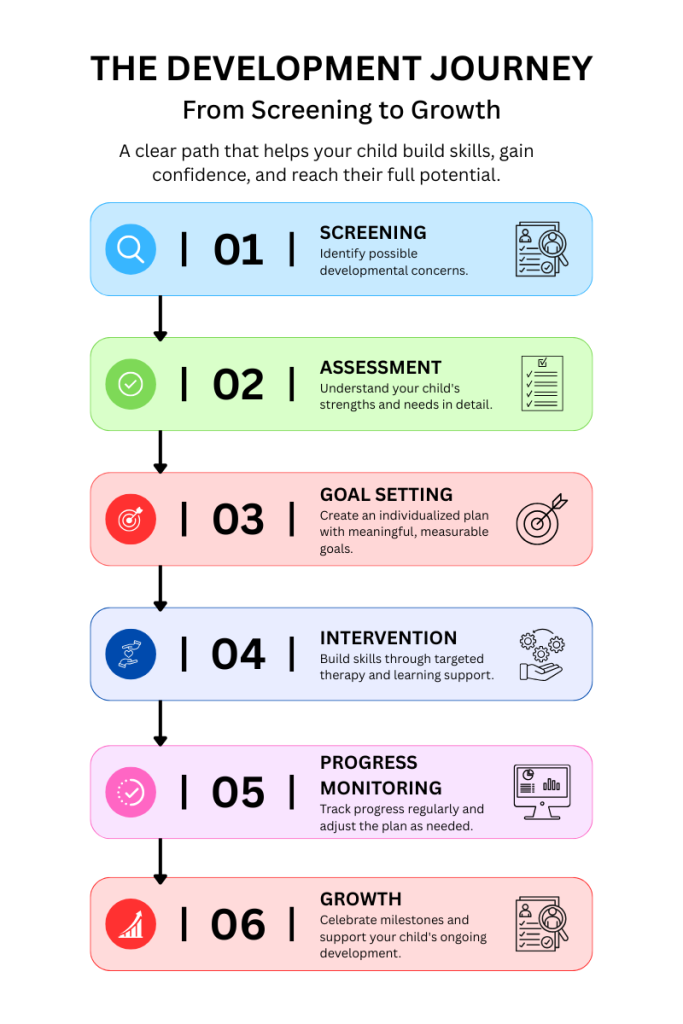
The child development journey from screening to growth.

Before anything else, it helps to see the full picture. Many parents receive a screening report and feel overwhelmed because they can’t see what comes after. Here is the journey from start to growth: 

Screening → Assessment → Goal Setting → Intervention →Progress Monitoring → Growth

Each stage builds on the one before it. Screening opens the door. Assessment provides the map. Goals set the destination. Intervention is the journey itself. Progress monitoring keeps everyone on course. And growth, growth that is real, meaningful, and observable, is what it all leads toward.

What a Developmental Screening Really Means 

A screening is a brief, structured observation designed to identify children who may benefit from a closer look. It measures whether a child’s development is broadly on track for their age, flagging areas where further evaluation might be valuable. Screenings look at communication, motor skills, learning readiness, social interaction, behaviour, and adaptive skills. 

But here is what many parents don’t initially understand: a screening is not a diagnosis. It does not tell you what is wrong, why a challenge exists, or what a child will or won’t be capable of. It is a signal, not a verdict. A flag raised in a screening simply means that a more detailed look would be worthwhile — nothing more, and nothing less. 

Receiving a screening recommendation is not confirmation that something is seriously wrong with your child. It is an invitation to gather better information so that the right support, if needed, can be put in place as early as possible.

Key Takeaway

When the Report Arrives, Many Parents Feel Stuck 

This is one of the most important things to acknowledge, because it is also one of the least spoken about: receiving a developmental screening report can be an emotionally difficult experience, even when the language in the report is calm and clinical. 

Many parents describe feeling confused because they are not sure what the results actually mean in practical terms. Others feel fear about what the future holds. Some feel a quiet guilt, wondering whether something they did or didn’t do contributed to the concern. And almost all parents experience uncertainty about what the right next step actually is. 

These reactions are completely normal. A developmental screening report touches on something deeply personal — a parent’s hopes and worries for their child’s future. What matters most is that the emotional weight of receiving a report doesn’t cause a parent to freeze. Because the most valuable thing a parent can do after a screening is to keep moving forward toward information, clarity, and support.

Does any of this sound familiar? 

  • “The teacher mentioned concerns, but I’m not sure how serious they are.” 
  • “Everyone is giving me different advice.” 
  • “I’m worried about waiting too long, but I don’t want to overreact.” 
  • “I just want to know what my child needs.” 

If you’ve had any of these thoughts, you’re not alone. Many families find themselves asking the same questions after a screening.

The “Wait and See” Trap: The Biggest Mistake Parents Make 

After receiving a screening report, one of the most common responses is to wait. To observe for a few more months. To hope the concern resolves on its own. 

This instinct is understandable. No parent wants to make a big deal out of something that might turn out to be nothing. But the evidence on early intervention is clear and consistent: the earlier appropriate support begins, the better the outcomes tend to be. 

The brain is at its most adaptable in the early years of life. Waiting means missing months, or sometimes even years, during this critical window. In many cases, children who receive support earlier have more opportunities to build skills during critical periods of development. 

Acting early is not overreacting. If further assessment reveals that a child is developing typically and no support is needed, nothing has been lost. But if support is needed and it begins early, the difference it makes can be profound and lasting.

Step 1: Comprehensive Assessment — Looking Deeper Than the Screening  

The next step after a screening recommendation is a comprehensive assessment conducted by qualified professionals. Where a screening casts a wide net, an assessment looks in depth at specific areas of development to understand not just whether a challenge exists, but its nature, its degree, and how it shows up in the child’s daily life.

A full assessment may explore several domains:

  • Speech and language — receptive language, expressive language, articulation, and social communication
  • Motor skills — fine motor control (handwriting, grip, cutting) and gross motor skills (balance, coordination, movement)
  • Sensory processing — how the child’s nervous system processes and responds to sensory input
  • Learning and cognition — problem-solving, memory, attention, and how the child processes new information
  • Behaviour — patterns of response, self-regulation, and emotional management
  • Social skills — how the child interacts with peers, reads social cues, and engages in group settings

This assessment is conducted by a team that may include a speech-language pathologist, an occupational therapist, a special educator, or a psychologist — depending on what the screening flagged and what the child’s specific needs appear to be. The result is not a label. It is a detailed, individualized profile of how this child learns, communicates, and engages with the world.

Step 2: Understanding Your Child’s Strengths — Not Just Challenges  

A good assessment does not only map what a child finds difficult. It also identifies what a child does well — and this matters more than many parents initially realise.

Every child brings a unique combination of strengths, interests, and learning preferences to any therapeutic or educational setting. A child who struggles with spoken language may be a remarkably strong visual learner. A child who finds sitting still difficult may show exceptional creativity or spatial reasoning. A child with challenges in social interaction may demonstrate deep focus and an extraordinary memory for things that interest them.

These strengths are not merely encouraging anecdotes. They are practical tools. Effective intervention is built on a foundation of what a child can already do, using their interests and natural abilities to create pathways toward the skills they are still developing. Understanding your child’s learning style, what motivates them, and where their confidence already exists allows therapists and educators to create support that feels less like struggle and more like genuine progress.

Step 3: Setting Meaningful Goals — From Information to Action  

Once assessment is complete, the findings are translated into individualized goals. This is where the plan begins to take concrete shape. Goals are prioritized based on what will most meaningfully improve a child’s daily life in communication, independence, participation at school, and engagement at home.

Goals should be specific, measurable, and time-bound. Not “improve communication” but “will use two-word phrases to request preferred items in four out of five opportunities.” Not “improve attention” but “will remain on task during a structured activity for ten minutes with minimal prompting.”

Understanding the IEP  

For many children receiving developmental support, goals are formalized in an Individualized Education Program (IEP) — a documented plan that outlines what a child is working toward, what support they will receive, and how progress will be measured. The IEP is developed collaboratively by the therapeutic team, the school, and the family.

Family involvement at the goal-setting stage is not optional; it is essential. Parents bring knowledge of a child’s daily context, home environment, and personal motivations that professionals cannot fully access from a clinical setting. The best goals are always built with parents, not just for them.

Many schools and therapy teams now use digital platforms such as XceptionalLEARNING to document goals, coordinate intervention plans, and monitor progress across settings.

Assessment → Goals → Activities → Progress Review → Updated Goals

Step 4: Beginning Intervention — Putting the Plan Into Practice  

Intervention is where the goals a child and their team have set begin to be actively worked toward. Not every child needs the same combination of services, and not every child needs intensive support across all areas. What intervention looks like depends entirely on the individual child’s profile.

Common types of intervention include:

  • Speech Therapy — building communication, language comprehension, articulation, and social language skills
  • Occupational Therapy — developing fine motor control, sensory processing, daily living skills, and postural stability
  • Special Education Support — personalized academic learning and classroom participation strategies
  • Behavioural Support — developing self-regulation, focus, emotional management, and adaptive behaviour

The most effective intervention is always individualized. Two children with similar screening results may need very different approaches, different intensities of support, and different combinations of services. This is why the assessment stage matters so much — it ensures that intervention is targeted, relevant, and genuinely matched to the child in front of the therapist.

What Happens Between Therapy Sessions?  

Most children attending therapy spend perhaps two hours a week in sessions, which means the remaining 150-plus waking hours happen at home, at school, and in the everyday moments of daily life. Development doesn’t pause between appointments. Skills are reinforced or they fade. Progress is consolidated or it stalls.

The consistency of what happens between sessions is often the single most important factor in how quickly a child moves forward. Parents receive recommendations during sessions but don’t always have clear guidance on how to carry them into daily routines. Teachers want to support therapy goals but rarely have direct access to what a child is currently working on.

XceptionalLEARNING‘s Digital Activity Book (VergeTAB) and home activity tools help bridge that gap — giving parents structured, therapist-approved activities to use between sessions, and giving therapists visibility into how those activities are going.

How Do You Know If Therapy Is Actually Working?  

Developmental progress is rarely sudden or dramatic. It tends to be gradual, sometimes uneven, and easy to miss in the busyness of daily life — particularly when a parent is too close to their child’s day-to-day experience to see the larger arc of change. Progress often appears first in everyday life rather than during formal testing.

Progress shows up in ways that might seem small but aren’t. A child who struggled with dressing independently may now complete the whole routine with just one prompt. A child who rarely initiated conversation may now be the one asking questions. These are significant milestones in a child’s growing independence and confidence — and they deserve to be recognised as such.

For example, a child who once needed repeated reminders to complete a morning routine may begin doing most steps independently. Small changes like these are often early signs that intervention is having an impact.

Progress tracking also supports good decision-making. When progress is measured and recorded consistently, therapists and families can see what is working, identify what needs to be adjusted, and ensure that intervention continues to be well-matched to the child’s current level and next steps.

Signs of Meaningful Progress  

As a parent, knowing what to look for makes it easier to recognise progress as it happens:

  • Better attention and focus during tasks
  • Improved communication — more words, clearer speech, or richer sentences
  • Greater independence in daily routines
  • Better participation in family activities
  • Improved classroom engagement
  • Greater confidence in social situations
  • More willingness to try new tasks
  • Fewer emotional outbursts or quicker recovery from them
How XceptionalLEARNING Tracks Progress  

The XceptionalLEARNING platform gives therapists structured tools to document session observations, track goal completion, and share updates with parents and teachers — all in one place. Parents have access to progress information in real time rather than waiting until the next appointment. And the data captured over time supports evidence-based decisions about when to adjust goals, introduce new areas of focus, or celebrate a milestone that has genuinely been reached.

A Development Journey Is Not Always a Straight Line  

This is one of the most important things for any parent to understand — and one of the most relieving once it truly sinks in: developmental progress is not linear.

It plateaus. It doubles back. It accelerates for a few weeks and then seems to stall. A child may make strong gains in one area and then appear to plateau when a new environment introduces different demands. These are not signs that intervention has stopped working. They are a normal, expected part of how children develop.

Small gains matter. A child who takes two steps forward and one step back is still one step ahead of where they started. Recognising and celebrating incremental progress, rather than measuring a child only against where you hope they will eventually be, is one of the most important things a parent can do to sustain energy through the longer journey. Trusting the process, staying consistent, and holding a long view: these are the habits that distinguish families who see meaningful outcomes over time.

Frequently Asked Questions  

Does every child who is screened need therapy? 

No. A screening recommendation leads to assessment, and assessment determines whether intervention is appropriate — and if so, what form it should take. Some children may only need monitoring, minor support, or a conversation with a specialist to rule out concerns entirely.

How soon should assessment happen after a screening recommendation? 

As promptly as possible, particularly for younger children. The earlier a challenge is identified and understood, the more time there is to intervene during the years when the brain is most responsive. Waiting several months without a specific reason is generally not advisable.

Can developmental delays actually improve with the right support? 

Yes, significantly. Many children make substantial progress with consistent, individualized intervention, particularly when support begins early and is reinforced at home and school. The nature and degree of progress varies between children, but early and consistent support consistently improves outcomes compared to no intervention.

What can parents realistically do at home to support progress? 

Home practice is one of the highest-impact things a parent can contribute. Following through on therapist recommendations, using structured activities between sessions, creating consistent daily routines, and maintaining open communication with the therapeutic team all make a measurable difference in a child’s rate of progress.

My child seems to do well some weeks and struggle others. Is that normal?

Completely. Variability from week to week is entirely expected. Factors like sleep, illness, changes in routine, and emotional stress all influence how a child performs on any given day. What matters is the trend over weeks and months, not performance on any single day.

Every Journey Starts With Understanding  

A developmental screening report can feel like a lot to carry. Many parents expect answers and instead receive more questions, more appointments, and more uncertainty before clarity begins to emerge. That is completely normal, and it is not a sign that something has gone wrong.

Screening is not the destination. It is the first step on a path that, with the right support, leads somewhere genuinely hopeful. Assessment provides the picture. Goal setting creates the direction. Intervention builds the skills. Progress monitoring reveals how far a child has come. And growth, growth that is real, measurable, and life-changing, is what every one of those steps is working toward.

Children who receive early, consistent, individualized support go on to communicate more effectively, participate more fully, learn more confidently, and live more independently than they would have without it. The developmental journey is not always quick or smooth, but it is always worth taking.

Your child’s potential is not defined by a screening result. It is shaped by the support, consistency, and love that come after it.

Every child develops at their own pace. The goal is not to compare children with one another, but to understand where a child is today and what support will help them move forward.

Where Is Your Child on the Journey Right Now?  

Every family reading this is at a different point. Wherever you are, the right next step exists — and you don’t have to figure it out alone.

  • Recently screened
  • Waiting for assessment
  • Beginning intervention
  • Tracking progress
  • Looking for additional support

No matter where your family is today, understanding the next step can help you move forward with greater confidence.

Your Child’s Screening Is Only the Beginning  

If your child has recently been screened and you’re unsure what the next step should be, you don’t have to figure it out alone. Our team can help you understand the recommendations, explore support options, and create a plan that fits your child’s needs.

One challenge many families face is keeping assessments, therapy goals, home practice, and school support connected. When information is scattered, progress becomes harder to track and harder to act on.

From digital screening and assessment to therapy planning, home activities, and progress documentation and review — XceptionalLEARNING connects every stage of your child’s developmental journey in one place, keeping families, therapists, and educators aligned every step of the way.

Can Technology Teach Emotions? Helping Children Develop Emotional and Social Skills Through Digital Learning

Reading Time: 6 minutes

Written By Anjana VS

Special Educator

Digital Tools for Social-Emotional Learning in Neurodiverse Children

In today’s world, children are growing up surrounded by screens, sounds, animations, and interactive digital experiences. While many people still debate whether technology is helping or distracting children, one important question is gaining increasing attention:

Can Technology Actually Teach Emotions?

For neurodiverse children—including those with autism, ADHD, developmental delays, sensory sensitivities, and communication difficulties—understanding emotions and social behaviour can sometimes be challenging. Social situations may feel confusing, fast-paced, or emotionally intense. Recognizing facial expressions, responding to conversations, or managing feelings in different environments may require additional support.

In such cases, technology can provide calm, interactive, and predictable learning spaces where children can explore emotions, practice social responses, and build confidence in ways that feel safe, supportive, and easier to process.

Rather than replacing human interaction, digital learning tools are increasingly becoming supportive bridges that help children understand emotions, strengthen social skills, build relationships, and develop confidence in real-life experiences.

Understanding Social-Emotional Learning (SEL)  

Social-Emotional Learning (SEL) refers to the process through which children learn to:

  • Recognize emotions
  • Manage feelings
  • Build empathy
  • Develop relationships
  • Make responsible decisions
  • Communicate effectively

These skills are essential for emotional well-being, independence, learning, and successful participation in everyday life.

While many children naturally develop emotional understanding through observation and social interaction, neurodiverse children may benefit from clearer instruction, visual supports, and repeated opportunities to practice these skills. Many neurodiverse learners respond particularly well to structured, visual, and interactive learning experiences. This is where technology can play an important role.

Why Technology Feels Natural for Neurodiverse Children  

Many neurodiverse children are naturally drawn to digital environments. Technology provides consistency, structure, and control—qualities that often reduce stress and support learning.

Unlike real-life social interactions, digital tools can:

  • Slow down communication
  • Repeat lessons multiple times
  • Use visuals and animations
  • Offer immediate feedback
  • Reduce social pressure

For example, a child who finds facial expressions difficult to understand during conversations may feel more comfortable learning through animated characters on a screen. Technology also supports multisensory learning through visuals, sounds, and interactive activities, helping improve attention, engagement, and participation.

Digital Tools That Help Teach Emotions  

Today, many digital tools support emotional learning and social-emotional development in neurodiverse children, ranging from simple emotion-recognition applications to interactive virtual learning experiences.

1. Emotion Recognition Apps  

Emotion-recognition apps help children identify feelings using pictures, animations, and facial expressions through simple interactive activities.

These tools often focus on:

  • Happy, sad, angry, scared, surprised, and frustrated expressions
  • Body language cues
  • Emotional vocabulary
  • Real-life social scenarios

For children who find social cues difficult to interpret, repeated visual exposure can gradually improve emotional understanding.

2. Social Stories and Interactive Narratives  

Digital social stories help children prepare for everyday situations such as making friends, visiting a doctor, sharing toys, or managing disappointment.

These stories use visuals, narration, and step-by-step explanations to teach appropriate emotional responses and social behaviour.

Interactive stories are particularly effective because children actively participate in decision-making. Instead of simply reading about emotions, they experience emotional situations through guided interaction.

For example, a story may ask:

  • What should the character do if a friend feels sad?
  • How might this person feel after being ignored?
  • What is a calm way to respond when angry?

This active participation strengthens emotional reasoning and social understanding.

3. Virtual Role-Play and Simulations  

One of the biggest challenges for neurodiverse children is transferring skills learned in structured environments into real-world situations.

Virtual role-play tools create safe practice spaces where children can:

  • Start conversations
  • Respond to emotions
  • Solve social conflicts
  • Practice empathy
  • Understand consequences

For example, a virtual classroom simulation may help a child practice:

  • Raising a hand
  • Sharing materials
  • Understanding personal space
  • Responding when someone feels sad

Because mistakes inside simulations are safe, children often become more willing to try new responses and behaviours.

4. Augmentative and Alternative Communication (AAC) Tools  

Some neurodiverse children experience difficulty expressing emotions verbally. AAC devices and communication apps provide alternative ways to communicate.

Children can use symbols, pictures, or words to express:

  • “I am angry.”
  • “I need a break.”
  • “I feel scared.”
  • “I want help.”

This reduces frustration and emotional outbursts caused by communication barriers.

When children gain a reliable voice—even a digital one—emotional regulation and self-expression often improve significantly.

5. Emotion-Based Games  

Gamified emotional learning is becoming increasingly popular. Rather than simply teaching emotions through explanation, games allow children to experience emotional decision-making in an engaging and interactive way.

Examples include:

  • Choosing calming strategies during stressful situations
  • Helping characters solve conflicts
  • Identifying emotional triggers
  • Matching coping skills to emotions

These experiences make emotional learning more meaningful, practical, and enjoyable.

How Technology Supports Emotional Safety  

One of the most overlooked benefits of digital intervention is the emotional safety it can provide. Many neurodiverse children experience anxiety in social situations because they fear making mistakes, being judged, or not responding quickly enough.

They may avoid participation because:

  • They fear embarrassment
  • They process information slowly
  • They struggle with sensory overload
  • They find social reactions difficult to interpret

Technology creates safer and less stressful learning environments where children can explore communication and social interaction more comfortably.

Digital tools allow children to:

  • Pause and think before responding
  • Retry activities without punishment
  • Learn privately without social pressure
  • Practice skills independently at their own pace

Unlike real-life interactions that may sometimes feel overwhelming, technology offers predictable and controlled experiences that reduce pressure and encourage participation.

This emotional safety promotes confidence-building, experimentation, and active engagement.For example, a child who avoids face-to-face conversation practice may willingly interact with a digital avatar, interactive application, or virtual character. Over time, the confidence gained through these experiences can gradually transfer into real-world social situations.

See How Technology-Supported Learning Can Build Confidence and Engagement

Watch how technology-assisted learning helps children participate more actively, build confidence, and strengthen important developmental skills through engaging activities.

XceptionalLEARNING: The Key to Faster Learning & Better Results

Need Guidance for Your Child’s Learning and Development?

The Role of Visual Learning in Emotional Understanding  

Emotions are invisible experiences, and many neurodiverse children benefit from seeing emotions represented visually.

Digital tools can break down emotional concepts through:

  • Colour coding
  • Emoji scales
  • Animated facial expressions
  • Step-by-step emotional sequences
  • Visual coping charts

For example:

  • Red may represent anger
  • Blue may represent sadness
  • Green may represent calmness

Visual emotional mapping helps children understand feelings in a more concrete and accessible way.

Can Technology Replace Human Connection?  

The answer is simple: No.

Technology should never replace emotional relationships, caregivers, teachers, therapists, or peer interactions. Instead, technology works best as a supportive tool. Human relationships teach empathy, warmth, spontaneity, and authentic emotional experiences. Technology simply creates structured opportunities to practice these skills in a safe and supportive environment.

The most effective emotional learning happens when:

  • Digital tools
  • Human guidance
  • Real-life practice

work together.

For example:

Technology becomes a bridge—not the destination.

The Future of Emotional Learning Technology  

The future of emotional learning is becoming increasingly personalized and technology-driven. Emerging innovations are exploring how brain activity, attention patterns, and emotional responses can be supported in real time, particularly for neurodiverse children and children with ADHD.

Brain-Tracking Technology  

Wearable devices may help monitor focus, attention, and emotional stress during learning activities.

Attention Development Tools  

Interactive brain-based activities may support concentration, impulse control, and sustained attention.

Neurofeedback Training  

Children may receive real-time visual or auditory feedback based on brain activity to improve self-regulation and focus.

Personalized Emotional Support  

AI-powered platforms may adapt learning activities according to a child’s emotional state and attention level.

Stress and Anxiety Detection  

Smart systems may identify early signs of stress or sensory overload and provide calming strategies when needed.

These innovations have the potential to make emotional learning more individualized, engaging, and effective. In this evolving landscape, technology-based platforms can help support emotional learning, communication development, sensory-friendly engagement, and personalized intervention strategies that encourage confidence, emotional regulation, and meaningful participation in everyday life.

Conclusion

Technology cannot replace human relationships, empathy, or meaningful social experiences, but it can become a powerful tool for helping neurodiverse children understand emotions, strengthen communication, develop social skills, and build confidence. Through interactive learning experiences, visual supports, emotional learning activities, and personalized interventions, digital tools create opportunities for children to practice important life skills in ways that feel engaging, structured, and accessible.

As educational technology continues to evolve, XceptionalLEARNING continues to support neurodiverse children through innovative digital learning solutions that bridge the gap between education, therapy, and everyday development. By combining emotional learning, communication support, sensory-friendly activities, and personalized interventions, the platform helps children build confidence, improve focus, strengthen emotional regulation, and participate more meaningfully in daily life. When combined with the guidance of parents, educators, and therapists, technology becomes more than a learning tool—it becomes a supportive bridge that empowers children to grow, connect, and succeed.

Ready to Explore Technology-Supported Learning Solutions?

Digital Transformation in Special Education: Integrating Therapy, Assessment and Progress Tracking

Reading Time: 4 minutes

Clinically Reviewed by

Meha P. Parekh
Special Educator

Quick Summary

  • Digital systems connect therapy, assessment, and progress tracking in one place
  • Eliminates fragmented documentation across professionals
  • Enables real-time progress monitoring and better decision-making
  • Improves collaboration between therapists, educators, and parents
  • Helps institutions deliver consistent, measurable outcomes

Introduction: Why Many Therapy Systems Still Struggle

Why do many therapy programs struggle to deliver consistent results despite expert intervention?

Special education is evolving rapidly. More children are being identified with speech delays, learning difficulties, developmental disorders, and behavioural challenges at an early stage. While this is a positive shift, it also exposes a major gap in how therapy services are delivered.

Most therapy systems today still operate in silos:

  • Therapy sessions happen in isolation
  • Progress is recorded manually
  • Assessments are not continuously tracked
  • Parents receive limited updates

This lack of integration makes it difficult to ensure consistent, measurable outcomes.

Digital transformation solves this by connecting therapy, assessment, and progress tracking into one structured ecosystem.

Challenges in Traditional Therapy Systems

1. Fragmented Documentation

Different professionals maintain separate records:

  • Speech therapy notes
  • Occupational therapy reports
  • Classroom observations

Result: No unified view of the child’s development.

Without a centralized system, valuable insights across developmental areas are often missed.

2. Limited Progress Visibility

Manual tracking makes it difficult to:

  • Measure long-term improvement
  • Identify developmental patterns
  • Adjust therapy strategies effectively

Therapists rely on periodic reviews instead of continuous data.

3. Low Parent Involvement

Parents often:

  • Receive updates only during review meetings
  • Lack structured guidance for home practice

This reduces therapy consistency outside sessions.

Want to see how a connected therapy system solves these challenges?

Traditional vs Digital Therapy Systems

Traditional ApproachDigital Approach
Manual documentationReal-time tracking
Isolated sessionsConnected ecosystem
Limited insightsData-driven decisions
Minimal parent involvementContinuous collaboration
A Comparative View of Traditional and Digital Therapy Systems in Special Education

This shift is the foundation of modern special education systems.

What a Modern Digital Therapy System Should Include

A truly effective system should support the entire therapy workflow, not just one part of intervention:

  • Therapy Session Management – Conduct and record structured sessions
  • Digital Screening and Assessments – Identify developmental needs early
  • Structured Activity Libraries – Pre-designed therapy exercises across domains
  • Progress Tracking Dashboards – Visual reports and analytics
  • Parent Collaboration Tools – Guided home-based activities
  • Institutional Management Systems – Manage schedules, records, and performance

Together, these create a complete therapy ecosystem, not just a tool.

How a Digital Therapy System Works (Step-by-Step)

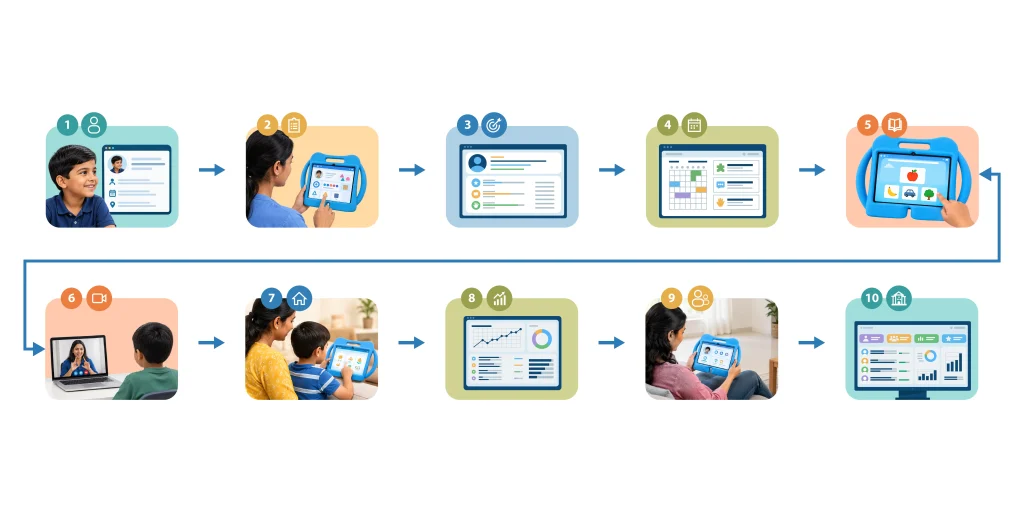
A connected therapy platform follows a structured workflow:

  1. Child Profile Creation
    Developmental history, screening results, and therapy goals
  2. Assessment and Evaluation
    Identify strengths, delays, and intervention areas
  3. Therapy Plan Creation
    Personalized therapy programs based on data
  4. Therapy Sessions
    Interactive, structured activities for engagement
  5. Progress Tracking
    Real-time recording with reports and analytics
  6. Parent Collaboration
    Guided home activities and regular updates

This ensures consistency, accountability, and measurable progress.

See How a Digital Therapy Platform Works in Real Environments

Instead of imagining how a connected therapy system works, watch how therapy sessions, assessments, and progress tracking come together in real environments.

Watch the platform in action below:
Revolutionary Change in Rehabilitation | XceptionalLEARNING’s Digital Therapy Platform

Want to implement this structured system in your school or clinic?

Example of a Connected Therapy Ecosystem

Platforms like XceptionalLEARNING are designed specifically for special education and therapy environments.

They integrate:

  • Digital therapy content libraries
  • Tele-therapy capabilities
  • Therapy plan creation and management
  • Progress monitoring
  • Parent engagement tools

This creates a seamless ecosystem where therapy, learning, and tracking work together.

Digital Screening and Early Identification

Early intervention is critical for better outcomes.

Digital screening tools help professionals:

  • Identify developmental delays early
  • Assess multiple developmental domains
  • Start targeted therapy faster

Early identification = more effective intervention and better long-term results

Technology and Assistive Devices in Therapy

Therapy is no longer limited to traditional tools.

Assistive devices like VergeTAB are transforming therapy sessions by enabling:

  • Structured learning activities
  • Speech and communication training
  • Cognitive and behavioural development
  • Motor skill improvement

Unlike regular tablets, these are designed specifically for therapy-focused environments.

When combined with digital platforms, they also provide performance insights and engagement tracking.

See How VergeTAB Transform Learning in Special Schools

Understanding the concept is one thing—but seeing how structured digital tools are used in real classrooms makes the difference.

Watch how VergeTAB support learning, engagement, and therapy outcomes in special school environments:
How VergeTAB Is Transforming Learning for Children with Special Needs | A Special School Perspective

Want to implement this in your school?

Benefits for Schools and Therapy Centres

Digital systems provide significant advantages:

  • Improved therapy consistency
  • Clear tracking of student progress
  • Better collaboration between professionals
  • Reduced manual workload
  • Data-driven decision making

Institutions gain both operational efficiency and better therapy outcomes.

Emerging Trends in Digital Special Education

The future of therapy systems is moving toward:

  • AI-driven progress analysis
  • Adaptive learning content
  • Cloud-based collaboration
  • Personalized therapy pathways

The goal: Fully connected, intelligent therapy ecosystems.

Frequently Asked Questions

What is a digital therapy system?

A platform that connects therapy sessions, assessments, and progress tracking in one structured environment.

How does it improve outcomes?

By enabling progress data tracking, structured workflows, and consistent intervention strategies.

Can parents use it at home?

Yes. Parents can access guided activities and support therapy goals outside sessions.

Conclusion: The Future is Connected Therapy

Special education is rapidly moving toward structured, connected systems that ensure consistency across therapy, classroom, and home. Platforms like XceptionalLEARNING are enabling schools, therapists, and families to collaborate more effectively while delivering measurable, data-driven outcomes. Combined with assistive tools like VergeTAB and structured activity libraries, institutions can build scalable, consistent, and result-oriented intervention programs.

Institutions that adopt digital therapy systems can:

  • Deliver better outcomes
  • Improve collaboration
  • Track progress more effectively

If your current system is still fragmented, now is the time to evolve.

Ready to Upgrade Your Therapy System?

See how it can work for your school or clinic.

Why Special Education is Important for Real-Life Skill Development in Children

Reading Time: 3 minutes

Written by: Jasna K
Special Educator

Introduction  

When we see a child with different learning needs say a new word, hold a pencil, or stay focused for a few minutes, it feels like a big achievement. These moments often come through speech therapy, occupational therapy, and behavioural support.

However, development does not stop there.

Special education programs play an equally important role in helping children use these skills in real-life situations. Skills become meaningful only when they are applied in daily life—at home, in school, and in social environments.

This is where therapy and special education work together, supporting the child’s overall development in a complete and practical way.

Beyond Learning a Skill  

Therapies help children develop essential abilities like communication, movement, and behaviour, creating a strong foundation for growth.

But learning a skill is only the first step.

What truly matters is:
Can the child use that skill in real life?

Special education bridges this gap by helping children apply what they learn during therapy into everyday situations. This makes learning more meaningful, functional, and useful.

How Special Education Supports Daily Learning  

Special education focuses on practical application through structured support.

It helps children by:

  • Providing consistent routines
  • Using simple, guided activities
  • Encouraging repetition and practice
  • Supporting learning in real-life environments like home and school

Children are guided step-by-step to understand:

  • What to do
  • When to do it
  • How to do it

Over time, this builds confidence, independence, and consistency.

Real-Life Examples of Skill Application  

  • A child learns to say “water” in speech therapy → uses it when thirsty at home or in class
  • A child learns greetings → starts saying “hello” to teachers and family
  • A child practices sitting during therapy → follows classroom sitting routines

These small transitions show how skills become meaningful when used naturally.

Watch how special education helps children apply skills in real-life classroom settings:
How VergeTAB Is Transforming Learning for Children with Special Needs | A Special School Perspective

This video shows how structured support and guided activities help children use learned skills naturally in everyday environments like classrooms and home.

Want to implement this structured learning approach for your child or school?

Supporting Daily Life Through Special Education  

Special education helps children connect learning with real-life experiences. It supports them in:

  • Using communication skills in different situations
  • Following daily routines and instructions
  • Participating in classroom and home activities
  • Interacting with others confidently

With regular practice, children begin to use their skills more independently in everyday life.

Working Together for the Child  

A child’s development becomes stronger when all supports work together.

  • Therapy builds the skill
  • Special education helps apply the skill

When combined, they create a complete learning system that supports real progress.

This integrated approach is especially important in early intervention programs, where consistency and collaboration make a big difference.

Platforms like XceptionalLEARNING are designed to support this model by connecting therapists, educators, and parents—ensuring that every skill learned is practiced and applied effectively in daily life.

Conclusion  

A child’s development becomes truly meaningful when learning goes beyond acquiring skills and extends into using them in everyday life.

Special education plays a vital role in this journey by helping children apply what they learn through therapy in real-world situations. When therapies and special education programs work together, children gain not only skills but also the confidence and independence to use them naturally.

Want to see how structured therapy and special education work together in real life?

Explore how this approach can support your child or institution.

Empowering Parents at Home: Building a Structured Digital Learning Ecosystem for Children

Reading Time: 4 minutes

Written by

Athira. M.K

Special Educator

The Role of Technology in a Connected Therapy Ecosystem

A child’s learning journey does not end at the classroom door. For children receiving therapy, special education support, or early intervention, learning continues at home through structured routines, guided practice, and meaningful parent involvement.

In today’s digital age, education and therapy no longer function in isolation. Instead, they operate within a connected learning and therapy ecosystem — where children, parents, therapists, educators, and digital platforms work together toward shared developmental goals.

For parents, this ecosystem creates powerful opportunities. When used thoughtfully, technology does not replace parental involvement — it strengthens it. With structured tools and guided digital systems, parents become active partners in their child’s progress.

Establishing a Structured Learning Routine at Home

Children — especially those receiving speech therapy, occupational therapy, behavioural support, or early intervention — develop in predictable environments. Structure reduces anxiety, improves attention, and increases engagement.

Parents can establish consistency by:
  • Setting fixed times for learning, therapy practice, play, meals, and rest
  • Balancing digital sessions with offline reinforcement
  • Using visual schedules and guided transitions

Within the XceptionalLEARNING ecosystem, tools like the XL Portal support structured implementation by organizing therapy goals, digital sessions, and daily reinforcement activities in one unified space. Parents can clearly see what needs to be practiced and when — reducing uncertainty and increasing confidence.

When routines are structured, children transition more smoothly between activities and engage more positively with learning tasks.

Using Technology as a Support System, Not a Substitute

Technology is most effective when it supports human interaction — not replaces it. Emotional connection, encouragement, and presence remain central to a child’s development.

Parents can strengthen learning by:
  • Sitting with their child during guided digital sessions
  • Discussing therapy goals and progress
  • Asking open-ended questions
  • Encouraging reflection and communication

Structured tools such as VergeTAB, a digital activity book, enable therapists to assign targeted activities aligned with speech, motor, behavioural, and cognitive goals. Parents can reinforce these goals at home using the same structured activities, ensuring consistency and continuity across environments.

This alignment transforms digital tools into collaborative support systems rather than passive screen time.

Enabling Personalized Learning Through Digital Tools

Every child learns differently. One of the most powerful advantages of technology-enabled therapy is personalization.

Digital systems allow:
  • Adjustment of learning pace
  • Custom difficulty levels
  • Visual, auditory, and interactive formats
  • Repetition without pressure

This is especially critical in Early Intervention Programs, where small, consistent gains build long-term developmental foundations.

Through the XL Portal, therapy goals are clearly structured and measurable. Parents can see what skill is being targeted — whether it is speech articulation, fine motor coordination, sensory regulation, or social communication — and support it appropriately at home.

Personalization removes comparison and builds confidence.

Strengthening Communication Through Structured Digital Supports

Communication is central to learning — particularly for children with speech delays, autism spectrum conditions, or expressive language challenges.

Digital tools support communication by:
  • Providing visual-based interaction formats
  • Supporting structured choice-making
  • Reducing frustration during expression

When parents consistently use structured communication supports at home, children experience fewer breakdowns and greater confidence. This strengthens both learning engagement and emotional bonding.

Connecting Home Practice With Institutional Goals

One of the biggest challenges in therapy is lack of continuity between clinic/school sessions and home practice.

A connected ecosystem solves this.

With institutional dashboards, educators and therapists can:

  • Track progress
  • Monitor consistency
  • Adjust therapy goals
  • Share updates transparently

Parents gain visibility into performance metrics and session engagement, ensuring that home reinforcement directly aligns with professional objectives.

This consistency significantly improves skill retention and generalization.

Balancing Digital Learning With Real-World Reinforcement

Technology enhances learning — but real-world application strengthens it.

Digital sessions introduce skills in a structured way, but children truly internalize those skills when they practice them in everyday situations. Real-life reinforcement builds confidence, independence, and meaningful skill transfer.

Parents can:
  • Follow digital therapy sessions with drawing, building, or sensory-based play
  • Reinforce communication skills during meals, playtime, or family outings
  • Practice motor skills through daily routines like dressing, organizing toys, or helping in simple household tasks

Within this connected ecosystem, the XL Marketplace further supports families by providing access to qualified therapists, specialized intervention services, and structured digital therapy resources. Parents can explore professional guidance, curated learning supports, and additional therapy services that complement their child’s goals.

This ensures that digital guidance does not remain confined to the screen. Instead, it becomes part of a broader, professionally supported learning journey — translating structured therapy into practical, everyday progress.

Using Data to Understand Progress and Intervene Early

One of the most empowering aspects of a connected therapy ecosystem is visibility.

Through centralized platforms, parents can:
  • Track engagement patterns
  • Identify emerging strengths
  • Detect learning gaps early
  • Collaborate with therapists proactively

Rather than reacting to challenges months later, parents can respond early and confidently.

This is particularly impactful in early childhood, where timely intervention shapes long-term developmental outcomes.

Encouraging Healthy and Responsible Technology Use

Structured digital ecosystems are not about unlimited screen exposure — they are about purposeful engagement.

Healthy habits include:
  • Defined session durations
  • Movement breaks
  • Calm, distraction-free environments
  • Parent-guided participation

When technology is structured and goal-oriented, it becomes a developmental tool rather than entertainment.

How a Connected Therapy Ecosystem Empowers Parents

Technology, when implemented within a unified system like XceptionalLEARNING, empowers parents by:

  • Reducing confusion about therapy goals
  • Offering structured reinforcement pathways
  • Providing measurable progress tracking
  • Strengthening collaboration with institutions
  • Supporting early intervention consistency

Parents move from uncertainty to clarity — from passive observers to informed partners.

Conclusion

When parents actively participate in a connected therapy ecosystem, children experience structured progress, personalized support, and consistent developmental growth. Learning at home becomes focused, measurable, and aligned — never random or overwhelming.

Through solutions offered by XceptionalLEARNING, families gain access to digital therapy systems that unify therapy goals with practical home-based support.

Learning becomes consistent. Progress becomes measurable. Development becomes collaborative.

Take the Next Step

Ready to build a structured digital therapy ecosystem for your child or institution?

Connect with our team on WhatsApp for personalized guidance on implementation, solutions, and professional support.

Let’s create clarity, continuity, and measurable growth — together.

Learning Beyond Theory: Evidence and Technology in Neurodiverse Intervention

Reading Time: 3 minutes

Written by

Kavya S Kumar

Speech Language Pathologist

Bridging Evidence, Practice, and Technology

The field of neurodiverse intervention is rapidly evolving, demanding approaches that are evidence-based, multidisciplinary, and adaptable to technological advancements. Addressing this need, the National Workshop on “Emerging Trends in Multidisciplinary Evidence-Based Intervention of Neurodiverse Population”, held on 18–19 December 2025 at AIISH, Mysuru, brought together clinicians, students, and professionals from allied disciplines for two days of immersive learning and dialogue.

With close to 60 participants, the workshop created a collaborative space to explore emerging clinical practices, technological innovations, and interdisciplinary perspectives shaping the future of neurodiverse care.

A Holistic View of Neurodiversity

The workshop began with sessions that strengthened the theoretical and clinical foundation of neurodiverse intervention. Topics such as neuroscience of language in autism, gestalt language processing, and parent-mediated intervention highlighted the importance of understanding neurodiversity beyond isolated skill deficits.

These sessions reinforced a growing consensus in clinical practice—that meaningful outcomes emerge when intervention is individualized, family-centered, and grounded in evidence.

“Effective intervention begins with understanding the neurobiology, environment, and lived experience of the neurodiverse individual.”

Play, Participation, and Functional Communication

Sessions on play-based strategies emphasized naturalistic, child-led approaches to communication development. Rather than focusing solely on structured drills, speakers highlighted the importance of embedding learning within play, interaction, and everyday contexts.

This approach resonated strongly with participants, reinforcing the shift toward functional communication and participation-based goals in therapy.

Technology in Neurodiverse Intervention: From Concept to Practice

One of the most engaging segments of the workshop focused on the interaction of technology in neurodiverse intervention. The sessions explored how XceptionalLEARNING digital solutions can support clinicians in assessment, goal tracking, documentation, and caregiver collaboration.

A live demonstration of the XceptionalLEARNING platform showcased how technology can streamline clinical workflows while maintaining therapeutic integrity. Participants observed how structured digital systems can enable multidisciplinary teams to work collaboratively and consistently.

“Technology does not replace the clinician—it enhances collaboration, continuity, and clarity in care.”

The discussion also extended beyond clinical use to address scalability and sustainability, highlighting how thoughtfully designed platforms can support institutions, clinics, and individual practitioners alike.

Translating Knowledge into Clinical Action

Day two of the workshop emphasized applied learning through sessions on PROMPT therapy, AAC systems, sensory integration, nutritional considerations, and psychological perspectives on emotional and behavioural needs.

A standout component was the interactive technology segment, which included open query discussions and a live case discussion by XceptionalLEARNING team. These sessions demonstrated how technology can be seamlessly integrated into real-world clinical reasoning, from assessment interpretation to intervention planning.

“When technology aligns with clinical reasoning, it becomes a powerful tool for individualized intervention.”

Key Takeaways

  • Neurodiverse intervention thrives on multidisciplinary collaboration
  • Evidence-based practices must remain functional, contextual, and family-centered
  • Technology enhances efficiency, access, and outcome monitoring
  • Live demonstrations and case discussions deepen clinical understanding
  • Ethical and sustainable technology integration is essential for long-term impact

Looking Ahead

The workshop concluded with a strong emphasis on the future of neurodiverse intervention—one that is inclusive, evidence-driven, and technology-enabled. As the needs of neurodiverse individuals continue to evolve, professionals must embrace innovation while staying rooted in sound clinical judgment.

Workshops such as this play a vital role in shaping informed, reflective, and future-ready practitioners committed to delivering meaningful outcomes.

To take this vision forward, contact us to learn how we support neurodiverse intervention through innovative, evidence-based solutions. Our Digital Activity Book empowers practitioners with technology-enabled tools for meaningful and measurable outcomes.

From Tiny Steps to Big Tomorrows: What Christmas and New Year Teach About Hope

Reading Time: 4 minutes

Clinically Reviewed by

Aswathy Ponnachan

Medical and Psychiatric Social Worker

As December arrives, the world slowly transforms — twinkling lights, cheerful songs, and children excitedly preparing for Christmas and the New Year fill every corner. Beyond the celebrations, this season carries a deeper meaning — the spirit of new beginnings.

For educators, therapists, and parents, this is not just the close of a calendar year; it’s a chance to pause, reflect, and renew our commitment to nurturing every child’s growth. Just as Christmas symbolizes hope and generosity, education during this time reminds us that learning is an act of giving — the gift of opportunity, patience, and encouragement.

Lessons from the Season

The holiday season offers lessons far beyond the classroom. It teaches values that are at the heart of inclusive education — compassion, sharing, and understanding differences.

Christmas reminds us to celebrate every child’s uniqueness. Each learner brings their own gifts — curiosity, creativity, persistence — and it’s our role to recognize and nurture them.

The New Year symbolizes growth and renewal. It encourages educators and families to set new goals, try different approaches, and believe that progress, however small, is still progress.

In therapy and learning environments, these seasonal lessons resonate deeply. When children experience setbacks or slow progress, hope becomes the invisible thread that keeps everyone moving forward.

Inclusion as the True Celebration

Inclusive education isn’t just about policies or classrooms — it’s about a mindset of belonging. Festivals like Christmas and New Year create wonderful opportunities to model inclusion naturally.

  • When children decorate a shared Christmas tree, they learn teamwork.
  • When schools host inclusive celebrations, children with special needs feel part of something bigger.
  • When a teacher adapts an activity for a child with speech or motor delays, inclusion becomes an everyday act of kindness.

These small, thoughtful gestures remind us that the most meaningful celebrations are those where every child can participate — in their own way, at their own pace.

Practical Ways to Bring Festive Learning into Classrooms and Homes

Here are a few simple, joyful ways educators and parents can turn Christmas and New Year into opportunities for meaningful learning:

Storytelling for Empathy:
Share stories about kindness, gratitude, and giving. Encourage children to express what these mean to them.

Holiday-Themed Art & Craft:
Activities like making greeting cards, sensory decorations, or handmade gifts help children build fine motor and communication skills.

Music and Movement Sessions:
Christmas carols and dance activities are great for speech, rhythm, and coordination — especially for children in developmental or occupational therapy.

“Acts of Kindness” Calendar:
Encourage kids to perform one kind act a day leading up to Christmas. It builds social understanding and emotional growth.

New Year Goal Board:
Let children create a “Dream Board” with pictures of what they’d like to learn or do in the coming year — teaching self-expression and goal setting.

Holiday Tip:
Always make activities sensory-friendly — avoid loud sounds or flashing lights that may overwhelm children with sensory sensitivities.

The Teacher’s and Therapist’s Reflection  

For educators and therapists, this season is also a time to reflect. Behind every child’s milestone lies endless patience, creativity, and resilience. The festive pause reminds professionals to:

  • Celebrate their own growth as much as their students’.
  • Recognize the importance of collaboration between families and therapy teams.
  • Embrace technology and digital resources that make therapy engaging and measurable.

Because when a therapist sees a child finally pronounce a word they’ve been practising for weeks, or when a teacher witnesses a shy child take part in a Christmas play — that’s the true magic of the season.

Stories of Hope: Every Progress Counts

Take, for example, a therapist who uses a Digital Activity Book to help children improve speech and communication through playful, festive exercises. Over time, a child who once hesitated to speak starts singing along during Christmas music sessions — a small moment that represents enormous growth.

These moments reflect the true essence of Christmas and New Year: progress, no matter how gradual, deserves celebration.

The Role of Technology in Today’s Learning

While warmth and empathy are irreplaceable, modern therapy and learning also grow on the power of digital tools. Technology acts as a bridge — connecting therapists, learners, and families beyond physical boundaries.

Digital platforms and smart devices have made therapy more interactive, tracking every tiny improvement and allowing therapists to personalize sessions like never before.

When used thoughtfully, technology doesn’t replace human connection — it enhances it.

How XceptionalLEARNING Carries the Spirit Forward

As we look ahead to the coming year, one name that stands out in shaping this connected, compassionate learning future is XceptionalLEARNING.

The platform embodies the festive spirit of growth and inclusivity throughout the year by:

  • Providing VergeTAB, a digital activity-based tablet that makes therapy playful and interactive.
  • Offering personalized online therapy programs that connect families and therapists across locations.
  • Creating a safe, structured environment where every learner can progress at their own pace.

Imagine starting the New Year with renewed confidence — a therapist tracking improvements digitally, a parent watching their child’s progress with pride, a learner smiling as therapy feels more like play.

That’s the hope XceptionalLEARNING helps turn into reality.
Just like Christmas lights brighten a room, innovative learning tools brighten a child’s journey.

Looking Ahead: A Year of Growth and Connection

As the calendar turns, we are reminded that learning — like the spirit of Christmas — never truly ends. Every new day, every new activity, every word spoken or task completed becomes part of a larger story of perseverance.

Let’s make the coming year one of growth, compassion, and meaningful learning.

Whether it’s in classrooms, therapy centres, or homes, each of us has the power to create spaces where every child feels valued and capable.

Inclusion in Action

To see how the spirit of Christmas and inclusion comes alive beyond words, explore our gallery from Opening Doors to Inclusion: A Christmas Cake-Making Celebration 2025.

Watch: Inclusion in Action

Experience real-life inclusive learning in this documentary-style video of cake mixing with special children. Inclusion comes alive through moments like Inclusion in Action: Cake Mixing with Special Children at Gokulam Park, capturing how simple festive activities create belonging, joy, and shared learning experiences for every child.

Conclusion: The Promise of Tiny Steps

The holidays remind us of something simple yet profound — the joy of progress.

Just as no two snowflakes are alike, no two learning journeys are the same. But each one, in its own way, reflects hope.

This festive season, may we carry that hope forward — as educators, therapists, and parents — into every session, every smile, and every success story.