
What If We Saw the Person First?

Reading Time: 7 minutes
Written By:

Jasna K
Special Educator

Looking Beyond the Diagnosis to Recognize Identity, Strength, and Potential  

Imagine meeting someone for the very first time.

Before you learn their name, someone tells you, “He’s autistic.” Or perhaps, “She has cerebral palsy.” Maybe it’s, “He has dyslexia.”

What picture comes to your mind?

Without realizing it, many of us begin to form expectations based on a diagnosis. We imagine limitations before possibilities, challenges before strengths, and support needs before personality. The diagnosis becomes the introduction, often overshadowing everything else that makes that person unique.

But what if we chose a different way?

What if, before mentioning a diagnosis, we introduced the person?

“She loves painting landscapes and dreams of becoming an artist.”

“He can spend hours learning about space and never misses a chance to make someone laugh.”

“She is a compassionate friend, an excellent dancer, and an enthusiastic learner.”

And then, almost as an additional detail:

“She also has autism.”

It may seem like a small difference in language, but it reflects a profound difference in perspective. The words we choose influence how we see others, and often, how they come to see themselves.

Understanding the Purpose of a Diagnosis

A diagnosis can be life-changing, not because it defines a person, but because it helps us understand how to support them better.

In education, healthcare, and rehabilitation, a diagnosis plays a vital role. It helps educators adapt teaching strategies, therapists design individualized intervention plans, healthcare professionals provide appropriate care, and families better understand their loved one’s unique needs. More importantly, it opens the door to essential services, accommodations, and opportunities that can significantly improve an individual’s quality of life.

In rehabilitation, a diagnosis helps answer important questions:

  • What support does this person need?
  • Which interventions are most appropriate?
  • How can barriers to learning, participation, and independence be reduced?
  • What strengths can be nurtured to help this individual thrive?

These questions are not about defining a person. They are about understanding how to empower them.

However, while a diagnosis provides valuable insight into an individual’s strengths, challenges, and support needs, it was never meant to become their identity. A diagnosis may explain certain aspects of how a person learns, communicates, or experiences the world, but it cannot capture the richness of who they are.

It cannot describe their dreams, passions, kindness, creativity, resilience, sense of humour, relationships, or aspirations. These qualities are discovered only when we choose to look beyond the label and take the time to know the person.

The true purpose of a diagnosis is not to limit expectations, but to remove barriers, create opportunities, and enable every individual to reach their fullest potential.

Beyond the Label: The Person Behind It

Every person has a story that cannot be captured by a diagnosis.

Think about the people who matter most in your own life.

How would you describe them?

Would you begin with a medical condition?

Or would you talk about the way they make you laugh, the kindness they show, the dreams they pursue, the challenges they have overcome, or the memories you have shared together?

What makes a person who they are is never found in an assessment report.

It is found in their curiosity, compassion, resilience, relationships, passions, and dreams.

Long before an assessment, there is a child who laughs at silly jokes, a teenager who dreams of becoming a musician, an adult who enjoys travelling, a parent who works tirelessly for their family, or a friend who is always there when someone needs support.

Unfortunately, society often notices the diagnosis before it notices the person.

When we introduce someone by saying, “He has autism,” or “She has cerebral palsy,” we unintentionally encourage others to see that individual through a single lens. Their interests, talents, and aspirations become secondary to a label that was never intended to define them.

Every one of us carries labels.

Teacher, Student, Parent, Engineer, Artist, Athlete.

None of these labels fully describe who we are.

Disability is no different. It is one part of a person’s identity, but it should never become their entire identity.

Every individual deserves the opportunity to be known for who they are, not just for the challenges they experience.

Seeing Potential Instead of Limitations

Throughout history, there have been remarkable individuals whose contributions remind us that potential cannot be predicted by a diagnosis.

Stephen Hawking transformed our understanding of black holes, cosmology, and the universe while living with ALS.

Temple Grandin revolutionized livestock welfare through innovative designs and became one of the world’s most influential voices on autism.

Helen Keller became an author, educator, and advocate whose work continues to inspire generations across the world.

These individuals are remembered for their ideas, discoveries, leadership, and contributions. Their diagnoses are part of their stories, but they are not the reason the world remembers them.

However, we must be careful not to use extraordinary success stories as the only way to demonstrate potential. Not every individual needs to become famous, achieve something exceptional, or meet society’s definition of success to have a meaningful and valuable life.

Success Looks Different for Everyone

For every famous scientist, author, or advocate, there are millions of people quietly making a difference in their own communities.

  • A child learning to communicate their needs for the first time.
  • A student gaining the confidence to answer a question in class.
  • A young adult securing their first job.
  • A parent learning to live independently.
  • A neighbour who brings joy to everyone around them with their kindness.

These stories may never appear in newspapers or history books, but they are no less meaningful.

Success should never be measured only by awards, wealth, or worldwide recognition. For one individual, success may mean publishing groundbreaking research. For another, it may mean making a friend, completing school, travelling independently, expressing their thoughts, or living with confidence and dignity.

Every achievement deserves to be celebrated because every journey is unique.

The true purpose of rehabilitation and inclusive education is not to create extraordinary people. It is to ensure that every person can become the best version of themselves, according to their own aspirations and abilities.

Every milestone carries a different meaning for different people. The joy of speaking a first word, making a first friend, completing school, finding meaningful employment, or living independently may seem ordinary to some, but for others, these moments represent years of determination, support, and perseverance. They deserve to be celebrated with the same respect as society celebrates extraordinary achievements.

Changing the Way We Introduce People

Perhaps the greatest change we can make begins with something remarkably simple: the way we introduce one another.

Instead of saying,

“She has Down syndrome.”

We could say,

“She loves baking, dreams of opening her own cafe, enjoys making people smile, and happens to have Down syndrome.”

Instead of,

“He’s autistic.”

We could say,

“He’s fascinated by astronomy, enjoys solving complex puzzles, and is autistic.”

The diagnosis remains important. It helps us understand how to provide support and create inclusive opportunities.

But it no longer becomes the first, or the only, thing we know about the person.

How Can Therapists and Educators See the Person First?

Awareness is a starting point, but practice is what makes it real. In day-to-day therapy, teaching, and caregiving, seeing the person first can look like:

  1. Learn the individual’s interests and preferences before building a plan around them—not after.
  2. Include their strengths when setting therapy goals, so goals are built on what they can already do, not only on what needs correcting.
  3. Ask how they prefer to communicate, and use that method consistently, rather than defaulting to what is easiest for the professional.
  4. Measure meaningful functional progress, not only clinical outcomes. Clinical milestones are important, but they may not always capture what matters most in a person’s daily life.
  5. Involve the individual in decisions about their own support whenever possible, so the plan is done with them, not just for them.

None of these steps require extra time or resources. They require a shift in habit: treating the person in front of us as the expert on their own life, and the diagnosis as one useful piece of information among many.

Seeing the Person First: 5 Practical Reminders

Know the person beyond their diagnosis.
Identify strengths alongside support needs.
Ask about interests and preferences.
Respect how they communicate and how they describe themselves.
Set meaningful goals based on what matters to the individual.

A Note on Language: Person-First and Identity-First

This essay leans toward person-first language, “a person with autism” rather than “an autistic person,” because that framing supports its central argument: introduce the individual before the diagnosis. But it’s worth being honest that language preference is not settled, and it varies by community and by individual.

Some people in the disability community, including autistic self-advocates, prefer identity-first language. Their view is that a trait like autism is not an accessory separate from the self but an integral part of how a person thinks, perceives, and moves through the world, so “autistic person” honours that integration rather than distancing the person from it. Other communities and individuals feel differently, and prefer person-first phrasing precisely because they don’t want a diagnosis to feel definitional.

There is no single correct answer that applies to everyone. The most respectful approach is not a fixed rule but a habit: ask the person, or their family, if they are not yet able to express a preference, how they would like to be described, and follow their lead. What matters most is not which grammatical structure we use, but the intention behind it: naming the whole person, in whatever words they choose for themselves.

Seeing the Person First

Labels have a purpose. They guide assessment, intervention, education, and rehabilitation. They help us understand support needs and remove barriers to participation.

However, labels should never replace identity.

Every person deserves to be recognised for their character, dreams, strengths, and potential, not reduced to a diagnosis or condition.

Perhaps the question we should ask is no longer,

“What diagnosis does this person have?”

Instead, let us begin with a different question:

Who is this person? What do they love? What are they capable of becoming?

When we choose to ask these questions first, we move beyond labels and begin to see people as they truly are: not as diagnoses to be understood, but as individuals to be respected, empowered, and celebrated.

A diagnosis can help us understand a person’s condition and guide appropriate support, but it can never define the whole person.

Every Person Deserves Support That Sees Beyond the Diagnosis

Every individual has unique strengths, needs, interests, and goals. With personalised therapy, meaningful goals, and the right digital tools, we can create opportunities for every person to participate, learn, communicate, and grow.

Explore Personalised Therapy and Learning Solutions

Beyond the Classroom: Why Accessible Rehabilitation Matters

Reading Time: 8 minutes

Written by

Jasna K
Special Educator


Introduction  

A child’s development is shaped by far more than what happens inside a classroom. While education provides opportunities to learn, communicate, and participate, it cannot, on its own, address every developmental challenge a child may face. A child may receive high-quality instruction at school and still struggle with communication, sensory processing, motor coordination, behaviour, attention, or independent living skills. These challenges are not a reflection of poor teaching; rather, they highlight the need for rehabilitation alongside education.

For many children with developmental disabilities, learning difficulties, or other developmental challenges, meaningful progress depends not only on education but also on timely rehabilitation. Yet for countless families, accessing rehabilitation remains one of the greatest barriers to a child’s development. Understanding why requires us to look beyond classrooms and examine how rehabilitation is delivered, accessed, and connected within our communities.

The Role of a Special Educator: More Than Teaching  

The role of a special educator is often misunderstood. To many, a special educator is simply a teacher who works with children with disabilities or learning difficulties. While teaching is certainly an important part of the profession, it represents only one aspect of a much broader responsibility. In practice, special educators function as observers, facilitators, advocates, coordinators, and collaborators who help ensure that every child receives the support necessary for meaningful participation in learning and everyday life.

Their responsibilities extend far beyond classroom instruction and include:

  • Early identification of developmental concerns through continuous observation in natural learning environments.
  • Monitoring children’s progress across communication, behaviour, social interaction, academic readiness, motor skills, and adaptive functioning.
  • Adapting the learning environment by modifying teaching methods, classroom routines, and learning materials to meet individual needs.
  • Referring children for multidisciplinary assessment when additional support from rehabilitation professionals is required.
  • Collaborating with therapists by sharing classroom observations and reinforcing therapeutic goals during everyday school activities.
  • Facilitating carry-over of skills learned during therapy into classroom routines, helping children generalize skills across different settings.
  • Partnering with families by communicating concerns, sharing progress, and providing guidance that supports learning and rehabilitation at home.
  • Monitoring functional outcomes, focusing not only on academic achievement but also on communication, participation, independence, and quality of life.
  • Advocating for inclusive practices and ensuring that children receive the services and accommodations necessary to participate meaningfully in education.

Ultimately, special educators are more than teachers. They are the vital link connecting children, families, schools, and rehabilitation professionals, ensuring that education and rehabilitation work together to support every child’s overall development.

Understanding Rehabilitation: Beyond Individual Therapies  

When people hear the word rehabilitation, they often think of therapy sessions. However, rehabilitation is much more than a weekly visit to a therapist. According to the World Health Organization (WHO), rehabilitation is a coordinated set of interventions that helps individuals optimize functioning, reduce disability, and participate more independently in education, family life, work, and the community.

For children with developmental disabilities, rehabilitation is not about “fixing” limitations but about building abilities, removing barriers, and improving participation in everyday life. It is a multidisciplinary process involving professionals such as speech-language pathologists, occupational therapists, physiotherapists, psychologists, behaviour therapists, special educators, assistive technology specialists, and, most importantly, families.

Effective rehabilitation depends on collaboration rather than isolated interventions. Skills learned during therapy become meaningful only when they are reinforced at home, in school, and within the community. This shared approach ensures continuity of care and promotes better functional outcomes.

Rehabilitation is also an ongoing process that evolves with a child’s changing needs. Ultimately, its success is measured not by the number of therapy sessions provided, but by how effectively children are empowered to communicate, learn, participate, and live as independently as possible.

The Real Challenge: Accessibility Is More Than Distance  

When we talk about rehabilitation accessibility, the first question is often, “Is there a rehabilitation centre nearby?” While distance is an important factor, accessibility is much more than geographical proximity. A rehabilitation centre may exist, yet families may still struggle to access services because of several interconnected challenges.

Some of the major barriers include:

  • Limited availability of services: Rehabilitation centres and specialists are often concentrated in urban areas, leaving rural and remote communities with fewer options.
  • Shortage of professionals: The demand for speech-language pathologists, occupational therapists, physiotherapists, psychologists, and other specialists often exceeds the available workforce, leading to heavy caseloads and delayed intervention.
  • Long waiting periods: Children may wait weeks or even months for assessment or therapy, reducing the benefits of early intervention.
  • Fragmented service delivery: Schools, hospitals, rehabilitation centres, and private clinics often work independently, with limited communication and coordination.
  • Parents as care coordinators: Families are frequently responsible for managing appointments, carrying reports, and coordinating communication between different professionals.
  • Geographic barriers: Long travel distances, especially for rural families, make regular rehabilitation difficult and time-consuming.
  • Financial burden: Beyond therapy fees, families must often manage transportation, accommodation, assistive devices, repeated assessments, and loss of income due to frequent appointments.
  • Time constraints: Parents balance work, household responsibilities, school schedules, and multiple therapy appointments, while limited appointment slots and waiting lists add further delays.
  • Lack of awareness: Many families are unsure where to seek help, which professional to consult, or what rehabilitation services are available.
  • Poor continuity of care: Therapy may be interrupted by financial difficulties, transportation issues, therapist changes, family relocation, or poor coordination among professionals, affecting a child’s long-term progress.

A rehabilitation centre being nearby doesn’t guarantee a child receives coordinated care — accessibility depends just as much on whether professionals, schools, and families are actually working from the same page.

Consider a family in a small town whose child is referred for both speech therapy and occupational therapy. The nearest clinic offering both is over an hour away, with separate waitlists for each. By the time both assessments are complete, months have passed, and the two therapists have never spoken to one another, leaving the parents to relay progress notes back and forth by hand. This is not a story about a lack of services; it is a story about a lack of coordination — and it plays out, in some form, for countless families every day.

Accessibility is therefore not simply about the presence of rehabilitation centres. It is about ensuring that children receive timely, affordable, coordinated, and continuous support. Achieving this requires an integrated system where healthcare, education, rehabilitation professionals, families, and communities work together to support every child’s development. Families who are unsure where to start can use resources such as Find a Therapist to connect with the right professional more quickly.

Building a More Accessible Rehabilitation System: The Role of Government  

Improving rehabilitation accessibility requires more than expanding infrastructure; it demands systemic reforms that place children and families at the centre of service delivery. Governments can strengthen public rehabilitation by recruiting more rehabilitation professionals, establishing multidisciplinary teams, integrating education and healthcare, and creating clear referral pathways that connect schools, hospitals, and rehabilitation centres. Reducing waiting periods through increased service capacity, community-based rehabilitation, and efficient referral systems is equally important, particularly for early intervention.

Digital solutions such as tele-rehabilitation can further improve access, continuity of care, and support for families in underserved areas. At the same time, community outreach, developmental screening, and public awareness programmes can promote early identification and timely intervention. Building an accessible rehabilitation system therefore requires coordinated action across health, education, and social welfare sectors, supported by policies that encourage collaboration, digital innovation, workforce development, and child-centred care rather than fragmented service delivery.

Digital Rehabilitation: Building a Connected Ecosystem of Care  

Digital rehabilitation is more than online therapy — it is a connected ecosystem that uses technology to improve access, continuity, and collaboration in rehabilitation. Through tele-rehabilitation, digital assessments, home programmes, progress tracking, AI-assisted intervention planning, and digital activity libraries, rehabilitation can extend beyond clinical settings into homes and schools. It also enables real-time communication among therapists, special educators, families, and healthcare professionals, ensuring coordinated, multidisciplinary care and reducing fragmentation. By supporting parent training, monitoring outcomes, and reinforcing intervention across environments, digital rehabilitation transforms rehabilitation from isolated therapy sessions into a continuous, child-centred process.

Platforms such as XceptionalLEARNING demonstrate how digital technologies can successfully integrate remote service delivery, collaborative care, and data-driven intervention. Rather than replacing conventional rehabilitation, digital rehabilitation strengthens it by creating a more accessible, connected, and sustainable system that helps children receive consistent support wherever they are.

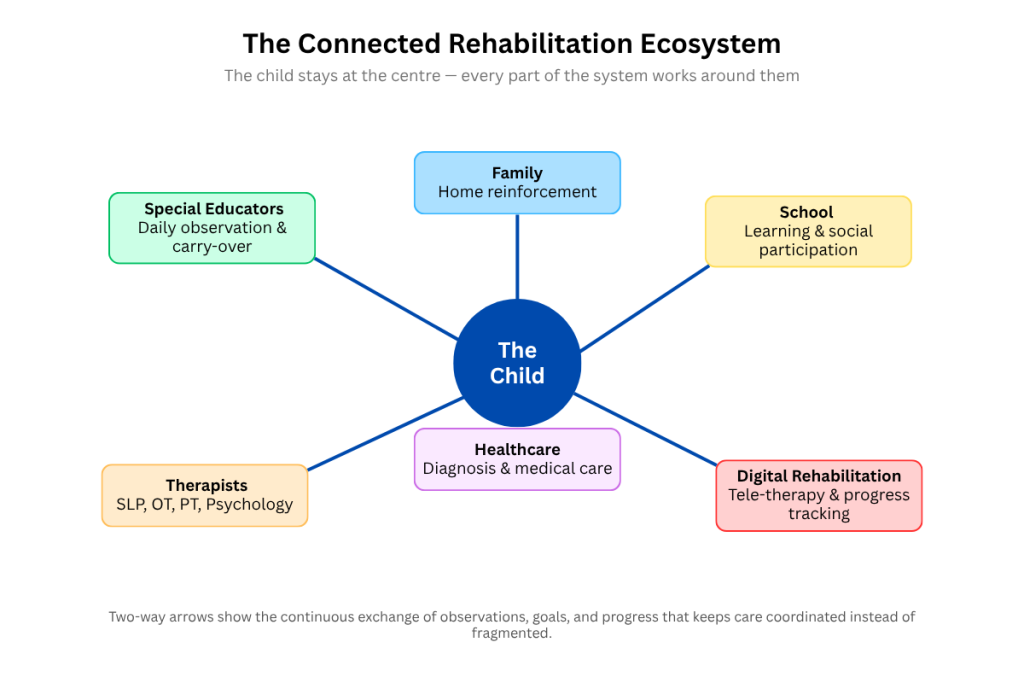
The diagram below shows how this ecosystem holds together, with the child at the centre and every other part working in coordination around them.

 The Connected Rehabilitation Ecosystem — the child stays at the centre while family, school, healthcare, special educators, therapists, and digital rehabilitation work in coordination around them. 

Traditional vs. Connected Rehabilitation Delivery  

AspectTraditional (Isolated) DeliveryConnected / Digital Rehabilitation
Coordination between professionalsTherapists, educators, and doctors often work separately, with reports passed by handReal-time communication and shared progress tracking across the care team
Geographic reachLimited to families who can travel to a centreExtends to rural and underserved areas via tele-rehabilitation
Waiting periodsLong waits for assessment and therapy slotsFaster scheduling and remote assessment options reduce delays
Continuity of careEasily disrupted by relocation, therapist changes, or missed appointmentsProgress history and goals persist digitally, supporting continuity
Parent involvementParents relay updates manually between providersParents access real-time progress and guided home activities
Skill generalisationDepends on informal communication between school and clinicStructured carry-over between therapy, classroom, and home

Why Special Educators Matter in This Ecosystem  

An accessible rehabilitation system depends on collaboration, and special educators are at its centre. Unlike therapists who may see a child periodically, special educators interact with children daily, allowing them to observe progress, identify emerging needs, and reinforce therapeutic goals within natural learning environments. They bridge the gap between home, school, and rehabilitation services by collaborating with families, therapists, and healthcare professionals to ensure consistent, child-centred intervention. As digital rehabilitation expands, their role in monitoring progress, facilitating communication, and promoting continuity of care becomes even more significant.

Conclusion: Looking Beyond the Classroom  

A child’s development does not occur within the boundaries of a classroom or a rehabilitation centre. It is shaped by the collective efforts of families, educators, therapists, healthcare professionals, policymakers, and communities working towards a common goal. When any one of these systems functions in isolation, children are left navigating fragmented services rather than receiving the coordinated support they deserve.

Closing the gaps described above calls for stronger public rehabilitation systems, closer collaboration between education and healthcare, empowered families, multidisciplinary teamwork, and thoughtful integration of digital technologies that extend support beyond traditional service settings.

Within this ecosystem, special educators play a uniquely significant role. Their daily interactions with children, close partnerships with families, and collaboration with rehabilitation professionals position them as the bridge connecting assessment, intervention, education, and participation. Their work reminds us that rehabilitation is not confined to therapy sessions; it becomes meaningful only when it is carried into classrooms, homes, playgrounds, and communities where children learn, communicate, and grow.

Rehabilitation should no longer be viewed as a service that children travel to receive. Instead, it should become a system that reaches children wherever they are through schools, communities, government institutions, digital technologies, and coordinated multidisciplinary care. When rehabilitation becomes accessible rather than exceptional, inclusion moves beyond policy and becomes a lived reality.

When our systems are designed around real outcomes such as confident participation, effective communication, greater independence, and a sense of belonging, rehabilitation becomes more than a service. It becomes an investment in every child’s right to learn, participate, and reach their full potential.


Redefining the Future of Rehabilitation Delivery: My Experience at Samvaad 

Reading Time: 3 minutes

Written By Rakshitha S
Senior Subject Specialist – SLP


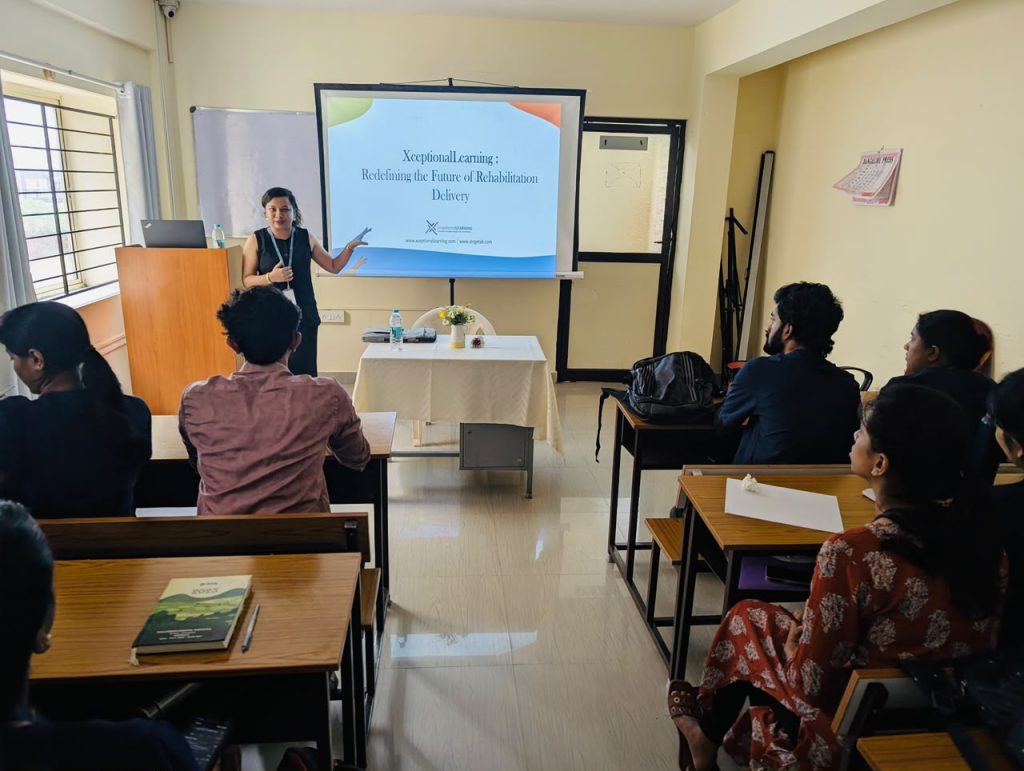
Rakshitha S conducting an industry-integrated session on “Redefining the Future of Rehabilitation Delivery” for postgraduate students at Samvaad Institute of Speech & Hearing.

Setting the Context

On 19th June 2026, I had the privilege of conducting an industry-integrated session titled “Redefining the Future of Rehabilitation Delivery” for the 4th Semester PG students at Samvaad Institute of Speech & Hearing. This programme was initiated following Dr. Rajashekhar Sir’s recommendation to bridge academic learning with emerging digital rehabilitation practices. Our goal was to give outgoing PG students direct exposure to technology-enabled service delivery models and the career pathways they unlock in employment, entrepreneurship, and private practice.

The Session 

We began promptly at 10:00 AM. Dr. Rajashekhar Sir joined us virtually for the first 20 minutes, sharing his insights on the evolving rehabilitation landscape. His address set a strong foundation and contextualized why digital transformation is no longer optional in clinical  practice. 

I then led the core session from 10:20 AM to 1:00 PM. We started by mapping existing market gaps in rehabilitation services and traced the evolution from conventional therapy to teletherapy and hybrid models. I emphasized the growing importance of systematic clinical  documentation and discussed the future outlook of rehabilitation practice within an ICF informed, person-centered framework. 

The second half was a hands-on demonstration of the XceptionalLEARNING platform. I walked students through features that support the complete clinical workflow: assessment, intervention planning, session documentation, and outcome tracking. To support continued learning, each student received a resource manual outlining  applications and tools for technology-based therapy.

Student Engagement 

The response from the students was truly encouraging. They were engaged throughout, asked insightful questions on digital service delivery, ethical telepractice, and business models for  private practice. Their curiosity about integrating technology into day-to-day clinical work reaffirmed the need for such industry-academic programmes. 

After the session, I had the opportunity to interact with Dr. Radhika Ma’am and Dr. Suman Sir. They appreciated the  relevance of the content and mentioned that they would review the platform with their faculty and students to explore the way forward.

Reflection & Gratitude 

I am grateful to Dr. Rajashekhar Sir for his trust and for initiating this collaboration. His feedback that the session was “well-structured, informative, with a well-curated presentation and effective demonstration” and his recommendation to establish this facility at Samvaad ISH is deeply motivating. 

I also extend my thanks to Dr. Jino and Ms. Anjana from XceptionalLEARNING for their support in curating this workshop, and to the faculty at Samvaad for their warmth and academic rigor.

Looking Ahead 

This session reinforced my belief that the future of rehabilitation delivery lies in equipping  students with both clinical competence and digital fluency. When academic institutions and industry partners come together, we create pathways for better training, wider service outreach, and improved access for underserved populations — goals that align strongly with ISHA and  RCI mandates.

I look forward to continued collaborations with Samvaad and other institutions committed to redefining rehabilitation delivery for the next generation.