From Therapy Room to Real Life: Helping Children Generalise Skills Beyond Sessions

Reading Time: 6 minutes

Introduction

A child learns to request “water” during a therapy session. They identify emotions correctly from pictures. They follow a three-step instruction with their therapist and complete a task independently.

Then they go home, and suddenly the same skill seems to disappear.

For therapists and parents, this can be confusing. Was the skill actually learned?

Often, the child may have learned the skill under specific conditions but may not yet be able to use it flexibly across different situations. The challenge is not always the skill itself, but using it across different people, places, materials and situations. This is called generalisation, and it is an important goal of meaningful behavioural intervention.

What Is Generalisation?

Generalisation means a child can use a learned skill beyond the exact situation in which it was taught. If a child learns to say “help” in a session, we want that communication to happen:

  • with the therapist, parents and teachers
  • at home and at school
  • during play
  • whenever a task is genuinely difficult

The goal is not just correct performance in therapy. It is for the skill to become functional in everyday life.

Generalisation is usually discussed alongside maintenance, meaning the skill continues over time after direct teaching stops.

Generalisation and Maintenance

Generalisation means using a learned skill in different settings, with different people or in new situations. Maintenance means continuing to use that skill over time, even after direct teaching or support has been reduced.

Why Is Generalisation Sometimes Difficult?

Children often learn skills under very specific conditions. They may know how one therapist asks a question, recognise the same flashcards, sit at the same table and respond to the same type of prompt. When one of these elements changes, the child may not realise the skill still applies.

For example, a child learns to identify “apple” from a picture in therapy. Later, the teacher holds up a real apple and the child doesn’t respond. This doesn’t mean the child doesn’t know what an apple is. They may simply need support transferring the skill from one example to another.

Learning a skill and using it across settings are related but separate challenges. That is why generalisation has to be planned, not just hoped for.

From Structured Practice to Functional Use

Behaviour therapy often begins with structured teaching because structure helps a child understand what is expected. But structure should eventually become a bridge to natural situations. Take requesting a preferred item:

  1. Therapy setting. The therapist teaches the child to request a toy using a word, gesture, picture or communication system.
  2. Different materials. The child practises requesting different toys, snacks and activities.
  3. Different people. The child uses the same communication with the therapist, parent, teacher and other familiar adults.
  4. Different environments. The skill is practised at home, in the classroom, during play and in community settings.
  5. Natural opportunities. The child begins to use the skill spontaneously when they genuinely want or need something.

These stages often overlap rather than following a strict order. Therapists may start varying people and materials early, and the child’s progress will guide the pace. Over time, this turns a therapy target into a functional life skill.

From Structured Practice to Everyday Life

A skill learned during therapy needs opportunities for practice in everyday situations. Gradually extend practice from structured activities to familiar routines at home, at school and in the community.

The Role of Parents in Generalisation

Therapy cannot, and should not, be limited to the hours a child spends with a therapist. Parents and caregivers naturally create opportunities for skills to be used throughout the day. A routine like getting ready for school can involve:

  • following instructions
  • making choices
  • requesting help
  • waiting
  • moving between activities
  • completing routines independently
  • communicating feelings

The goal is not to turn every moment at home into a therapy session. Parents don’t need to become therapists. Instead, practice can be built into everyday routines:

  • Asking for a preferred food at breakfast is often a more meaningful communication opportunity than a worksheet.
  • Waiting for a turn in a family game is a natural way to practise waiting.

It helps to ask the therapist which skills to focus on and how to respond, so that home and therapy stay consistent.

Generalisation Is More Than Repetition

Repeating the same activity can help establish a skill, but generalisation also requires opportunities to practise across different examples. In behaviour intervention, this may include multiple-exemplar training, where a child learns to apply a skill across varied people, materials, instructions and situations. Therapists may deliberately vary:

  • People: different therapists, parents, teachers and caregivers.
  • Places: the therapy room, classroom, home, playground and community.
  • Materials: different toys, pictures, real objects, books and digital activities.
  • Instructions: different but equivalent ways of presenting the same expectation.
  • Situations: both structured activities and natural routines.

Variation helps the child learn the concept behind the skill rather than depending on one teaching arrangement.

Natural consequences can also make a skill meaningful. For example, when a child appropriately asks for help opening a container, receiving suitable assistance shows how communication can help them in everyday situations.

Watch for Prompt Dependence

Prompts are valuable teaching tools. They give the child the support needed to respond successfully. But if a child always waits for an adult to tell them what to do, the skill may not yet be independent.

For example:

Adult: “What do you need?” Child: “Help.”

The next step is teaching the child to recognise when help is needed and say “help” without waiting for the question. The therapist’s role gradually shifts from providing support to creating opportunities for independence.

Prompt fading should be carefully planned and based on each child’s individual needs.

Measuring What Happens Outside Therapy

One of the most useful questions a therapist can ask is: “Is the skill happening outside the therapy room?”

Progress monitoring should go beyond whether a child can perform a task in session. It can also track:

  • who the child performs the skill with
  • where it occurs
  • how independently it is performed
  • how often it occurs
  • whether it continues over time
  • whether it appears spontaneously
  • whether the child can use it in a new situation

Parent and teacher observations are a valuable part of this picture. They show whether intervention is translating into everyday functioning.

Connecting Assessment, Planning and Everyday Practice

Generalisation works best when it is part of the whole intervention journey, not an afterthought at the end. One useful way to organise that journey is in four linked steps:
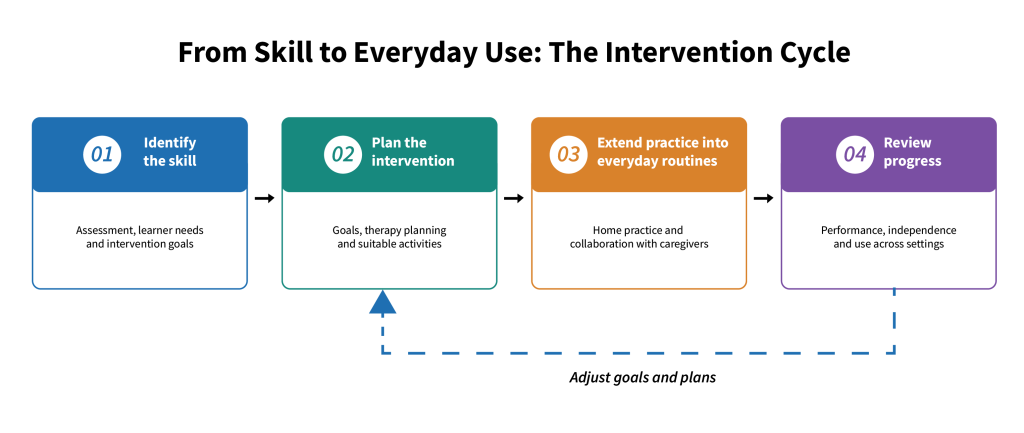
  1. Identify the skill. Assessment helps therapists understand the learner’s needs and set clear intervention goals.
  2. Plan the intervention. Goals are turned into a therapy plan with suitable activities, including opportunities to practise across different people, materials and settings.
  3. Extend practice into everyday routines. Caregivers and therapists work together so that practice continues at home through ordinary routines.
  4. Review progress. Therapists observe performance, independence and use of the skill across settings, then adjust the plan.

This is a suggested framework, and generalisation never happens automatically. It depends on planning, practice with different people and places, and careful observation.

This is also how therapy clinics and hospitals can organise intervention as one ongoing process, where assessment, planning, intervention, reinforcement and monitoring are linked parts rather than separate tasks. For special educators and schools, the same cycle supports school-based intervention and coordination with families. If you would like to read more about structuring intervention goals, see our article on behaviour therapy and intervention planning.

How Digital Activities Can Support Generalisation

Digital activities can offer additional opportunities to practise skills using different pictures, examples, instructions and learning scenarios. When these activities are selected according to a child’s goals, they can complement structured teaching and support continued practice beyond individual therapy sessions.

However, completing a digital activity successfully does not necessarily mean that a child can use the same skill independently in everyday life. Therapists and caregivers still play an important role in creating opportunities to apply learned skills during conversations, play, classroom activities and daily routines.

XceptionalLEARNING connects planned intervention, digital activities and progress monitoring, supporting therapists and educators in organising learning activities and reviewing progress. VergeTAB, a locked digital learning device powered by the XL Platform, can support this process when used as part of the integrated approach. These tools can complement therapist-led teaching and home practice, while observations from everyday situations help establish whether a skill is being used beyond structured activities.

The objective is not to replace real-world experiences with screen-based practice. It is to use structured digital learning alongside meaningful opportunities for children to apply their skills in everyday situations.

The Real Measure of Progress

Imagine a child who has learned to ask for help. In therapy, they request help correctly ten times. That is meaningful progress.

Now imagine more. At home, the child struggles to open a container and says, “Help.” At school, they can’t find their pencil and ask the teacher. At the playground, they approach an adult when they need assistance.

These moments may not look like formal therapy achievements, but they show something bigger: the child is using a learned skill to take part more independently in everyday life.

Quick Takeaways

  • Generalisation doesn’t happen automatically; plan for it.
  • Vary people, places, materials and instructions.
  • Use everyday routines instead of extra worksheets.
  • Fade prompts gradually to build independence.
  • Track whether skills appear outside therapy, not just inside it.

Conclusion

Therapy shouldn’t end when the session ends. A skill becomes truly meaningful when a child can carry it from one environment to another, from one person to another, and from structured practice into everyday life.

For therapists, this means planning not only for skill acquisition but also for generalisation, maintenance, independence and functional use. For parents and caregivers, it means recognising that ordinary routines can be powerful opportunities for learning. For the child, it means that skills from therapy become tools for communicating, participating, making choices and solving problems.

The ultimate goal is not for a child to perform a skill because therapy taught them to. It is for the child to use that skill because it helps them navigate their world.

Editorial Note

This article was originally written by Danita Rose and has since been reviewed and updated by the XceptionalLEARNING team.

Connect Therapy Planning with Everyday Learning

XceptionalLEARNING brings together intervention planning, digital activities and progress monitoring to support therapists and educators in organising learning and extending practice beyond structured sessions.

Parent-Teacher Collaboration in Special Education: How Families and Teachers Can Work Together

Reading Time: 6 minutes
Written by Anjuna.M

Special Educator

Every child learns in their own unique way. For children with diverse learning needs, learning is not limited to the classroom. It happens through communication, play, daily routines, social interaction, technology, and meaningful experiences at home and in the community.

This is why strong parent-teacher collaboration is one of the most important parts of special education. When parents and teachers work together, they create a consistent and supportive learning environment where children can build skills with greater confidence and independence.

Parents and Teachers: Two Perspectives, One Goal

Teachers spend time observing children in the classroom and understand their learning patterns, strengths, challenges, and educational needs. Parents know their child beyond the classroom: their interests, routines, preferences, communication styles, and everyday experiences.

When these two perspectives come together, teachers gain a more complete understanding of the child. Regular communication lets both sides share what is working, identify challenges early, and see how a child responds to different strategies across environments.

What Effective Collaboration Looks Like

Effective collaboration is more than occasional updates. It involves regular two-way communication, shared goals, and a willingness to understand the child’s needs across different settings.

Parents and teachers can collaborate by:

  • Sharing observations about the child’s strengths, interests, and challenges
  • Discussing strategies that work at home and at school
  • Setting clear, realistic goals together
  • Keeping important routines and expectations consistent
  • Communicating changes that may affect the child’s learning or participation
  • Reviewing progress and adjusting strategies when needed

Collaboration does not mean using exactly the same methods everywhere. Parents and teachers can work toward the same goals while adapting strategies to each environment. The strongest collaboration is a two-way process: teachers bring educational expertise, and parents bring deep knowledge of their child.

Active Parent Involvement Makes Learning More Meaningful

Parent involvement goes beyond attending meetings or reading updates. Parents can be active partners in the learning journey.

Simple activities at home, such as counting household objects, identifying colours, practising communication, following daily routines, or building self-care skills, can reinforce what a child learns at school. When parents understand the child’s learning goals and the strategies teachers are using, everyday moments become natural practice opportunities. This creates continuity between school learning and real-life learning.

PRACTICAL TIP

Choose One Skill to Practise at Home
Instead of trying to practise everything, choose one skill that is currently being worked on at school. Ask the teacher how the skill is being practised, then look for one simple opportunity to use it during an everyday routine at home.
Example: If the goal is requesting help, create a natural opportunity for the child to request help while preparing a meal, getting dressed, or completing a household task.

Consistency Between Home and School

Children often find it easier to use and generalise new skills when they meet connected expectations and strategies across different environments.

For example, if a child is encouraged to request help using a word, picture, gesture, or AAC (Augmentative and Alternative Communication) at school, the same opportunity can be encouraged during everyday activities at home. Similarly, a child learning to follow a visual sequence for a classroom routine may benefit from visual supports for routines at home.

Consistency does not mean making home and school identical. It means creating connected opportunities to practise and use skills in different places.

HOME–SCHOOL CONNECTION

A simple way to strengthen collaboration is to connect one school goal with one everyday opportunity at home.
School goal: Following a visual sequence
Home opportunity: Use a visual sequence for getting ready in the morning
School goal: Communication
Home opportunity: Encourage the child to request a preferred item
School goal: Counting
Home opportunity: Count objects during a daily routine

Technology Can Connect the Classroom and Home

Digital learning gives children access to interactive, visual, and engaging experiences that can be adapted to their individual needs. It can also help bridge the gap between teachers and parents, so learning no longer stays within the four walls of the classroom.

When teachers use digital activities to target specific learning goals, parents can better understand which skills are being practised and create similar opportunities in daily life. This is especially valuable for children who benefit from visual learning, repetition, interactive activities, and personalised experiences.

Platform in Action: Connecting Goals, Activities and Progress

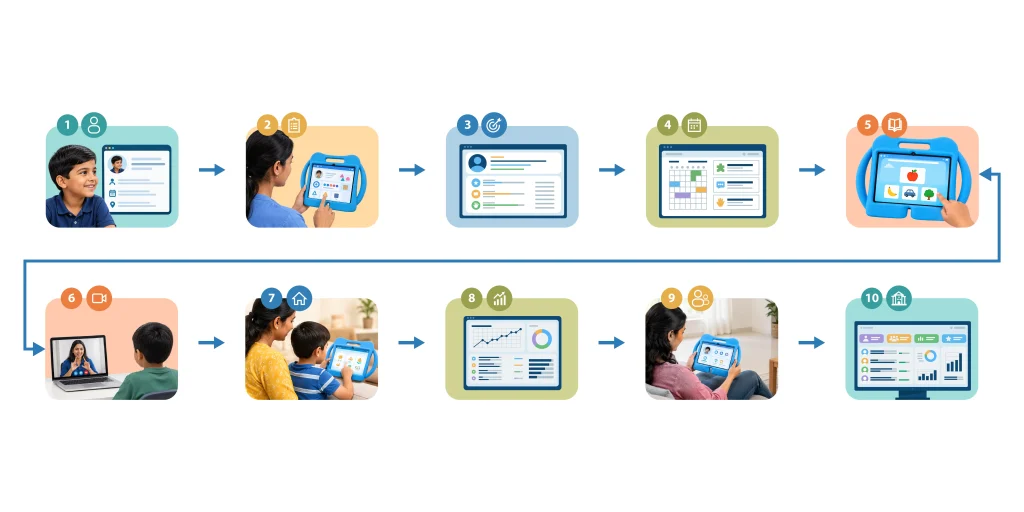
XceptionalLEARNING brings different parts of the learning and intervention journey into a connected workflow. From understanding the learner’s profile and assessment findings to setting goals, planning intervention, delivering structured activities and reviewing progress, the platform helps professionals organise support around individual needs.

Profile → Assessment → Goals → Plan → Activities → Session → Home Practice → Progress → Parent → Institution
The workflow can be adapted to each learner’s needs, and not every learner will follow every step in this order.

This connected workflow can help maintain continuity between intervention, home practice and progress review. Parents can gain greater visibility into relevant learning goals and activities, while teachers and therapists can use observations and progress information to review learning and adjust support plans when appropriate.

Digital Learning with XceptionalLEARNING and VergeTAB

Digital tools can help connect classroom learning with practice at home when they are used as part of a structured learning approach. Through the XceptionalLEARNING Platform, educators can plan learning activities around individual goals and assign structured digital activities for children to practise.

VergeTAB, the locked digital learning device powered by the XceptionalLEARNING Platform, provides controlled access to these activities without the distractions of general-purpose device use.

Here is how that can look in practice:

A teacher assigns a counting activity through XceptionalLEARNING as part of a child’s number-recognition goal. At home, the parent, aware of the goal, invites the child to count spoons while setting the table or count steps on the way to the door. The parent can then share observations from home, helping the teacher understand how the child is applying the skill beyond the classroom.

For teachers, XceptionalLEARNING provides a structured way to plan and assign digital activities according to a child’s individual goals. For parents, understanding the learning goals and activities being worked on can make it easier to create meaningful practice opportunities at home.

The value of technology is not simply in the device. It is in how the platform, device, educators, and families work together to support the child’s individual learning journey.

Connecting Parents, Teachers, and Children

A successful digital learning ecosystem brings together three partners:

  • The teacher plans and supports learning.
  • The parent understands everyday life and extends learning beyond school.
  • The child remains at the centre of the entire process.

When these three work together, technology becomes a bridge rather than a barrier. Teachers share learning objectives and observations; parents share feedback on interests, responses, and progress at home. This two-way exchange helps teachers make better-informed decisions and adapt learning to the child.

Individual Goals, Not One-Size-Fits-All Learning

Every child is different, so collaboration should focus on individual goals rather than comparing one child with another. A goal might be to recognise numbers, communicate a need, follow a simple instruction, improve social interaction, develop motor skills, or complete a daily living activity independently. When parents and teachers identify meaningful goals and support them consistently, children have more opportunities to practise and apply their skills.

When Collaboration Is Challenging

Parents and teachers will not always see things the same way. A child may behave differently at home and at school, or a strategy that works in one place may not work in another. These differences can become opportunities for discussion rather than conflict.

By listening to each other and keeping the focus on the child’s needs, families and educators can find practical solutions together. The goal is not to decide who is right, but to understand what will best support the child.

Celebrating Progress Together

Progress can look different across settings. A skill shown at school may later appear at home, and a strategy that works at home may help a child participate more successfully at school. Sharing these moments lets parents and teachers recognise progress together and spot the next opportunity for practice.

3 Ways to Start This Week

  1. Start a shared communication notebook or message thread. Exchange one short note a week: something that went well and something to watch.
  2. Schedule a brief goals check-in. Agree on one or two priority goals and how each side will support them.
  3. Link one home activity to one school goal. If the goal is counting, count objects during a daily routine. If it is communication, create one extra chance to request something.

Collaboration Creates a Stronger Future

Parent-teacher collaboration is not just about exchanging information. It is about building shared understanding, shared responsibility, and a shared vision for the child.

Technology can make this collaboration more accessible, but the foundation remains human connection. A device or platform can support learning, but a parent’s encouragement and a teacher’s guidance give that learning its purpose.

The most effective special education journey is one where parents are not merely observers, teachers are not working alone, and technology is not just a tool, but where everyone works together as a team. Ultimately, the goal is not simply to teach a child what to learn, but to help them discover how they can learn, communicate, participate, and become more independent in their own world.

“When parents, teachers, and technology work together, learning moves beyond the classroom and becomes a part of everyday life.”

Explore Structured Learning with XceptionalLEARNING

See how XceptionalLEARNING helps educators and therapists organise learning and intervention around individual goals, structured activities, home practice, and progress review.

Preparing Children with Special Needs for Adulthood: Life Skills Families Can Build at Home

Reading Time: 5 minutes
Written by Silja K X

Special Educator

Watching a child reach the end of their school years brings a flood of mixed emotions. There is immense pride in how far they have come, but for families raising children with special needs, that pride is often mixed with a quiet anxiety: what happens next?

Preparing for an independent and meaningful life happens across settings. While schools provide structured learning and transition support, everyday routines and learning opportunities at home give children valuable opportunities to practise these skills. Preparing a child for adulthood isn’t an overnight switch that flips on graduation day; it is a gradual journey of shifting roles within the family, where parents slowly move from being primary carers to lifelong coaches.

Here is how families can turn everyday home life into a powerful launchpad for life after school.

1. Cultivating Self-Advocacy and Decision-Making

Before mastering complex tasks, young people benefit from opportunities to express their preferences, communicate their needs and make choices. Self-advocacy begins at home with small, daily decisions long before stepping into the adult world.

Start by embedding meaningful choices into every day. Instead of asking open-ended questions like “What do you want to do today?”, offer structured options: “Would you prefer to go for a walk in the park or visit the library this afternoon?” Practising choice-making in low-stakes environments builds the decision-making muscles needed for bigger decisions later in life.

Equally important is helping your child understand and express their needs. Help them learn to articulate:

  • What they are naturally good at (their strengths).
  • What environments or tasks overwhelm them (their sensory triggers or struggles).
  • What specific tools help them succeed (their accommodations, such as noise-cancelling headphones or written instructions).

When a child can comfortably say, “I work best when I get instructions written down,” they are developing an important skill for advocating for themselves in higher education, workplace environments or community settings.

2. Transforming Daily Household Chores into Life Skills

It is natural for parents to fall into the habit of doing household tasks for their children simply because it is faster or easier. However, mastering domestic routines is an important way to build confidence and independence as a young person prepares for adulthood.

The key to teaching these skills without causing overwhelm is a technique called gradual release:

  1. I do, you watch. Start by performing a task, like cooking a simple meal or sorting laundry, while explaining out loud why you are doing each step.
  2. We do together. Move to doing the task as a team. Let them stir the pot, measure the laundry detergent or fold the towels alongside you.
  3. You do, I watch. Stand back and let them take the lead, offering gentle guidance only when asked or strictly necessary.
  4. Independent ownership. Hand over full responsibility for that specific task on a regular schedule.

Beyond chores, focus on self-directed personal care. Moving away from frequent verbal reminders, such as “Did you brush your teeth?” or “Did you finish your morning routine?”, towards self-managed visual checklists, timers or other appropriate reminders can help children gradually take greater ownership of personal routines.

3. Navigating Money and Ownership of Time

Two of the biggest hurdles to adulthood are managing money and managing time. In a world of digital transactions and abstract schedules, these concepts can feel invisible without direct, practical experience.

Financial Literacy in the Real World

Budgeting textbooks can only teach so much; real-world context makes financial concepts stick.

  • Hands-on shopping. Involve your child in grocery shopping. Give them a small, age-appropriate budget and a list of a few items, then let them calculate costs, compare brands and pay at the register using cash or a debit card.
  • Banking basics. Open a basic bank or savings account in their name. Review bank statements together monthly so they can physically see money going in (allowance or earnings) and coming out (purchases).
Owning the Clock

In school, bells and schedules dictate every hour of the day. As children move into adulthood, they may need to take greater responsibility for managing their own time. Help your child gradually take greater responsibility for managing their own time by replacing frequent parental prompts with practical tools. Show them how to use alarms, calendar apps, visual schedules or other tools that suit their needs to track their own appointments, social plans and daily routines. When they take ownership of their schedule, they gain a powerful sense of autonomy.

4. Bridging Home Life to the Broader Community

Preparing for life beyond school means stepping outside the comfortable safety net of the family home and building connections in the wider community.

Active Leadership in Future Planning

If your child is still attending transition meetings or IEPs, move them into the driver’s seat. Before any official meeting, sit down together to discuss their personal goals, interests and fears. During the meeting, encourage them to open the discussion, read a short list of their goals or voice what they want their post-school life to look like. Their future should be planned with them, rather than simply for them.

Real-World Community Mobility

Vocational readiness relies heavily on community navigation. Practise taking public transport, using ride-share apps or walking local routes together until your child feels confident travelling independently. Explore local volunteer opportunities, vocational centres or entry-level job shadowing based entirely on their personal passions, whether that is working with animals, organising books at a library or helping out at a local coffee shop.

5. Creating Opportunities for Consistent Practice

Independence develops through regular opportunities to practise skills in meaningful situations. A child may learn a skill at school or during therapy, but applying that skill at home and in the community helps strengthen its use in everyday life.

Families can work with teachers and therapists to identify a few priority skills and create opportunities to practise them regularly. These might include following a morning routine, communicating a need, completing a household task, making a purchase or following a simple schedule.

Digital learning and therapy tools can support this process by providing structured activities, home practice and ways to monitor progress. When families, educators and therapists work towards shared goals, children have more consistent opportunities to practise skills across different environments. XceptionalLEARNING supports this connected approach by helping teams plan goals, provide structured activities, extend practice beyond sessions and monitor progress over time.

Practical Tip

Choose one or two everyday skills to practise consistently at home rather than trying to work on everything at once. Discuss the goals with your child’s teachers or therapists and look for opportunities to practise the same skills in different settings.

Conclusion

Transitioning to adulthood is not a single leap off a cliff; it is a series of small, intentional steps taken day after day. There will be mistakes, setbacks and moments of frustration along the way, and that is completely normal.

By starting early, focusing on practical everyday experiences and giving your child the space to try, fail and try again, you are helping them build something equally important: confidence in their own abilities and greater ownership of their self-determined future. Each skill practised at home can contribute to greater confidence, participation and independence as children move towards adulthood.

Support Every Step Towards Greater Independence

XceptionalLEARNING helps educators, therapists and families plan meaningful goals, provide structured activities, extend practice beyond sessions and monitor progress across the child’s development journey. Explore how a connected digital approach can support learning and intervention across home, school and therapy settings.

How Interactive Digital Worksheets Can Make Special Education Classrooms More Engaging

Reading Time: 6 minutes
Written By Arjun K S

Special Educator

Moving Beyond Traditional Worksheets Through Interactive Learning

Every learner engages with information differently. In special education classrooms, students may differ significantly in their cognitive abilities, communication skills, attention span, motor abilities, academic readiness, and pace of learning.

Traditional worksheets can support structured practice, but they often provide limited opportunities for direct interaction with the learning content. Interactive digital worksheets offer a different approach: they allow teachers to transform learning tasks into active, participatory, and individualised experiences where students interact directly with the learning content.

For learners with diverse educational needs, this shift can make classroom activities more engaging while giving teachers greater flexibility to adapt tasks according to individual learning levels.

At XceptionalLEARNING, educators can create and assign interactive activities through VergeTAB, also referred to as the Digital Activity Book, allowing learning tasks to be adapted to individual classroom objectives and learner needs.

From Completing Worksheets to Interacting With Learning

The primary difference between a traditional worksheet and an interactive digital worksheet is how students interact with the learning content.

Instead of simply looking at a question and writing an answer, students can move objects, select options, arrange pictures, identify images, complete sequences, and respond to questions directly on the screen.

This creates opportunities for students to:

  • Make choices
  • Respond independently
  • Explore different answers
  • Practice skills repeatedly
  • Review their responses
  • Complete tasks at their own pace
  • Participate more actively in classroom activities

For teachers, these interactions provide greater flexibility to design activities at an appropriate level of difficulty and adapt the task according to each learner’s abilities and learning needs.

Drag-and-Drop Activities: Learning Through Action

Drag-and-drop activities turn learning into a physical interaction with the content. For example, a teacher can ask a student to:

  • Drag fruits into a basket
  • Match objects with their correct categories
  • Place numbers in the correct order
  • Move an object to its corresponding shadow
  • Sort household items into different groups

For students who find conventional writing tasks challenging, drag-and-drop activities provide an alternative way to demonstrate understanding. They can provide opportunities to practise skills such as visual discrimination, categorisation, sequencing, hand-eye coordination and task completion.

Matching Activities: Building Connections Between Concepts

Matching is a fundamental learning skill that can be adapted to numerous educational goals. Digital worksheets can include activities such as:

  • Animal → Habitat
  • Fruit → Name
  • Number → Quantity
  • Object → Use
  • Emotion → Facial Expression
  • Shape → Corresponding Shape

These activities encourage students to identify relationships between concepts rather than simply memorising information. Teachers can also adjust the number of choices and the complexity of the matching task according to the learner’s current ability.

Click-and-Choose Activities: Encouraging Independent Decision-Making

Click-and-choose activities provide students with opportunities to make decisions independently. A worksheet might ask:

  • Which object is a fruit?
  • Click the red colour.
  • Which animal lives in water?
  • What should you use to brush your teeth?

The student selects an answer directly from the available options. This simple interaction can support recognition, discrimination, decision-making, and independent responding.

For learners who experience difficulty expressing their knowledge through speech or writing, selecting an appropriate visual option can provide another meaningful way to demonstrate understanding.

Sequencing Activities: Understanding Order and Routine

Sequencing activities are particularly useful when teaching concepts that depend on order. Teachers can create tasks involving:

  • Getting ready for school
  • Washing hands
  • Brushing teeth
  • Preparing simple food
  • Following classroom routines
  • Arranging numbers
  • Understanding a story sequence

Students can arrange pictures or steps into the correct order. These activities can support logical thinking, chronological understanding, task organisation, and functional independence. Sequencing also allows teachers to connect academic learning with everyday routines, making classroom instruction more meaningful.

Picture-Based Activities: Making Concepts More Accessible

Pictures can make abstract or unfamiliar concepts easier to understand, particularly for students who benefit from visual representations. Interactive digital worksheets can use photographs, illustrations, symbols, or familiar objects to create activities around:

  • Vocabulary development
  • Object identification
  • Emotions
  • Community places
  • Household objects
  • Animals
  • Food items
  • Safety signs
  • Daily routines

For example, instead of asking a learner to read the word “apple”, the worksheet can present several pictures and ask the student to identify the apple. This creates a more accessible learning pathway while allowing teachers to gradually move from concrete visual representations towards more abstract concepts.

Interactive Quizzes: Turning Assessment Into Participation

Assessment does not always need to be a separate activity at the end of a lesson. Interactive quizzes can be incorporated directly into digital worksheets to check understanding during learning. Teachers can create questions involving:

  • Multiple-choice responses
  • Picture identification
  • True or false activities
  • Number recognition
  • Vocabulary
  • General awareness
  • Curriculum-based concepts

Because the student interacts directly with the questions, assessment can become a more engaging classroom experience rather than a purely evaluative process. Teachers can use these activities to identify areas where additional instruction or practice may be required.

Fill-in-the-Blank Activities: Developing Academic Skills

Fill-in-the-blank activities can be used when students are ready to move towards more conventional academic responses. Examples include:

  • 1 + 2 = ___
  • The sun rises in the ___.
  • My name is ___.
  • Monday comes before ___.

Digital fill-in-the-blank activities can be adapted according to the student’s academic level, making them useful for language, mathematics, general knowledge, and functional academics. They also provide a gradual transition from recognition-based activities towards more independent academic responses.

One Learning Goal, Multiple Ways to Participate

One of the greatest strengths of interactive digital worksheets is that the same learning objective can be taught through different activity formats. For example, if the learning goal is to identify colours, a teacher could create:

  • A click-and-choose activity to identify red
  • A matching activity to match objects with colours
  • A drag-and-drop activity to sort objects by colour
  • A picture-based activity to identify colours in real-life objects
  • An interactive quiz to assess recognition

This allows teachers to approach the same concept from different directions without simply repeating the same worksheet. It can also help teachers identify which type of interaction is most effective for an individual learner.

Supporting Differentiated Instruction

A classroom may include students working towards different learning objectives at the same time. Interactive worksheets make it easier for teachers to differentiate activities by modifying:

  • Number of questions
  • Difficulty level
  • Number of response choices
  • Visual complexity
  • Type of interaction
  • Amount of prompting
  • Expected response
  • Content and vocabulary

For example, while one student may identify colours by clicking on the correct option, another student may sort multiple objects according to colour. Both students are participating in the same broad learning area, but the activity is adapted to their individual learning level.

Interactive Learning for Special Education

XceptionalLEARNING supports special schools and inclusive education environments with structured digital learning solutions that can be adapted to classroom objectives and individual learner needs.

Making Students Active Participants

Interactive learning changes the role of the student from a passive recipient of information to an active participant in the learning process. A student is not simply watching the teacher demonstrate a concept. They are required to:

Observe → Understand → Choose → Respond → Adjust → Complete

This repeated interaction can make classroom learning more purposeful. For students who require additional opportunities for practice, digital activities can also provide structured repetition without making the learning experience identical every time.

Supporting Teacher-Led and Individual Learning

Interactive digital worksheets do not need to replace teacher instruction. They can work alongside conventional teaching methods. A teacher can introduce a concept using real objects or classroom demonstrations, explain the concept, and then use an interactive worksheet to provide individual practice. For example:

Teacher instruction → Demonstration → Interactive activity → Individual practice → Review

This approach allows the teacher to remain central to the learning process while technology provides additional opportunities for participation and practice.

Extending Learning Beyond the Classroom

Interactive worksheets can also support continuity between school and home. Through the Digital Activity Book on VergeTAB, assigned activities can provide students with opportunities to practise targeted skills beyond classroom hours.

This can help create greater consistency in areas such as:

  • Academic practice
  • Functional skills
  • Vocabulary
  • Recognition tasks
  • Daily routines
  • Communication-related activities
  • Concept reinforcement

Parents and carers can also become more aware of the skills being practised at school, supporting greater continuity between learning environments.

The Role of XceptionalLEARNING and VergeTAB

XceptionalLEARNING brings these interactive possibilities into a structured digital learning environment through VergeTAB, also referred to as the Digital Activity Book. Educators can use interactive activities aligned with their classroom objectives and individual learner needs.

The focus is not simply on converting paper worksheets into digital formats — it is about reimagining what a worksheet can become. Powered by the XceptionalLEARNING platform, a digital worksheet can become an interactive learning space where students make choices, manipulate information, solve problems, practise skills, and demonstrate their understanding.

Conclusion

Interactive digital worksheets are helping special education move beyond the limitations of one-format, paper-based learning. By using drag-and-drop, matching, click-and-choose, sequencing, picture-based activities, interactive quizzes, and fill-in-the-blank tasks, educators can create learning experiences that encourage students to participate rather than simply complete worksheets.

More importantly, these activities can be differentiated according to each learner’s abilities, goals, and pace. With XceptionalLEARNING and VergeTAB, traditional worksheets can evolve from static pages into more interactive, individualised and purposeful learning experiences.

In special education, meaningful technology is not about making learning more complicated. It is about creating more ways for every learner to participate, respond, practise, and progress.

Bring Interactive Digital Learning Into Your Institution

Special schools and inclusive education programmes can use XceptionalLEARNING to introduce structured digital activities alongside classroom instruction, individual learning goals and existing educational practices.

Positive Reinforcement in Special Education: Encouraging Learning and Positive Behaviour

Reading Time: 5 minutes
Written By Ashnamol P S

Special Educator

Introduction

In special education, effective teaching requires strategies that consider each child’s individual needs, abilities, interests, and learning style. Positive reinforcement is an important teaching and behaviour-support strategy used to increase desired behaviours and encourage learning.

It can support communication, classroom participation, task completion, social interaction, appropriate behaviour, and independence. When used intentionally, it helps learners understand which behaviours are expected and increases the likelihood of those behaviours occurring again. 

What Is Positive Reinforcement?

Positive reinforcement occurs when a consequence is added after a behaviour and increases the likelihood of that behaviour occurring again in the future.

The word “positive” means that something is added — it does not simply mean “good.”

Example: Student completes a task → Teacher provides specific praise → Student is more likely to complete similar tasks again.

Not everything given to a child is automatically a reinforcer. A consequence is considered a reinforcer only when it actually increases the future occurrence of the behaviour. Reinforcement should therefore be based on the individual child’s preferences rather than adult assumptions, a principle that applies throughout this article, from choosing a reinforcer to praising a specific action.

Key Principle

Positive reinforcement means adding a consequence after a behaviour that increases the likelihood of that behaviour occurring again.
Behaviour → Reinforcer → Increased Future Behaviour

How Does Positive Reinforcement Work?

Positive reinforcement follows a simple sequence:

Desired Behaviour → Meaningful Reinforcer → Increased Future Behaviour

Example: Student raises their hand → Teacher provides specific praise → Student is more likely to raise their hand again.

Effective reinforcement requires:

  • A clearly identified target behaviour
  • A meaningful reinforcer
  • Prompt delivery after the behaviour
  • Clear feedback about the behaviour being reinforced
  • Observation of whether the behaviour actually increases
  • Adjustment according to the learner’s changing needs and preferences

Types of Reinforcement and Reinforcement Systems

Different children respond to different reinforcers.

1. Social Reinforcement Positive attention or interaction from another person, such as praise, smiles, high-fives, thumbs-up, and encouraging statements. Example: A student waits for their turn → Teacher says, “Excellent waiting! You waited for your turn.”

2. Tangible Reinforcement Providing access to a preferred physical item after a desired behaviour, such as stickers, small toys, art materials, or preferred classroom objects. Example: Complete the writing task → Receive a preferred sticker.

3. Activity Reinforcement Providing access to a preferred activity after a desired behaviour, such as drawing, playing with blocks, listening to music, reading, or using a preferred learning application. Example: Complete the worksheet → Get five minutes of drawing time.

4. Edible Reinforcement Providing a preferred food item after a desired behaviour. This should be used carefully, considering dietary needs, allergies, family and cultural values, and school policies. Appropriate non-food reinforcers should be considered whenever possible.

5. Token Reinforcement System Providing tokens, stars, or points for desired behaviours that can later be exchanged for a preferred item or activity. Token systems can offer a clear, predictable structure, especially for learners who benefit from visual supports. Example: Complete three tasks → Earn three stars → Choose a preferred activity.

Identifying Meaningful Reinforcers

A reinforcer that works for one child may not work for another — one child may prefer drawing, another music. Educators can identify meaningful reinforcers by:

  • Observing the child’s preferred activities and objects
  • Offering choices
  • Considering the child’s interests
  • Talking with parents, caregivers, and other professionals
  • Monitoring whether the consequence actually increases the target behaviour
  • Reassessing preferences regularly

Using Positive Reinforcement in the Classroom

Encouraging Communication A child can be encouraged to use words, gestures, pictures, signs, or communication devices to express needs. Example: Student uses a picture card to request a toy → Teacher acknowledges the communication and provides access to the toy. This strengthens functional communication by showing that appropriate communication is effective.

Encouraging Participation A student who avoids group activities can initially be encouraged to participate for a short, achievable period. Example: Participate in a group activity for five minutes → Receive specific praise and access to a preferred activity. As participation becomes consistent, reinforcement can be gradually adjusted.

Supporting Learning and Task Completion For a child who finds an academic task difficult, reinforcement can follow completion of a manageable portion. Example: Complete five matching items → Earn one token. The goal is to strengthen engagement with the learning task and develop task-completion skills.

Encouraging Appropriate Behaviour Positive reinforcement can increase behaviours such as:

  • Waiting for a turn
  • Following instructions
  • Asking for help
  • Sharing materials
  • Transitioning between activities
  • Using appropriate communication
  • Remaining engaged in an activity

Example: When a child appropriately asks for help instead of leaving the classroom, the teacher can immediately acknowledge and reinforce the appropriate behaviour.

Bringing These Strategies to Life with Technology

Reinforcement doesn’t only happen with stickers, praise, or tokens; digital tools can also support it in structured, engaging ways. Interactive activities can provide immediate feedback, visual cues, and engaging learning experiences that educators can incorporate into individualized reinforcement strategies.

XceptionalLEARNING offers individualized digital learning activities that educators can tailor to a student’s needs and preferences — making it possible for educators to incorporate meaningful, personalized reinforcement strategies into the learning process. As with any potential reinforcer, access to a digital activity is only effective as reinforcement if it is meaningful to that particular learner, so pairing these tools with ongoing observation of student preferences remains essential.

Explore Solutions for Individualised Learning

Discover how XceptionalLEARNING supports structured digital learning and therapy experiences across different educational and therapeutic settings.

For Special Schools

Structured digital activities to support learning, participation, communication, and skill development.

For Clinics and Therapists

Support therapists with structured digital activities for individual therapy programmes.

Digital Early Intervention

Support early learning and development through personalised digital activities for children and caregivers.

Specific, Timely, and Consistent Reinforcement

“Good job!” does not always tell a child what they did correctly. Specific feedback makes the connection between behaviour and consequence clearer.

Instead of: “Good job!” The teacher can say: “Good job asking for help instead of leaving your seat.”

Praise is not automatically reinforcement; it functions as reinforcement only if it contributes to an increase in the future occurrence of the behaviour. Reinforcement should generally be provided soon after the desired behaviour, and educators should maintain a clear, predictable relationship between the desired behaviour and its reinforcing consequence.

Gradually Fading Reinforcement

The aim of positive reinforcement is not to create permanent dependence on external rewards. As a skill becomes established, reinforcement can be gradually reduced, or thinned:

  • Initially: Reinforcement after every successful response.
  • Later: Reinforcement after several successful responses.
  • Eventually: Natural consequences, successful task outcomes, social feedback, and meaningful activities play a greater role in maintaining the behaviour.

This process should be gradual, individualized, and paired with continued monitoring of the learner’s behaviour.

Common Mistakes to Avoid

  • Using the same reinforcer for every child — children have different preferences.
  • Overusing rewards — relying too heavily on external rewards may make it harder to transition toward more natural sources of reinforcement when appropriate.
  • Reinforcing the wrong behaviour — reinforcement should follow the behaviour educators want to increase.
  • Delaying reinforcement — delays can make the behaviour-consequence relationship unclear.
  • Being too general — specific feedback is more informative than simply saying “Good.”
  • Ignoring individual differences — reinforcement should reflect the learner’s abilities, preferences, and needs.
  • Failing to adjust reinforcement — strategies should be reviewed as the learner develops new skills.

Bring Structured Digital Learning to Your Special School

Support educators and therapists with structured digital activities designed to complement individual learning, therapy, and behavioural support goals.

Conclusion

Positive reinforcement is a purposeful teaching and behaviour-support strategy in special education. Its effectiveness depends on identifying the behaviour that needs to increase, selecting a meaningful reinforcer, providing it appropriately, and monitoring whether the behaviour actually increases.

When reinforcement is individualized, specific, timely, consistent, and gradually adjusted, it supports communication, participation, learning, task completion, appropriate behaviour, and independence. For special educators, positive reinforcement should not be viewed simply as giving rewards — it is an intentional teaching strategy that helps learners understand expectations, strengthen useful behaviours, and develop skills that support greater independence.

Support Individualized Learning with XceptionalLEARNING

Positive reinforcement works best when it is meaningful, individualized, and connected to clearly defined learning goals. XceptionalLEARNING helps educators and therapists create structured digital learning experiences that support engagement, participation, and individualized skill development.

This article is informed by foundational principles of applied behavior analysis (ABA) and positive behaviour-support practices commonly used in special education. Educators and professionals should consider each learner’s individual needs, goals, preferences, and support plan when applying reinforcement strategies.

What If We Saw the Person First?

Reading Time: 7 minutes
Written By:

Jasna K
Special Educator

Looking Beyond the Diagnosis to Recognize Identity, Strength, and Potential  

Imagine meeting someone for the very first time.

Before you learn their name, someone tells you, “He’s autistic.” Or perhaps, “She has cerebral palsy.” Maybe it’s, “He has dyslexia.”

What picture comes to your mind?

Without realizing it, many of us begin to form expectations based on a diagnosis. We imagine limitations before possibilities, challenges before strengths, and support needs before personality. The diagnosis becomes the introduction, often overshadowing everything else that makes that person unique.

But what if we chose a different way?

What if, before mentioning a diagnosis, we introduced the person?

“She loves painting landscapes and dreams of becoming an artist.”

“He can spend hours learning about space and never misses a chance to make someone laugh.”

“She is a compassionate friend, an excellent dancer, and an enthusiastic learner.”

And then, almost as an additional detail:

“She also has autism.”

It may seem like a small difference in language, but it reflects a profound difference in perspective. The words we choose influence how we see others, and often, how they come to see themselves.

Understanding the Purpose of a Diagnosis

A diagnosis can be life-changing, not because it defines a person, but because it helps us understand how to support them better.

In education, healthcare, and rehabilitation, a diagnosis plays a vital role. It helps educators adapt teaching strategies, therapists design individualized intervention plans, healthcare professionals provide appropriate care, and families better understand their loved one’s unique needs. More importantly, it opens the door to essential services, accommodations, and opportunities that can significantly improve an individual’s quality of life.

In rehabilitation, a diagnosis helps answer important questions:

  • What support does this person need?
  • Which interventions are most appropriate?
  • How can barriers to learning, participation, and independence be reduced?
  • What strengths can be nurtured to help this individual thrive?

These questions are not about defining a person. They are about understanding how to empower them.

However, while a diagnosis provides valuable insight into an individual’s strengths, challenges, and support needs, it was never meant to become their identity. A diagnosis may explain certain aspects of how a person learns, communicates, or experiences the world, but it cannot capture the richness of who they are.

It cannot describe their dreams, passions, kindness, creativity, resilience, sense of humour, relationships, or aspirations. These qualities are discovered only when we choose to look beyond the label and take the time to know the person.

The true purpose of a diagnosis is not to limit expectations, but to remove barriers, create opportunities, and enable every individual to reach their fullest potential.

Beyond the Label: The Person Behind It

Every person has a story that cannot be captured by a diagnosis.

Think about the people who matter most in your own life.

How would you describe them?

Would you begin with a medical condition?

Or would you talk about the way they make you laugh, the kindness they show, the dreams they pursue, the challenges they have overcome, or the memories you have shared together?

What makes a person who they are is never found in an assessment report.

It is found in their curiosity, compassion, resilience, relationships, passions, and dreams.

Long before an assessment, there is a child who laughs at silly jokes, a teenager who dreams of becoming a musician, an adult who enjoys travelling, a parent who works tirelessly for their family, or a friend who is always there when someone needs support.

Unfortunately, society often notices the diagnosis before it notices the person.

When we introduce someone by saying, “He has autism,” or “She has cerebral palsy,” we unintentionally encourage others to see that individual through a single lens. Their interests, talents, and aspirations become secondary to a label that was never intended to define them.

Every one of us carries labels.

Teacher, Student, Parent, Engineer, Artist, Athlete.

None of these labels fully describe who we are.

Disability is no different. It is one part of a person’s identity, but it should never become their entire identity.

Every individual deserves the opportunity to be known for who they are, not just for the challenges they experience.

Seeing Potential Instead of Limitations

Throughout history, there have been remarkable individuals whose contributions remind us that potential cannot be predicted by a diagnosis.

Stephen Hawking transformed our understanding of black holes, cosmology, and the universe while living with ALS.

Temple Grandin revolutionized livestock welfare through innovative designs and became one of the world’s most influential voices on autism.

Helen Keller became an author, educator, and advocate whose work continues to inspire generations across the world.

These individuals are remembered for their ideas, discoveries, leadership, and contributions. Their diagnoses are part of their stories, but they are not the reason the world remembers them.

However, we must be careful not to use extraordinary success stories as the only way to demonstrate potential. Not every individual needs to become famous, achieve something exceptional, or meet society’s definition of success to have a meaningful and valuable life.

Success Looks Different for Everyone

For every famous scientist, author, or advocate, there are millions of people quietly making a difference in their own communities.

  • A child learning to communicate their needs for the first time.
  • A student gaining the confidence to answer a question in class.
  • A young adult securing their first job.
  • A parent learning to live independently.
  • A neighbour who brings joy to everyone around them with their kindness.

These stories may never appear in newspapers or history books, but they are no less meaningful.

Success should never be measured only by awards, wealth, or worldwide recognition. For one individual, success may mean publishing groundbreaking research. For another, it may mean making a friend, completing school, travelling independently, expressing their thoughts, or living with confidence and dignity.

Every achievement deserves to be celebrated because every journey is unique.

The true purpose of rehabilitation and inclusive education is not to create extraordinary people. It is to ensure that every person can become the best version of themselves, according to their own aspirations and abilities.

Every milestone carries a different meaning for different people. The joy of speaking a first word, making a first friend, completing school, finding meaningful employment, or living independently may seem ordinary to some, but for others, these moments represent years of determination, support, and perseverance. They deserve to be celebrated with the same respect as society celebrates extraordinary achievements.

Changing the Way We Introduce People

Perhaps the greatest change we can make begins with something remarkably simple: the way we introduce one another.

Instead of saying,

“She has Down syndrome.”

We could say,

“She loves baking, dreams of opening her own cafe, enjoys making people smile, and happens to have Down syndrome.”

Instead of,

“He’s autistic.”

We could say,

“He’s fascinated by astronomy, enjoys solving complex puzzles, and is autistic.”

The diagnosis remains important. It helps us understand how to provide support and create inclusive opportunities.

But it no longer becomes the first, or the only, thing we know about the person.

How Can Therapists and Educators See the Person First?

Awareness is a starting point, but practice is what makes it real. In day-to-day therapy, teaching, and caregiving, seeing the person first can look like:

  1. Learn the individual’s interests and preferences before building a plan around them—not after.
  2. Include their strengths when setting therapy goals, so goals are built on what they can already do, not only on what needs correcting.
  3. Ask how they prefer to communicate, and use that method consistently, rather than defaulting to what is easiest for the professional.
  4. Measure meaningful functional progress, not only clinical outcomes. Clinical milestones are important, but they may not always capture what matters most in a person’s daily life.
  5. Involve the individual in decisions about their own support whenever possible, so the plan is done with them, not just for them.

None of these steps require extra time or resources. They require a shift in habit: treating the person in front of us as the expert on their own life, and the diagnosis as one useful piece of information among many.

Seeing the Person First: 5 Practical Reminders

Know the person beyond their diagnosis.
Identify strengths alongside support needs.
Ask about interests and preferences.
Respect how they communicate and how they describe themselves.
Set meaningful goals based on what matters to the individual.

A Note on Language: Person-First and Identity-First

This essay leans toward person-first language, “a person with autism” rather than “an autistic person,” because that framing supports its central argument: introduce the individual before the diagnosis. But it’s worth being honest that language preference is not settled, and it varies by community and by individual.

Some people in the disability community, including autistic self-advocates, prefer identity-first language. Their view is that a trait like autism is not an accessory separate from the self but an integral part of how a person thinks, perceives, and moves through the world, so “autistic person” honours that integration rather than distancing the person from it. Other communities and individuals feel differently, and prefer person-first phrasing precisely because they don’t want a diagnosis to feel definitional.

There is no single correct answer that applies to everyone. The most respectful approach is not a fixed rule but a habit: ask the person, or their family, if they are not yet able to express a preference, how they would like to be described, and follow their lead. What matters most is not which grammatical structure we use, but the intention behind it: naming the whole person, in whatever words they choose for themselves.

Seeing the Person First

Labels have a purpose. They guide assessment, intervention, education, and rehabilitation. They help us understand support needs and remove barriers to participation.

However, labels should never replace identity.

Every person deserves to be recognised for their character, dreams, strengths, and potential, not reduced to a diagnosis or condition.

Perhaps the question we should ask is no longer,

“What diagnosis does this person have?”

Instead, let us begin with a different question:

Who is this person? What do they love? What are they capable of becoming?

When we choose to ask these questions first, we move beyond labels and begin to see people as they truly are: not as diagnoses to be understood, but as individuals to be respected, empowered, and celebrated.

A diagnosis can help us understand a person’s condition and guide appropriate support, but it can never define the whole person.

Every Person Deserves Support That Sees Beyond the Diagnosis

Every individual has unique strengths, needs, interests, and goals. With personalised therapy, meaningful goals, and the right digital tools, we can create opportunities for every person to participate, learn, communicate, and grow.

Explore Personalised Therapy and Learning Solutions

Small Wins in Special Education: Why Every Step of Progress Matters

Reading Time: 6 minutes
Written By 

Sruthy S Kumar
Special Educator

“Success is not always measured by giant leaps. Sometimes, it begins with a single glance, a single word, or a single step.”

In most classrooms, success gets measured in high scores, completed assignments, academic excellence. In special education, it looks different, and that difference is exactly what makes it meaningful.

For many children with disabilities, learning isn’t a race to a finish line. It’s a journey made of hundreds of tiny milestones. A child who makes eye contact for the first time, responds to their name, holds a pencil independently, or communicates a need without falling apart — that child has done something extraordinary.

These moments can look small from the outside. But behind each one are countless hours of patient teaching, repeated practice, and adults who kept believing even when nothing seemed to be changing.

What counts as a “small win”?  

A small win is any meaningful step that moves a child closer to independence, communication, confidence, or learning.

Small Wins Can Look Like:

Responding to their name
Sitting for a few extra minutes
Sharing a toy
Writing one letter
Following a simple instruction independently

Traditional education measures progress in grades. Special education measures it in individual growth — and every child’s path looks different. A small win might be responding when their name is called, sitting attentively for five extra minutes, sharing a toy, writing one letter correctly, or following a single instruction without help.

None of these look like much on paper. But each one is often the result of weeks, sometimes months, of consistent teaching and encouragement.

Aarav’s first words  

The following is a composite example, created to illustrate how small wins can emerge during a child’s learning journey.

To understand what a small win really means, It helps to hear about Aarav, a six-year-old with mild autism.

When Aarav first joined the classroom, every morning began with tears. The room was unfamiliar. The teachers were unfamiliar. The routine was unfamiliar. He avoided eye contact, kept to himself, and showed almost no interest in the people around him. He never tried to communicate with his teacher.

His teacher understood something important early on: learning couldn’t begin until trust did. So instead of pushing for responses, she focused on making the room feel safe and predictable. She greeted him with a smile every day, spoke to him gently, kept the routine the same.

Slowly, the crying eased. He got comfortable walking in. He started sitting near her.

But he still wasn’t talking.

For nearly four months, there was no verbal response at all. Every day, she sat beside him with a set of colourful flashcards, held one up, and named it plainly. This is an apple. This is a ball. This is a cat. She never asked him to repeat it back. She just showed the card, said the word, smiled, and moved to the next one.

A week became two. Two became a month. Four months passed this way, and still, nothing.

Anyone watching from outside might have assumed the activity wasn’t working. Learning and skill development can sometimes be happening long before progress becomes visible to others.

Then came an ordinary afternoon. No lesson planned, no expectation in the air — just the two of them sitting in the classroom cabin with the same flashcards lying on the table as they had a hundred times before. The teacher picked one up, almost out of habit.

Very softly, almost a whisper, Aarav said the name of the object.

She paused. Showed him another card. He named that one too. And another.

For the first time in four months, he responded. She didn’t cheer or make a fuss, just smiled, praised him gently, and kept going, careful not to overwhelm the moment.

That whisper became one of the most memorable moments of his time in that classroom. Although his verbal responses hadn’t been visible before that day, the repeated exposure and steady routine may well have been supporting his learning underneath the surface. The whisper wasn’t necessarily the start of learning; it was the first clear sign of progress his teacher could actually observe.

In the weeks that followed, Aarav opened up. He tried new words, interacted more, grew more confident. None of it happened suddenly. It was built on hundreds of small, invisible moments that came before the whisper — the whisper was just the first one anyone could see.

Why Small Wins Support Learning  

There’s a reason celebrating small achievements works, and it isn’t just sentiment. Successful experiences can strengthen motivation and encourage children to keep trying. When a child receives meaningful feedback after completing a task, that experience can make future practice feel more achievable.

This matters enormously for children with autism, intellectual disabilities, ADHD, developmental delays, or communication challenges, who often need repeated opportunities before a new skill becomes visible from the outside. For these children, moments of success, even small ones, can help sustain engagement and participation over time, gradually building the sense that trying again is worthwhile.

Aarav’s story fits this pattern closely. He stayed quiet for four months, but the consistent routine and repeated practice appear to have laid the groundwork for what came next. The whisper wasn’t necessarily where his learning began; it was simply the moment it became visible to the people around him.

Why the small stuff matters more than it seems  

It’s easy to only celebrate the big milestones — reading independently, solving a maths problem. But every big achievement rests on a stack of smaller ones nobody applauds.

Take something as simple as writing your name. Before a child gets there, they need hand strength, the right pencil grip, letter recognition, an understanding of left-to-right movement, sustained visual attention, coordinated hand movement, and memory for the sequence of letters. Skip past all of that in your head, and you miss most of the actual work. Recognizing these steps, instead of only the finish line, keeps both the child and the family motivated through a process that can otherwise feel painfully slow.

Small wins can also ease behavioural distress. For some children, difficult behaviour is linked to frustration — especially when they struggle to communicate a need or understand what’s expected of them. A child who learns to request water with a picture card no longer needs to cry to get that need met. Aarav’s flashcards worked toward something related but distinct: rather than functional communication, they helped build his confidence in responding at all. Once he realized he could respond successfully, the interactions that followed came more easily.

They also make teachers sharper. Tracking daily change, such as a longer attention span, better fine motor control, or more independent task completion, gives teachers real information to work with rather than waiting weeks for a big, obvious outcome. And they change what parents hear. A note home that says “she greeted her classmates without being asked today” or “he named two flashcards after months of practice” tells a very different story than silence, even when the underlying pace of progress hasn’t changed at all.

Celebrating progress doesn’t need to be complicated  

None of this requires expensive rewards or elaborate systems. Praising effort in the moment, keeping a simple progress journal, sharing wins with parents as they happen, displaying a child’s work, setting one achievable goal at a time, these go a long way. The point isn’t to reward every single action a child takes. It’s to notice the progress that’s actually meaningful and let the child feel that it was noticed.

Technology’s role in catching what we’d otherwise miss  

One practical challenge with small wins is that they’re easy to miss — a child completing a matching activity with slightly less prompting, or holding attention for eight minutes instead of three, isn’t always obvious in the moment. Digital learning tools and progress-tracking platforms have made this easier to catch. Platforms such as XceptionalLEARNING, together with VergeTAB as a purpose-built digital activity device, can help educators deliver structured activities and monitor changes in participation and performance over time. It doesn’t replace the teacher’s judgment, but it does make the invisible a little easier to notice.

What Technology Can Help Track

Activity participation
Accuracy and performance
Level of assistance needed
Changes in attention and independence

The bigger shift  

Special education teaches something that’s easy to forget elsewhere: growth is rarely instant. It’s built through patience, repetition, trust, and hundreds of small victories that mostly go unnoticed by anyone outside the room.

Four months without a visible verbal response did not necessarily mean four months without progress. Every flashcard, every repeated word, every patient afternoon — together, they built the moment Aarav finally spoke. That whisper wasn’t just a couple of words. It was proof that persistence and belief eventually catch up with a child’s potential.

The first spoken word. The first independent step. The first smile after finishing something hard. None of these are small achievements, no matter how they look from outside the classroom. They’re the building blocks of everything that comes after.

In special education, progress doesn’t always arrive as a breakthrough. Sometimes, it arrives as one small win at a time, and every one of those wins deserves to be seen.

See How XL Can Support Your Child’s Progress

Every child’s journey is different. XceptionalLEARNING helps educators and families track progress, support learning, and build on every small win.
See how XL can support your child’s learning journey.

Beyond the Classroom: Why Accessible Rehabilitation Matters

Reading Time: 8 minutes

Written by

Jasna K
Special Educator


Introduction  

A child’s development is shaped by far more than what happens inside a classroom. While education provides opportunities to learn, communicate, and participate, it cannot, on its own, address every developmental challenge a child may face. A child may receive high-quality instruction at school and still struggle with communication, sensory processing, motor coordination, behaviour, attention, or independent living skills. These challenges are not a reflection of poor teaching; rather, they highlight the need for rehabilitation alongside education.

For many children with developmental disabilities, learning difficulties, or other developmental challenges, meaningful progress depends not only on education but also on timely rehabilitation. Yet for countless families, accessing rehabilitation remains one of the greatest barriers to a child’s development. Understanding why requires us to look beyond classrooms and examine how rehabilitation is delivered, accessed, and connected within our communities.

The Role of a Special Educator: More Than Teaching  

The role of a special educator is often misunderstood. To many, a special educator is simply a teacher who works with children with disabilities or learning difficulties. While teaching is certainly an important part of the profession, it represents only one aspect of a much broader responsibility. In practice, special educators function as observers, facilitators, advocates, coordinators, and collaborators who help ensure that every child receives the support necessary for meaningful participation in learning and everyday life.

Their responsibilities extend far beyond classroom instruction and include:

  • Early identification of developmental concerns through continuous observation in natural learning environments.
  • Monitoring children’s progress across communication, behaviour, social interaction, academic readiness, motor skills, and adaptive functioning.
  • Adapting the learning environment by modifying teaching methods, classroom routines, and learning materials to meet individual needs.
  • Referring children for multidisciplinary assessment when additional support from rehabilitation professionals is required.
  • Collaborating with therapists by sharing classroom observations and reinforcing therapeutic goals during everyday school activities.
  • Facilitating carry-over of skills learned during therapy into classroom routines, helping children generalize skills across different settings.
  • Partnering with families by communicating concerns, sharing progress, and providing guidance that supports learning and rehabilitation at home.
  • Monitoring functional outcomes, focusing not only on academic achievement but also on communication, participation, independence, and quality of life.
  • Advocating for inclusive practices and ensuring that children receive the services and accommodations necessary to participate meaningfully in education.

Ultimately, special educators are more than teachers. They are the vital link connecting children, families, schools, and rehabilitation professionals, ensuring that education and rehabilitation work together to support every child’s overall development.

Understanding Rehabilitation: Beyond Individual Therapies  

When people hear the word rehabilitation, they often think of therapy sessions. However, rehabilitation is much more than a weekly visit to a therapist. According to the World Health Organization (WHO), rehabilitation is a coordinated set of interventions that helps individuals optimize functioning, reduce disability, and participate more independently in education, family life, work, and the community.

For children with developmental disabilities, rehabilitation is not about “fixing” limitations but about building abilities, removing barriers, and improving participation in everyday life. It is a multidisciplinary process involving professionals such as speech-language pathologists, occupational therapists, physiotherapists, psychologists, behaviour therapists, special educators, assistive technology specialists, and, most importantly, families.

Effective rehabilitation depends on collaboration rather than isolated interventions. Skills learned during therapy become meaningful only when they are reinforced at home, in school, and within the community. This shared approach ensures continuity of care and promotes better functional outcomes.

Rehabilitation is also an ongoing process that evolves with a child’s changing needs. Ultimately, its success is measured not by the number of therapy sessions provided, but by how effectively children are empowered to communicate, learn, participate, and live as independently as possible.

The Real Challenge: Accessibility Is More Than Distance  

When we talk about rehabilitation accessibility, the first question is often, “Is there a rehabilitation centre nearby?” While distance is an important factor, accessibility is much more than geographical proximity. A rehabilitation centre may exist, yet families may still struggle to access services because of several interconnected challenges.

Some of the major barriers include:

  • Limited availability of services: Rehabilitation centres and specialists are often concentrated in urban areas, leaving rural and remote communities with fewer options.
  • Shortage of professionals: The demand for speech-language pathologists, occupational therapists, physiotherapists, psychologists, and other specialists often exceeds the available workforce, leading to heavy caseloads and delayed intervention.
  • Long waiting periods: Children may wait weeks or even months for assessment or therapy, reducing the benefits of early intervention.
  • Fragmented service delivery: Schools, hospitals, rehabilitation centres, and private clinics often work independently, with limited communication and coordination.
  • Parents as care coordinators: Families are frequently responsible for managing appointments, carrying reports, and coordinating communication between different professionals.
  • Geographic barriers: Long travel distances, especially for rural families, make regular rehabilitation difficult and time-consuming.
  • Financial burden: Beyond therapy fees, families must often manage transportation, accommodation, assistive devices, repeated assessments, and loss of income due to frequent appointments.
  • Time constraints: Parents balance work, household responsibilities, school schedules, and multiple therapy appointments, while limited appointment slots and waiting lists add further delays.
  • Lack of awareness: Many families are unsure where to seek help, which professional to consult, or what rehabilitation services are available.
  • Poor continuity of care: Therapy may be interrupted by financial difficulties, transportation issues, therapist changes, family relocation, or poor coordination among professionals, affecting a child’s long-term progress.

A rehabilitation centre being nearby doesn’t guarantee a child receives coordinated care — accessibility depends just as much on whether professionals, schools, and families are actually working from the same page.

Consider a family in a small town whose child is referred for both speech therapy and occupational therapy. The nearest clinic offering both is over an hour away, with separate waitlists for each. By the time both assessments are complete, months have passed, and the two therapists have never spoken to one another, leaving the parents to relay progress notes back and forth by hand. This is not a story about a lack of services; it is a story about a lack of coordination — and it plays out, in some form, for countless families every day.

Accessibility is therefore not simply about the presence of rehabilitation centres. It is about ensuring that children receive timely, affordable, coordinated, and continuous support. Achieving this requires an integrated system where healthcare, education, rehabilitation professionals, families, and communities work together to support every child’s development. Families who are unsure where to start can use resources such as Find a Therapist to connect with the right professional more quickly.

Building a More Accessible Rehabilitation System: The Role of Government  

Improving rehabilitation accessibility requires more than expanding infrastructure; it demands systemic reforms that place children and families at the centre of service delivery. Governments can strengthen public rehabilitation by recruiting more rehabilitation professionals, establishing multidisciplinary teams, integrating education and healthcare, and creating clear referral pathways that connect schools, hospitals, and rehabilitation centres. Reducing waiting periods through increased service capacity, community-based rehabilitation, and efficient referral systems is equally important, particularly for early intervention.

Digital solutions such as tele-rehabilitation can further improve access, continuity of care, and support for families in underserved areas. At the same time, community outreach, developmental screening, and public awareness programmes can promote early identification and timely intervention. Building an accessible rehabilitation system therefore requires coordinated action across health, education, and social welfare sectors, supported by policies that encourage collaboration, digital innovation, workforce development, and child-centred care rather than fragmented service delivery.

Digital Rehabilitation: Building a Connected Ecosystem of Care  

Digital rehabilitation is more than online therapy — it is a connected ecosystem that uses technology to improve access, continuity, and collaboration in rehabilitation. Through tele-rehabilitation, digital assessments, home programmes, progress tracking, AI-assisted intervention planning, and digital activity libraries, rehabilitation can extend beyond clinical settings into homes and schools. It also enables real-time communication among therapists, special educators, families, and healthcare professionals, ensuring coordinated, multidisciplinary care and reducing fragmentation. By supporting parent training, monitoring outcomes, and reinforcing intervention across environments, digital rehabilitation transforms rehabilitation from isolated therapy sessions into a continuous, child-centred process.

Platforms such as XceptionalLEARNING demonstrate how digital technologies can successfully integrate remote service delivery, collaborative care, and data-driven intervention. Rather than replacing conventional rehabilitation, digital rehabilitation strengthens it by creating a more accessible, connected, and sustainable system that helps children receive consistent support wherever they are.

The diagram below shows how this ecosystem holds together, with the child at the centre and every other part working in coordination around them.

 The Connected Rehabilitation Ecosystem — the child stays at the centre while family, school, healthcare, special educators, therapists, and digital rehabilitation work in coordination around them. 

Traditional vs. Connected Rehabilitation Delivery  

AspectTraditional (Isolated) DeliveryConnected / Digital Rehabilitation
Coordination between professionalsTherapists, educators, and doctors often work separately, with reports passed by handReal-time communication and shared progress tracking across the care team
Geographic reachLimited to families who can travel to a centreExtends to rural and underserved areas via tele-rehabilitation
Waiting periodsLong waits for assessment and therapy slotsFaster scheduling and remote assessment options reduce delays
Continuity of careEasily disrupted by relocation, therapist changes, or missed appointmentsProgress history and goals persist digitally, supporting continuity
Parent involvementParents relay updates manually between providersParents access real-time progress and guided home activities
Skill generalisationDepends on informal communication between school and clinicStructured carry-over between therapy, classroom, and home

Why Special Educators Matter in This Ecosystem  

An accessible rehabilitation system depends on collaboration, and special educators are at its centre. Unlike therapists who may see a child periodically, special educators interact with children daily, allowing them to observe progress, identify emerging needs, and reinforce therapeutic goals within natural learning environments. They bridge the gap between home, school, and rehabilitation services by collaborating with families, therapists, and healthcare professionals to ensure consistent, child-centred intervention. As digital rehabilitation expands, their role in monitoring progress, facilitating communication, and promoting continuity of care becomes even more significant.

Conclusion: Looking Beyond the Classroom  

A child’s development does not occur within the boundaries of a classroom or a rehabilitation centre. It is shaped by the collective efforts of families, educators, therapists, healthcare professionals, policymakers, and communities working towards a common goal. When any one of these systems functions in isolation, children are left navigating fragmented services rather than receiving the coordinated support they deserve.

Closing the gaps described above calls for stronger public rehabilitation systems, closer collaboration between education and healthcare, empowered families, multidisciplinary teamwork, and thoughtful integration of digital technologies that extend support beyond traditional service settings.

Within this ecosystem, special educators play a uniquely significant role. Their daily interactions with children, close partnerships with families, and collaboration with rehabilitation professionals position them as the bridge connecting assessment, intervention, education, and participation. Their work reminds us that rehabilitation is not confined to therapy sessions; it becomes meaningful only when it is carried into classrooms, homes, playgrounds, and communities where children learn, communicate, and grow.

Rehabilitation should no longer be viewed as a service that children travel to receive. Instead, it should become a system that reaches children wherever they are through schools, communities, government institutions, digital technologies, and coordinated multidisciplinary care. When rehabilitation becomes accessible rather than exceptional, inclusion moves beyond policy and becomes a lived reality.

When our systems are designed around real outcomes such as confident participation, effective communication, greater independence, and a sense of belonging, rehabilitation becomes more than a service. It becomes an investment in every child’s right to learn, participate, and reach their full potential.


Your Child Has Been Screened. What Happens Next? 

Reading Time: 10 minutes

A Parent’s Guide to Assessment, Therapy, and Developmental Progress

Clinically Reviewed by
Jinson Alias
Consultant Psychologist | Special Educator | Digital Therapy Trainer

The Development Journey at a Glance

The child development journey from screening to growth.

Before anything else, it helps to see the full picture. Many parents receive a screening report and feel overwhelmed because they can’t see what comes after. Here is the journey from start to growth: 

Screening → Assessment → Goal Setting → Intervention →Progress Monitoring → Growth

Each stage builds on the one before it. Screening opens the door. Assessment provides the map. Goals set the destination. Intervention is the journey itself. Progress monitoring keeps everyone on course. And growth, growth that is real, meaningful, and observable, is what it all leads toward.

What a Developmental Screening Really Means 

A screening is a brief, structured observation designed to identify children who may benefit from a closer look. It measures whether a child’s development is broadly on track for their age, flagging areas where further evaluation might be valuable. Screenings look at communication, motor skills, learning readiness, social interaction, behaviour, and adaptive skills. 

But here is what many parents don’t initially understand: a screening is not a diagnosis. It does not tell you what is wrong, why a challenge exists, or what a child will or won’t be capable of. It is a signal, not a verdict. A flag raised in a screening simply means that a more detailed look would be worthwhile — nothing more, and nothing less. 

Receiving a screening recommendation is not confirmation that something is seriously wrong with your child. It is an invitation to gather better information so that the right support, if needed, can be put in place as early as possible.

Key Takeaway

When the Report Arrives, Many Parents Feel Stuck 

This is one of the most important things to acknowledge, because it is also one of the least spoken about: receiving a developmental screening report can be an emotionally difficult experience, even when the language in the report is calm and clinical. 

Many parents describe feeling confused because they are not sure what the results actually mean in practical terms. Others feel fear about what the future holds. Some feel a quiet guilt, wondering whether something they did or didn’t do contributed to the concern. And almost all parents experience uncertainty about what the right next step actually is. 

These reactions are completely normal. A developmental screening report touches on something deeply personal — a parent’s hopes and worries for their child’s future. What matters most is that the emotional weight of receiving a report doesn’t cause a parent to freeze. Because the most valuable thing a parent can do after a screening is to keep moving forward toward information, clarity, and support.

Does any of this sound familiar? 

  • “The teacher mentioned concerns, but I’m not sure how serious they are.” 
  • “Everyone is giving me different advice.” 
  • “I’m worried about waiting too long, but I don’t want to overreact.” 
  • “I just want to know what my child needs.” 

If you’ve had any of these thoughts, you’re not alone. Many families find themselves asking the same questions after a screening.

The “Wait and See” Trap: The Biggest Mistake Parents Make 

After receiving a screening report, one of the most common responses is to wait. To observe for a few more months. To hope the concern resolves on its own. 

This instinct is understandable. No parent wants to make a big deal out of something that might turn out to be nothing. But the evidence on early intervention is clear and consistent: the earlier appropriate support begins, the better the outcomes tend to be. 

The brain is at its most adaptable in the early years of life. Waiting means missing months, or sometimes even years, during this critical window. In many cases, children who receive support earlier have more opportunities to build skills during critical periods of development. 

Acting early is not overreacting. If further assessment reveals that a child is developing typically and no support is needed, nothing has been lost. But if support is needed and it begins early, the difference it makes can be profound and lasting.

Step 1: Comprehensive Assessment — Looking Deeper Than the Screening  

The next step after a screening recommendation is a comprehensive assessment conducted by qualified professionals. Where a screening casts a wide net, an assessment looks in depth at specific areas of development to understand not just whether a challenge exists, but its nature, its degree, and how it shows up in the child’s daily life.

A full assessment may explore several domains:

  • Speech and language — receptive language, expressive language, articulation, and social communication
  • Motor skills — fine motor control (handwriting, grip, cutting) and gross motor skills (balance, coordination, movement)
  • Sensory processing — how the child’s nervous system processes and responds to sensory input
  • Learning and cognition — problem-solving, memory, attention, and how the child processes new information
  • Behaviour — patterns of response, self-regulation, and emotional management
  • Social skills — how the child interacts with peers, reads social cues, and engages in group settings

This assessment is conducted by a team that may include a speech-language pathologist, an occupational therapist, a special educator, or a psychologist — depending on what the screening flagged and what the child’s specific needs appear to be. The result is not a label. It is a detailed, individualized profile of how this child learns, communicates, and engages with the world.

Step 2: Understanding Your Child’s Strengths — Not Just Challenges  

A good assessment does not only map what a child finds difficult. It also identifies what a child does well — and this matters more than many parents initially realise.

Every child brings a unique combination of strengths, interests, and learning preferences to any therapeutic or educational setting. A child who struggles with spoken language may be a remarkably strong visual learner. A child who finds sitting still difficult may show exceptional creativity or spatial reasoning. A child with challenges in social interaction may demonstrate deep focus and an extraordinary memory for things that interest them.

These strengths are not merely encouraging anecdotes. They are practical tools. Effective intervention is built on a foundation of what a child can already do, using their interests and natural abilities to create pathways toward the skills they are still developing. Understanding your child’s learning style, what motivates them, and where their confidence already exists allows therapists and educators to create support that feels less like struggle and more like genuine progress.

Step 3: Setting Meaningful Goals — From Information to Action  

Once assessment is complete, the findings are translated into individualized goals. This is where the plan begins to take concrete shape. Goals are prioritized based on what will most meaningfully improve a child’s daily life in communication, independence, participation at school, and engagement at home.

Goals should be specific, measurable, and time-bound. Not “improve communication” but “will use two-word phrases to request preferred items in four out of five opportunities.” Not “improve attention” but “will remain on task during a structured activity for ten minutes with minimal prompting.”

Understanding the IEP  

For many children receiving developmental support, goals are formalized in an Individualized Education Program (IEP) — a documented plan that outlines what a child is working toward, what support they will receive, and how progress will be measured. The IEP is developed collaboratively by the therapeutic team, the school, and the family.

Family involvement at the goal-setting stage is not optional; it is essential. Parents bring knowledge of a child’s daily context, home environment, and personal motivations that professionals cannot fully access from a clinical setting. The best goals are always built with parents, not just for them.

Many schools and therapy teams now use digital platforms such as XceptionalLEARNING to document goals, coordinate intervention plans, and monitor progress across settings.

Assessment → Goals → Activities → Progress Review → Updated Goals

Step 4: Beginning Intervention — Putting the Plan Into Practice  

Intervention is where the goals a child and their team have set begin to be actively worked toward. Not every child needs the same combination of services, and not every child needs intensive support across all areas. What intervention looks like depends entirely on the individual child’s profile.

Common types of intervention include:

  • Speech Therapy — building communication, language comprehension, articulation, and social language skills
  • Occupational Therapy — developing fine motor control, sensory processing, daily living skills, and postural stability
  • Special Education Support — personalized academic learning and classroom participation strategies
  • Behavioural Support — developing self-regulation, focus, emotional management, and adaptive behaviour

The most effective intervention is always individualized. Two children with similar screening results may need very different approaches, different intensities of support, and different combinations of services. This is why the assessment stage matters so much — it ensures that intervention is targeted, relevant, and genuinely matched to the child in front of the therapist.

What Happens Between Therapy Sessions?  

Most children attending therapy spend perhaps two hours a week in sessions, which means the remaining 150-plus waking hours happen at home, at school, and in the everyday moments of daily life. Development doesn’t pause between appointments. Skills are reinforced or they fade. Progress is consolidated or it stalls.

The consistency of what happens between sessions is often the single most important factor in how quickly a child moves forward. Parents receive recommendations during sessions but don’t always have clear guidance on how to carry them into daily routines. Teachers want to support therapy goals but rarely have direct access to what a child is currently working on.

XceptionalLEARNING‘s Digital Activity Book (VergeTAB) and home activity tools help bridge that gap — giving parents structured, therapist-approved activities to use between sessions, and giving therapists visibility into how those activities are going.

How Do You Know If Therapy Is Actually Working?  

Developmental progress is rarely sudden or dramatic. It tends to be gradual, sometimes uneven, and easy to miss in the busyness of daily life — particularly when a parent is too close to their child’s day-to-day experience to see the larger arc of change. Progress often appears first in everyday life rather than during formal testing.

Progress shows up in ways that might seem small but aren’t. A child who struggled with dressing independently may now complete the whole routine with just one prompt. A child who rarely initiated conversation may now be the one asking questions. These are significant milestones in a child’s growing independence and confidence — and they deserve to be recognised as such.

For example, a child who once needed repeated reminders to complete a morning routine may begin doing most steps independently. Small changes like these are often early signs that intervention is having an impact.

Progress tracking also supports good decision-making. When progress is measured and recorded consistently, therapists and families can see what is working, identify what needs to be adjusted, and ensure that intervention continues to be well-matched to the child’s current level and next steps.

Signs of Meaningful Progress  

As a parent, knowing what to look for makes it easier to recognise progress as it happens:

  • Better attention and focus during tasks
  • Improved communication — more words, clearer speech, or richer sentences
  • Greater independence in daily routines
  • Better participation in family activities
  • Improved classroom engagement
  • Greater confidence in social situations
  • More willingness to try new tasks
  • Fewer emotional outbursts or quicker recovery from them
How XceptionalLEARNING Tracks Progress  

The XceptionalLEARNING platform gives therapists structured tools to document session observations, track goal completion, and share updates with parents and teachers — all in one place. Parents have access to progress information in real time rather than waiting until the next appointment. And the data captured over time supports evidence-based decisions about when to adjust goals, introduce new areas of focus, or celebrate a milestone that has genuinely been reached.

A Development Journey Is Not Always a Straight Line  

This is one of the most important things for any parent to understand — and one of the most relieving once it truly sinks in: developmental progress is not linear.

It plateaus. It doubles back. It accelerates for a few weeks and then seems to stall. A child may make strong gains in one area and then appear to plateau when a new environment introduces different demands. These are not signs that intervention has stopped working. They are a normal, expected part of how children develop.

Small gains matter. A child who takes two steps forward and one step back is still one step ahead of where they started. Recognising and celebrating incremental progress, rather than measuring a child only against where you hope they will eventually be, is one of the most important things a parent can do to sustain energy through the longer journey. Trusting the process, staying consistent, and holding a long view: these are the habits that distinguish families who see meaningful outcomes over time.

Frequently Asked Questions 

Every Journey Starts With Understanding  

A developmental screening report can feel like a lot to carry. Many parents expect answers and instead receive more questions, more appointments, and more uncertainty before clarity begins to emerge. That is completely normal, and it is not a sign that something has gone wrong.

Screening is not the destination. It is the first step on a path that, with the right support, leads somewhere genuinely hopeful. Assessment provides the picture. Goal setting creates the direction. Intervention builds the skills. Progress monitoring reveals how far a child has come. And growth, growth that is real, measurable, and life-changing, is what every one of those steps is working toward.

Children who receive early, consistent, individualized support go on to communicate more effectively, participate more fully, learn more confidently, and live more independently than they would have without it. The developmental journey is not always quick or smooth, but it is always worth taking.

Your child’s potential is not defined by a screening result. It is shaped by the support, consistency, and love that come after it.

Every child develops at their own pace. The goal is not to compare children with one another, but to understand where a child is today and what support will help them move forward.

Where Is Your Child on the Journey Right Now?  

Every family reading this is at a different point. Wherever you are, the right next step exists — and you don’t have to figure it out alone.

  • Recently screened
  • Waiting for assessment
  • Beginning intervention
  • Tracking progress
  • Looking for additional support

No matter where your family is today, understanding the next step can help you move forward with greater confidence.

Your Child’s Screening Is Only the Beginning  

If your child has recently been screened and you’re unsure what the next step should be, you don’t have to figure it out alone. Our team can help you understand the recommendations, explore support options, and create a plan that fits your child’s needs.

One challenge many families face is keeping assessments, therapy goals, home practice, and school support connected. When information is scattered, progress becomes harder to track and harder to act on.

From digital screening and assessment to therapy planning, home activities, and progress documentation and review — XceptionalLEARNING connects every stage of your child’s developmental journey in one place, keeping families, therapists, and educators aligned every step of the way.

How XceptionalLEARNING Supports the Development Journey

XceptionalLEARNING helps identify developmental needs, set individualised goals, deliver structured support, extend practice beyond therapy sessions, and monitor progress. By connecting parents, teachers, and therapists, it supports continuity across home, school, and therapy settings through one connected system.
Explore XceptionalLEARNING Solutions to support every stage of the developmental journey.

Can Technology Teach Emotions? Helping Children Develop Emotional and Social Skills Through Digital Learning

Reading Time: 6 minutes

Written By Anjana VS

Special Educator

Digital Tools for Social-Emotional Learning in Neurodiverse Children

In today’s world, children are growing up surrounded by screens, sounds, animations, and interactive digital experiences. While many people still debate whether technology is helping or distracting children, one important question is gaining increasing attention:

Can Technology Actually Teach Emotions?

For neurodiverse children—including those with autism, ADHD, developmental delays, sensory sensitivities, and communication difficulties—understanding emotions and social behaviour can sometimes be challenging. Social situations may feel confusing, fast-paced, or emotionally intense. Recognizing facial expressions, responding to conversations, or managing feelings in different environments may require additional support.

In such cases, technology can provide calm, interactive, and predictable learning spaces where children can explore emotions, practice social responses, and build confidence in ways that feel safe, supportive, and easier to process.

Rather than replacing human interaction, digital learning tools are increasingly becoming supportive bridges that help children understand emotions, strengthen social skills, build relationships, and develop confidence in real-life experiences.

Understanding Social-Emotional Learning (SEL)  

Social-Emotional Learning (SEL) refers to the process through which children learn to:

  • Recognize emotions
  • Manage feelings
  • Build empathy
  • Develop relationships
  • Make responsible decisions
  • Communicate effectively

These skills are essential for emotional well-being, independence, learning, and successful participation in everyday life.

While many children naturally develop emotional understanding through observation and social interaction, neurodiverse children may benefit from clearer instruction, visual supports, and repeated opportunities to practice these skills. Many neurodiverse learners respond particularly well to structured, visual, and interactive learning experiences. This is where technology can play an important role.

Why Technology Feels Natural for Neurodiverse Children  

Many neurodiverse children are naturally drawn to digital environments. Technology provides consistency, structure, and control—qualities that often reduce stress and support learning.

Unlike real-life social interactions, digital tools can:

  • Slow down communication
  • Repeat lessons multiple times
  • Use visuals and animations
  • Offer immediate feedback
  • Reduce social pressure

For example, a child who finds facial expressions difficult to understand during conversations may feel more comfortable learning through animated characters on a screen. Technology also supports multisensory learning through visuals, sounds, and interactive activities, helping improve attention, engagement, and participation.

Digital Tools That Help Teach Emotions  

Today, many digital tools support emotional learning and social-emotional development in neurodiverse children, ranging from simple emotion-recognition applications to interactive virtual learning experiences.

1. Emotion Recognition Apps  

Emotion-recognition apps help children identify feelings using pictures, animations, and facial expressions through simple interactive activities.

These tools often focus on:

  • Happy, sad, angry, scared, surprised, and frustrated expressions
  • Body language cues
  • Emotional vocabulary
  • Real-life social scenarios

For children who find social cues difficult to interpret, repeated visual exposure can gradually improve emotional understanding.

2. Social Stories and Interactive Narratives  

Digital social stories help children prepare for everyday situations such as making friends, visiting a doctor, sharing toys, or managing disappointment.

These stories use visuals, narration, and step-by-step explanations to teach appropriate emotional responses and social behaviour.

Interactive stories are particularly effective because children actively participate in decision-making. Instead of simply reading about emotions, they experience emotional situations through guided interaction.

For example, a story may ask:

  • What should the character do if a friend feels sad?
  • How might this person feel after being ignored?
  • What is a calm way to respond when angry?

This active participation strengthens emotional reasoning and social understanding.

3. Virtual Role-Play and Simulations  

One of the biggest challenges for neurodiverse children is transferring skills learned in structured environments into real-world situations.

Virtual role-play tools create safe practice spaces where children can:

  • Start conversations
  • Respond to emotions
  • Solve social conflicts
  • Practice empathy
  • Understand consequences

For example, a virtual classroom simulation may help a child practice:

  • Raising a hand
  • Sharing materials
  • Understanding personal space
  • Responding when someone feels sad

Because mistakes inside simulations are safe, children often become more willing to try new responses and behaviours.

4. Augmentative and Alternative Communication (AAC) Tools  

Some neurodiverse children experience difficulty expressing emotions verbally. AAC devices and communication apps provide alternative ways to communicate.

Children can use symbols, pictures, or words to express:

  • “I am angry.”
  • “I need a break.”
  • “I feel scared.”
  • “I want help.”

This reduces frustration and emotional outbursts caused by communication barriers.

When children gain a reliable voice—even a digital one—emotional regulation and self-expression often improve significantly.

5. Emotion-Based Games  

Gamified emotional learning is becoming increasingly popular. Rather than simply teaching emotions through explanation, games allow children to experience emotional decision-making in an engaging and interactive way.

Examples include:

  • Choosing calming strategies during stressful situations
  • Helping characters solve conflicts
  • Identifying emotional triggers
  • Matching coping skills to emotions

These experiences make emotional learning more meaningful, practical, and enjoyable.

How Technology Supports Emotional Safety  

One of the most overlooked benefits of digital intervention is the emotional safety it can provide. Many neurodiverse children experience anxiety in social situations because they fear making mistakes, being judged, or not responding quickly enough.

They may avoid participation because:

  • They fear embarrassment
  • They process information slowly
  • They struggle with sensory overload
  • They find social reactions difficult to interpret

Technology creates safer and less stressful learning environments where children can explore communication and social interaction more comfortably.

Digital tools allow children to:

  • Pause and think before responding
  • Retry activities without punishment
  • Learn privately without social pressure
  • Practice skills independently at their own pace

Unlike real-life interactions that may sometimes feel overwhelming, technology offers predictable and controlled experiences that reduce pressure and encourage participation.

This emotional safety promotes confidence-building, experimentation, and active engagement.For example, a child who avoids face-to-face conversation practice may willingly interact with a digital avatar, interactive application, or virtual character. Over time, the confidence gained through these experiences can gradually transfer into real-world social situations.

See How Technology-Supported Learning Can Build Confidence and Engagement

Watch how technology-assisted learning helps children participate more actively, build confidence, and strengthen important developmental skills through engaging activities.

XceptionalLEARNING: The Key to Faster Learning & Better Results

Need Guidance for Your Child’s Learning and Development?

The Role of Visual Learning in Emotional Understanding  

Emotions are invisible experiences, and many neurodiverse children benefit from seeing emotions represented visually.

Digital tools can break down emotional concepts through:

  • Colour coding
  • Emoji scales
  • Animated facial expressions
  • Step-by-step emotional sequences
  • Visual coping charts

For example:

  • Red may represent anger
  • Blue may represent sadness
  • Green may represent calmness

Visual emotional mapping helps children understand feelings in a more concrete and accessible way.

Can Technology Replace Human Connection?  

The answer is simple: No.

Technology should never replace emotional relationships, caregivers, teachers, therapists, or peer interactions. Instead, technology works best as a supportive tool. Human relationships teach empathy, warmth, spontaneity, and authentic emotional experiences. Technology simply creates structured opportunities to practice these skills in a safe and supportive environment.

The most effective emotional learning happens when:

  • Digital tools
  • Human guidance
  • Real-life practice

work together.

For example:

Technology becomes a bridge—not the destination.

The Future of Emotional Learning Technology  

The future of emotional learning is becoming increasingly personalized and technology-driven. Emerging innovations are exploring how brain activity, attention patterns, and emotional responses can be supported in real time, particularly for neurodiverse children and children with ADHD.

Brain-Tracking Technology  

Wearable devices may help monitor focus, attention, and emotional stress during learning activities.

Attention Development Tools  

Interactive brain-based activities may support concentration, impulse control, and sustained attention.

Neurofeedback Training  

Children may receive real-time visual or auditory feedback based on brain activity to improve self-regulation and focus.

Personalized Emotional Support  

AI-powered platforms may adapt learning activities according to a child’s emotional state and attention level.

Stress and Anxiety Detection  

Smart systems may identify early signs of stress or sensory overload and provide calming strategies when needed.

These innovations have the potential to make emotional learning more individualized, engaging, and effective. In this evolving landscape, technology-based platforms can help support emotional learning, communication development, sensory-friendly engagement, and personalized intervention strategies that encourage confidence, emotional regulation, and meaningful participation in everyday life.

Conclusion

Technology cannot replace human relationships, empathy, or meaningful social experiences, but it can become a powerful tool for helping neurodiverse children understand emotions, strengthen communication, develop social skills, and build confidence. Through interactive learning experiences, visual supports, emotional learning activities, and personalized interventions, digital tools create opportunities for children to practice important life skills in ways that feel engaging, structured, and accessible.

As educational technology continues to evolve, XceptionalLEARNING continues to support neurodiverse children through innovative digital learning solutions that bridge the gap between education, therapy, and everyday development. By combining emotional learning, communication support, sensory-friendly activities, and personalized interventions, the platform helps children build confidence, improve focus, strengthen emotional regulation, and participate more meaningfully in daily life. When combined with the guidance of parents, educators, and therapists, technology becomes more than a learning tool—it becomes a supportive bridge that empowers children to grow, connect, and succeed.

Ready to Explore Technology-Supported Learning Solutions?